Skip to content
CreatePricing
The Last Litany - AI-generated fantasy Hazard

The Last Litany

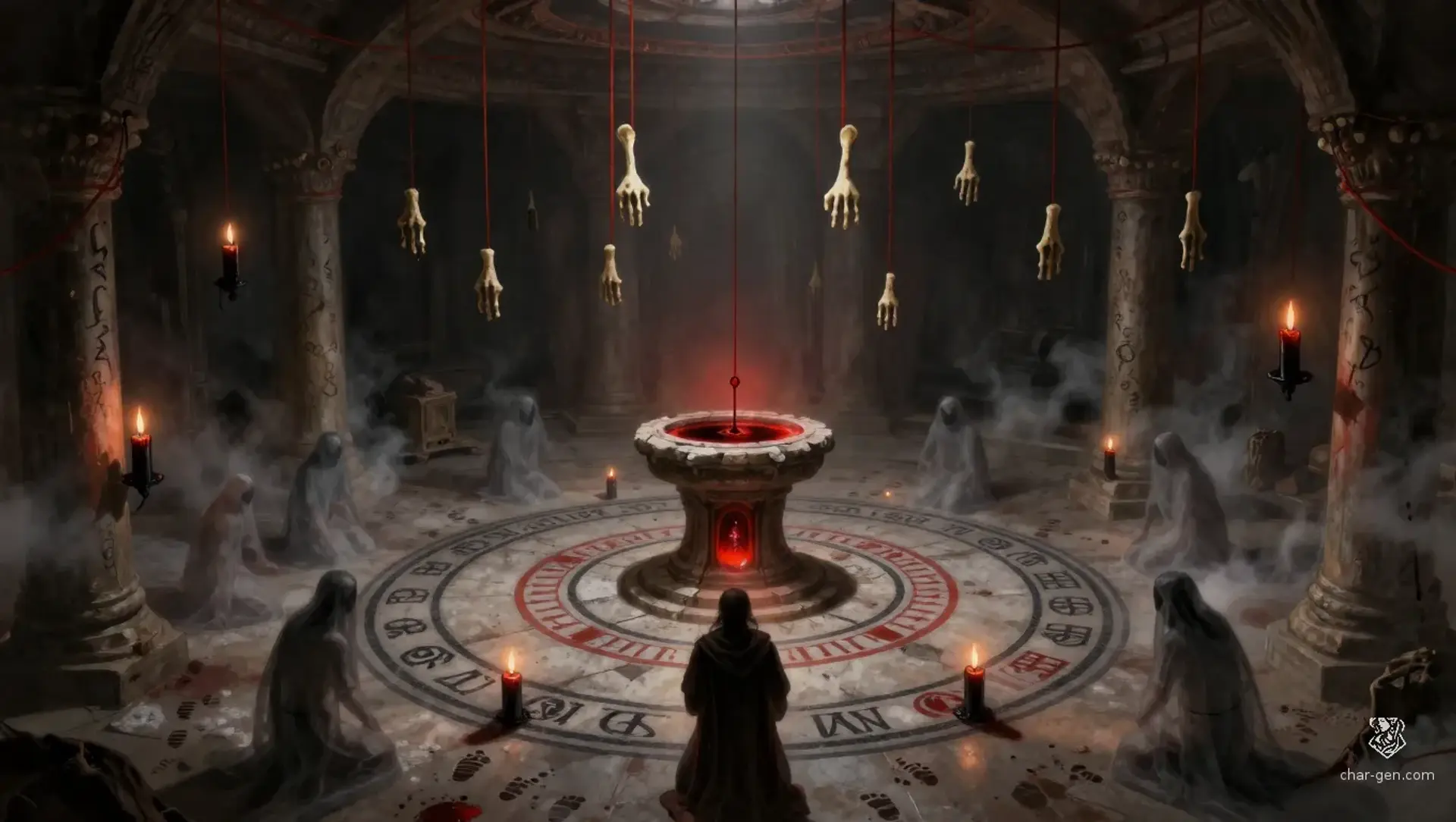
The Last Litany is a complex haunting that reenacts a failed cult ritual. It does not simply attack intruders. It recruits them as voices in an invisible congregation, forcing their movements, memories, and words into the ceremony. Each round, the sanctum becomes more populated by translucent worshipers, until the living risk becoming permanent members of the dead choir.

Complex · Haunting · Level 1000000000000000000000000000000000000

The Last Litany

The Last Litany is a complex haunting that reenacts a failed cult ritual.
Spot
Extreme before activation
Disable
The hazard cannot be…
AC
Beyond mortal measurement

At a glance

Level
1000000000000000000000000000000000000
Complex

Spot Extreme before activation

ACBeyond mortal measurement

FortExtremely high for the intended tier

RefExtremely high for the intended tier

WillExtremely high for the intended tier

HardnessExtremely high

HPExtremely high


Disable The hazard cannot be disabled by a single check

Initiative The haunting rolls initiative when a creature crosses the innermost…

The hazard

The Last Litany is a complex haunting that reenacts a failed cult ritual. It does not simply attack intruders. It recruits them as voices in an invisible congregation, forcing their movements, memories, and words into the ceremony. Each round, the sanctum becomes more populated by translucent worshipers, until the living risk becoming permanent members of the dead choir.

  • Complex
  • Haunting
  • Magical
  • Mental
  • Occult
  • Possession
  • Spiritual
Stealth
Extreme before activation. Once active, the haunting is not hidden, but its anchor remains concealed beneath the font until discovered or exposed by the ritual's clues.
Trigger
The haunting activates when a living creature crosses the innermost circle, speaks the cult's response phrase, sheds blood into the font, or attempts to remove the bloodglass reliquary's cover.
Disable
The hazard cannot be disabled by a single check. Each of seven ritual circles must be neutralized by two successful high-difficulty checks, such as Occultism, Religion, Arcana, Thievery, or an appropriate counter-ritual. A critical failure causes the circle to flare, immediately advancing the haunting's escalation. A character can attempt to disable a circle only while adjacent to it, and each circle can be attempted once per round.
Initiative
The haunting rolls initiative when a creature crosses the innermost ritual circle, speaks the response phrase, spills blood into the font, or removes the bloodglass reliquary's protective cover.
Routine
On its turn, the haunting performs three actions in sequence. First, it activates one still-functioning ritual circle. Second, it uses Borrowed Voice or Shadow Ordination against a creature inside the innermost circle. Third, it advances the congregation, causing spectral cultists to appear in an unoccupied space and attempt to immobilize nearby creatures. At escalation stages three and five, the haunting gains an additional manifestation each round.
Reset
The haunting resets after 1 hour if at least one ritual circle remains active. If all seven circles are neutralized but the bloodglass anchor survives, the haunting returns at the next midnight. Destroying or cleansing the anchor prevents the normal reset.

Damage

Immunities
  • Critical hits against incorporeal manifestations
  • Mental effects that merely cause fear
  • Bleed
  • Poison
  • Disease
  • Precision damage against spectral bodies
  • Nonmagical attempts to damage the ritual diagram
Resistances
  • Physical damage against incorporeal manifestations
  • Cold or shadow damage, if appropriate to the setting
  • Damage from unattended environmental hazards
Weaknesses
  • Consecration or sanctification
  • The complete and correctly performed counter-ritual
  • Effects that sever possession or banish spirits
  • Destroying the bloodglass anchor
  • A sincere confession that directly contradicts the cult's central doctrine
  • Preventing all living voices from repeating the response phrase

Effects

4
  • Borrowed Voice

    The target hears the cult's response phrase inside its own thoughts. It must attempt a Will save. On a failure, it is compelled to repeat the phrase at the start of its next turn and becomes a Voice of the Choir. On a critical failure, it is also stupefied or otherwise mentally impaired for 1 round.

  • Shadow Ordination

    A spectral celebrant reaches through the target's shadow. The target takes severe negative or necrotic damage appropriate to the party's tier and must attempt a Fortitude save. On a failure, it is slowed or similarly hindered for 1 round. On a critical failure, it is briefly possessed until the end of its next turn.

  • Congregation of Hands

    The chamber fills with kneeling ghosts. Creatures in the room must attempt a Reflex save or become immobilized by spectral hands until they Escape, move beyond the ritual boundary, or another creature disrupts the nearest sigil.

  • Election of the Hierophant

    A dead cultist points toward one living creature and names it as the next hierophant. Until the end of the hazard's next turn, all spectral manifestations prioritize that creature, and the target cannot benefit from concealment granted by darkness or smoke.

Special rules

Escalation of the Choir.The haunting has five escalation stages. It begins at stage one. It advances by one stage whenever a creature fails a save against Borrowed Voice, a ritual circle is critically failed during an attempt to disable it, or a living creature dies within the chamber. At stage three, the room becomes difficult terrain for living creatures. At stage five, the bloodglass anchor manifests beneath the font and the haunting gains a second attack each round.

Voices of the Choir.A Voice of the Choir is marked by a dark ring around the throat or a second shadow. A marked creature takes a penalty to checks made to resist the haunting and can involuntarily speak the response phrase once per round. The mark ends when the creature receives a successful cleansing, leaves the chamber for at least 10 minutes, or participates in the counter-ritual.

Bloodglass Anchor.The haunting is anchored to the bloodglass reliquary. While the anchor remains intact, spectral manifestations reform at the start of the next round after being destroyed. The anchor can be damaged only by effects that can harm magical objects, incorporeal beings, or ritual enchantments.

Initiation by Repetition.If any creature says the response phrase three times in the same encounter, the haunting temporarily treats that creature as an initiate. The creature is not automatically controlled, but the haunting can communicate through it, use it as the origin point for manifestations, and attempt possession without line of sight.

Sanctuary of the Unanswered Prayer.The dead cultists cannot cross a completed circle that has been properly consecrated. A consecrated circle also grants creatures inside it a bonus against the haunting's mental and possession effects. The protection ends if blood is spilled across the circle or if an initiate willingly invites a ghost inside.

Spotting it

Discovery

The ritual diagram, bone cords, and bloodglass residue reveal a ceremonial haunting.

Perception

The hazard is noticed automatically when its ritual circles activate.

Stop it

Signs of dangerCandles burn with black flames while casting no shadows. · A character hears a whispered answer before asking a question. · The hanging finger bones rotate toward living creatures. · Footprints appear in dust one step behind the party. · A dry font smells faintly of fresh blood when no blood is present. · The cult's response phrase appears scratched inside packs, spellbooks, or weapon grips.

Countermeasures

In short

Break the ritual sequence, protect the living from forced participation, and confront the haunting's anchor rather than merely damaging its manifestations.

Its story

What it looks like

The ruined sanctum is arranged as a vast ritual diagram, with black salt lines forming concentric circles around a dry stone font.

Why it is here

To complete the Last Door ritual by transforming living intruders into willing or unwilling members of an eternal spectral congregation

Who made it

The Choir of the Last Door, a cult that believed death was an incomplete initiation

Lore

The Choir of the Last Door sought to invite an unnamed afterlife intelligence into the world.

Where it is found

Ruined temples, sealed catacombs, abandoned monasteries, plague pits, and any chamber where a mass ritual ended in betrayal

Variants

The ritual was dedicated to a benevolent saint, making the haunting sorrowful rather than malicious. It asks intruders to finish the rite so the dead can finally depart.
One of the spectral cultists is still alive and trapped in suspended animation. Rescuing that person weakens the haunting but causes the remaining ghosts to become more aggressive.
The haunting has no anchor because the reliquary was stolen. It migrates from host to host, creating a mobile version that follows anyone who learns the final verse.
The chamber is beneath a living settlement. Every failed countermeasure causes a harmless but unsettling manifestation aboveground, escalating into possession if the party takes too long.
The cult intentionally designed the ritual as a weapon against an immortal tyrant. Destroying the haunting also erases the only force still capable of harming that tyrant.

Plot hooks

A noble family hires the party to recover a relative who entered the shrine and returned speaking in the voices of several dead ancestors.
The haunting has begun spreading through dreams, using sleepers as remote members of its congregation.
A rival cult wants the bloodglass reliquary intact because it contains the name of the entity the original ritual attempted to summon.

Media

0 images

No images yet.

Visual sheet

Turn The Last Litany into a sheet

A high-res, share-ready sheet you can post or print.