Skip to content
CreatePricing
The Lock That Remembers - AI-generated fantasy Hazard

The Lock That Remembers

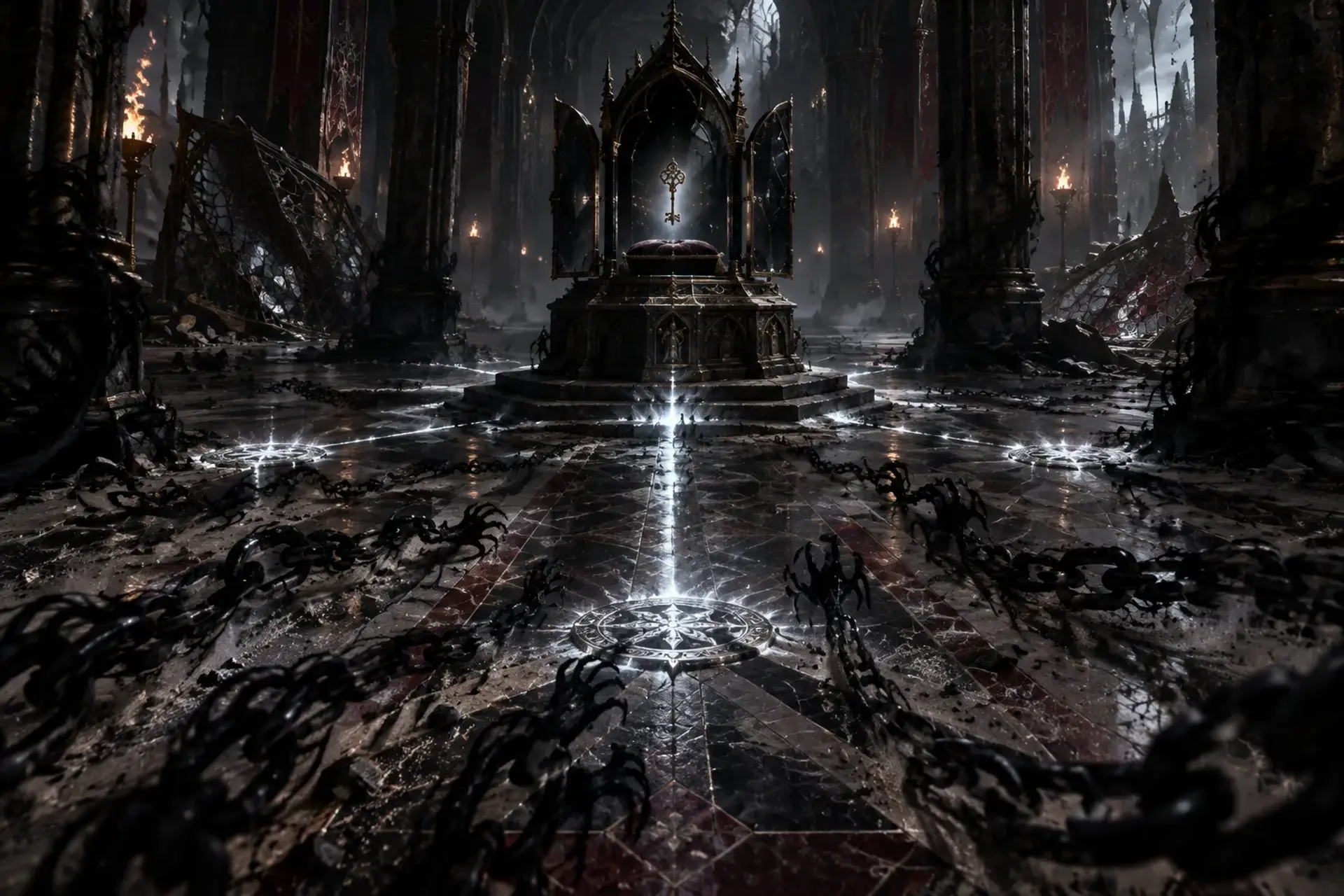
The key is not merely protected by the reliquary. The room remembers every hand that has tried to take it, and the shadows of those hands have been forged into chains. When the key is disturbed, the floor's silver seams flare, and the chains lash across the battlefield to seize intruders and draw them toward the plinth.

Complex · Magical · Level 10

The Lock That Remembers

The key is not merely protected by the reliquary.
Spot
29
Disable
29
AC
30

At a glance

Level
10
Complex
Spot DC
29

Defences

AC
30
Fort
+21
Ref
+21
Will
+19
Hardness
20
HP
80
BT
40

Disable Thievery or Religion DC 29 to Disable one of the three floor seals

Initiative Perception +22

The hazard

The key is not merely protected by the reliquary. The room remembers every hand that has tried to take it, and the shadows of those hands have been forged into chains. When the key is disturbed, the floor's silver seams flare, and the chains lash across the battlefield to seize intruders and draw them toward the plinth.

  • Complex
  • Magical
  • Trap
Stealth
(trained) to notice the floor seals and telltale chain-shadows before entering the inner ring; noticing the signs does not itself disable the hazard.
Trigger
A creature touches or attempts to remove the key, or enters the tiled inner ring around the plinth.
Disable
Thievery or Religion to Disable one of the three floor seals; three successful checks disable the hazard. The checks require a creature to be adjacent to a seal. A creature can instead attempt to counteract the binding magic as described under Countermeasures.
Initiative
Perception +22
Routine
The hazard uses Keyshadow Lash once, then uses Draw to the Lock once if any creature is grabbed by its shadow-chain. It can target different creatures with these actions.
Reset
The hazard deactivates if disabled or destroyed. If its routine ends without a creature in range, it remains active and ready. After all creatures leave the chamber, it resets after 1 minute, unless its seals or reliquary have been damaged or disabled.

Damage

Immunities

Critical hits, Precision damage, Object immunities

Resistances
  • Physical 10 (except adamantine)
Weaknesses

Adamantine 10

Effects

2
  • Keyshadow Lash

    DC 29

    The hazard targets one creature within 60 feet that it can perceive. The target attempts a Reflex save. Critical Success: The creature is unaffected. Success: The creature takes half damage. Failure: The creature takes force damage and is grabbed by a shadow-chain until the end of its next turn. Critical Failure: The creature takes double damage and is grabbed. A grabbed creature can Escape against .

  • Draw to the Lock

    The hazard targets one creature grabbed by its shadow-chain. The target is pulled up to 15 feet toward the reliquary and takes bludgeoning damage. This forced movement does not trigger reactions. If the target reaches the plinth, it falls prone in an adjacent space.

Special rules

A Room That Watches.The hazard can perceive creatures within 60 feet that are touching the floor or reliquary. It does not perceive creatures fully behind a solid barrier that blocks line of effect from the reliquary.

The Key Is Touched.If a creature touches or attempts to remove the key, or enters the tiled inner ring around the plinth, the hazard rolls initiative. The hazard can trigger only once per encounter.

Shadow-Bound.A grabbed creature can break line of effect from the reliquary to end the grabbed condition. The chain-shadow visibly slackens and vanishes when this happens.

Spotting it

Discovery

A creature that examines the floor or reliquary and succeeds at a Perception check notices that the key's shadow points toward the nearest of three silver floor seals, even when the light source moves.

Perception

+22

Stop it

Signs of dangerDust on the floor forms narrow, chain-shaped trails leading from the plinth to the three seals. · The key's shadow remains fixed when a torch is moved. · A faint metallic clink comes from the floor whenever someone steps near the inner ring.

Countermeasures

In short

The hazard can be disabled by disrupting its three floor seals, countering its binding magic, or destroying the reliquary.

Its story

What it looks like

A black-glass reliquary stands at the center of a tiled chamber.

Why it is here

To keep intruders from removing the key, pin them in the chamber, and draw them toward the reliquary for capture.

Who made it

The reliquary's original maker is unknown.

Lore

The chamber was designed to ensure that a stolen key could never be carried from the room by force.

Where it is found

A reliquary chamber built as a battlefield, with a central plinth, three floor seals set at different approaches, tiled lanes, and pillars or broken screens that can provide cover.

Variants

In a flooded chamber, the chain-shadows appear as dark ripples beneath the water. Replace the bludgeoning damage from Draw to the Lock with 3d8 cold damage.
For a reliquary protecting a false key, the hazard triggers when a creature speaks the name engraved on the plinth rather than when the key is touched.
A damaged version has only two floor seals. Disable DCs remain 29, but one successful check on each seal deactivates it.

Plot hooks

The key belongs to a captive ally, who insists the reliquary is guarding the wrong thing.
One of the chain-shadows resembles a missing party member or a known thief, hinting that the chamber has claimed someone recently.
The three floor seals are engraved with pieces of a name. Restoring the name may reveal who built the reliquary and what the key opens.

Media

0 images

No images yet.

Visual sheet

Turn The Lock That Remembers into a sheet

A high-res, share-ready sheet you can post or print.