
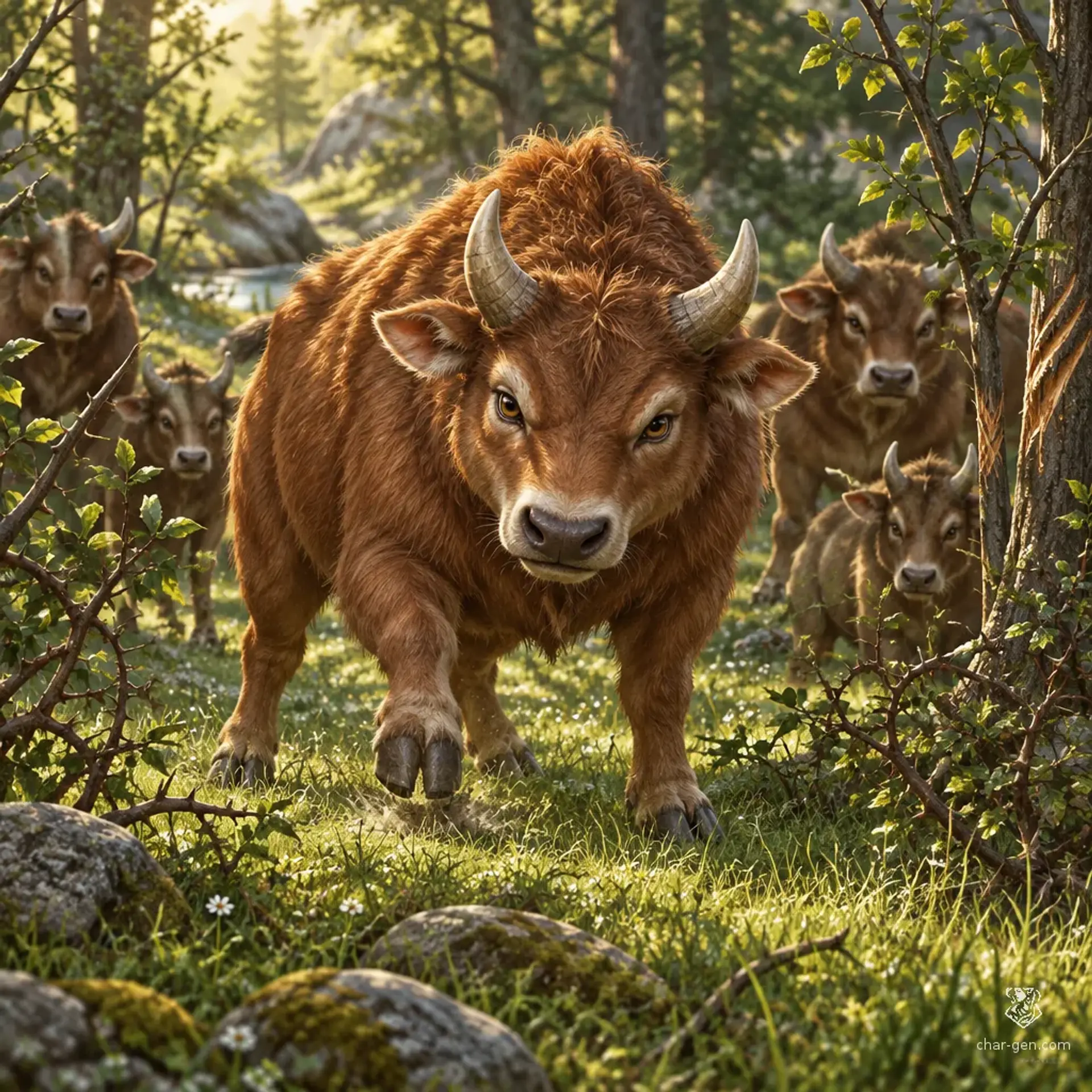
Bellwether
Forest guides call these creatures the Bellwethers, borrowing the name from an old shepherd's ballad about a flock that drove a wolf from its pasture. The name stuck because a watchful grazer often signals the whole herd's mood. Though not truly livestock, they are intelligent enough to recognize regular visitors and remember persistent threats.
Bellwether
Combat
AC 12 · HP 7 · CR 0 , very low individual threat; a group can create a Medium difficulty encounter through coordinated pressure.Bellwether
Actions
Reactions
- Role
- Territorial pack skirmisher
- Built for
- Any level; a single Bellwether is a negligible threat. For a low-level party, use 3 to 4 only if the encounter is meant to be avoidable or nonlethal.
Notes for the game master
Tactics
Opening
The nearest grazer stamps twice and snorts. If the intruders keep approaching, the herd fans out and two members charge the closest threat while the rest guard the patch.
Mid-fight
Grazer pairs alternate charges, keeping at least one member beside any injured herd-mate. They try to knock intruders prone or push them away from the grass rather than pursue kills.
End of the fight
If the herd has driven intruders away, it stops pursuing and resumes guarding the grazing patch. It does not chase fleeing creatures beyond the boundary it recognizes.
Retreat
A grazer retreats only if isolated and reduced to 1 hit point, attempting to rejoin its herd. The group scatters if half its members are incapacitated, but regroups nearby once the threat leaves.
How it fights
Who it attacks first
Works well with
How to beat it
Ways to avoid a fight
Ecology
A knee-high, round-bodied creature with russet fur, a pale muzzle, and two blunt, polished horns. Its wide-set golden eyes and delicate cloven hooves suggest a harmless woodland grazer, until it lowers its head and the rest of the herd forms a bristling ring around it.
Behavior
Grazes quietly in small family groups, then becomes stubbornly territorial when creatures approach its chosen clearing. Herd members coordinate by stamping and snorting, surrounding intruders and striking in turns.
How it lives
These creatures browse on tender grasses, shoots, and woodland herbs in sunny clearings. Their grazing keeps small glades open, while their dung disperses seeds. They favor places with several escape routes and nearby cover.
Lair
A shallow nest of leaves and grass beneath a thorny thicket, usually close to a favored grazing clearing.
- Habitat
- Forest clearings, meadow-like glades, and grassy woodland edges
Signs that it is near
Tags
Lore
Forest guides call these creatures the Bellwethers, borrowing the name from an old shepherd's ballad about a flock that drove a wolf from its pasture. The name stuck because a watchful grazer often signals the whole herd's mood. Though not truly livestock, they are intelligent enough to recognize regular visitors and remember persistent threats.
What drives it
Protect the herd's grazing ground and keep danger away from its young.
After the fight
The herd usually returns to grazing once intruders leave. A slain grazer may be harvested for a small quantity of unusually sweet, rich meat, but its herd-mates remember the scent of those who killed it.
“The name stuck because a watchful grazer often signals the whole herd's mood.”
Variants
Hooks
Plot hooks
How to use it
Treasure
Media
0 imagesNo images yet.
Turn Bellwether into a sheet
A high-res, share-ready sheet you can post or print.