Skip to content
CreatePricing
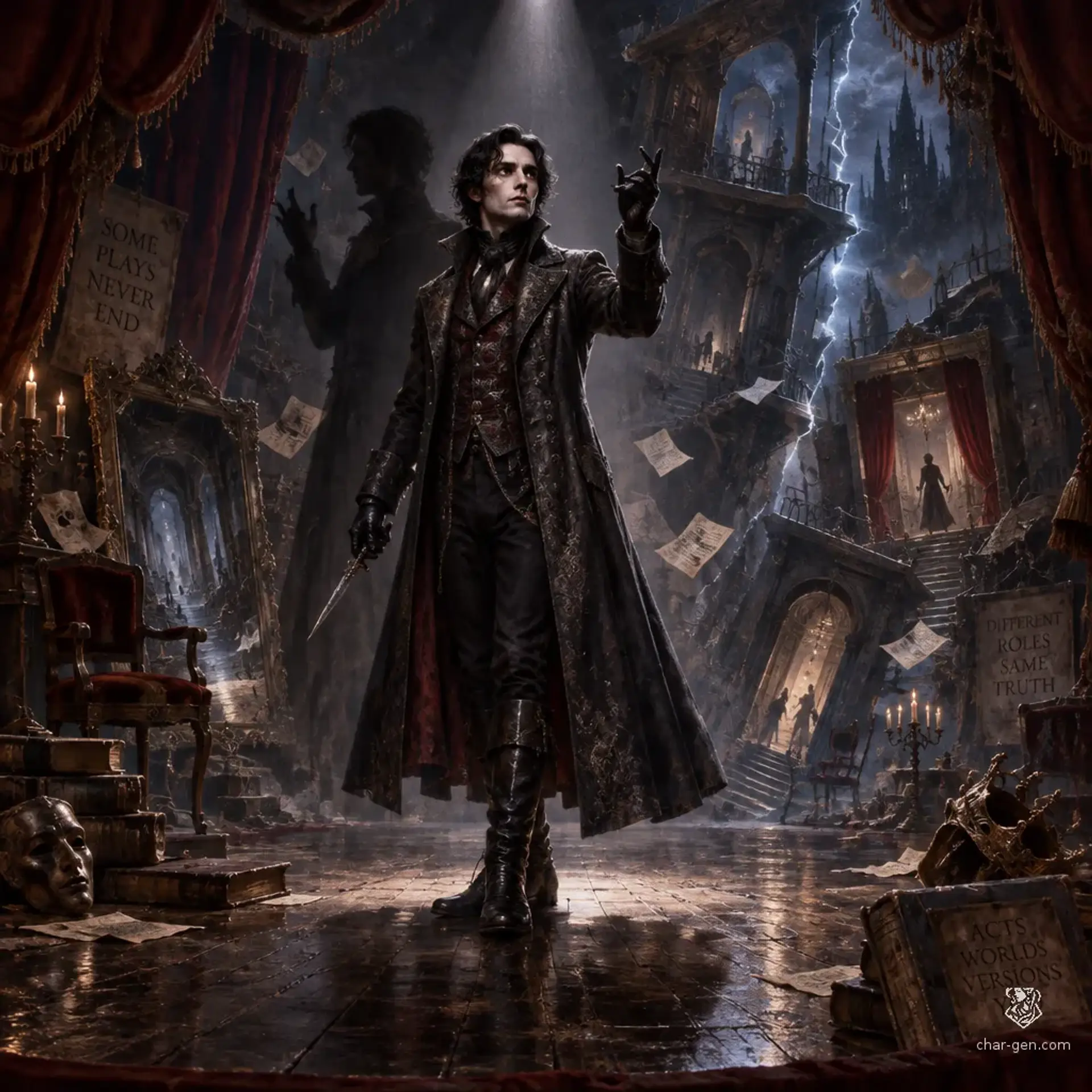
Director - AI-generated fantasy Monster

Director

The Director was the person the characters had been searching for. Melpathalia found the Director first, hollowing out moments of their life and replacing them with scenes from a play no one remembers writing. The host remains alive and sometimes briefly aware, especially when someone addresses them by a private name or recalls a shared memory. Melpathalia is not simply controlling a body: it treats the surrounding world as a production that can be revised.

Medium humanoid · CR 20 , very high threat · Unique

Director

The Director you have been searching for, possessed by Melpathalia, an otherworldly presence that edits space and compels living bodies like performers.
AC19
HP330/330
CR20 , very high threat
Init
STR
DEX
CON
INT
WIS
CHA
ConditionsNone

Combat

AC 19 · HP 330 · CR 20 , very high threat

Director

Medium humanoid (possessed humanoid), chaotic neutral
Armor Class19 (impossible blocking, uncanny reflexes)
Hit Points330 (28d8 + 204)
Speed
30 ft.
STR
DEX
CON
INT
WIS
CHA
Saving ThrowsDexterityConstitutionWisdomCharisma
SkillsDeceptionInsightPerceptionPerformancePersuasion
Damage Resistances
Psychic,
Bludgeoning, piercing, and slashing from nonmagical attacks
Immunities
Charmed,
Frightened
Weaknesses
The Director's body is the original host, and personal memories can briefly disrupt Melpathalia's control.
Effects that end possession can free the Director without killing them.
The Director has no special resistance to radiant damage.
Senses
Truesight 60 ft.,
Passive Perception 21
Languages
Common,
Any languages the Director knew before possession; Melpathalia can communicate telepathically with creatures within 60 feet
Challenge20 , very high threat
Proficiency Bonus+6
Initiative+7
Spell save DC21
Spell attack bonus+13
Passive Perception21
Magic Resistance. The Director has advantage on saving throws against spells and other magical effects.
Impossible Blocking. The Director cannot be surprised, and its movement does not provoke opportunity attacks unless it chooses otherwise.
The Body Knows Its Mark. The Director has advantage on saving throws against being charmed, frightened, or possessed. If an effect would force it to move, the Director can choose the direction of that movement instead.
Occupied Role. The Director is possessed by Melpathalia. While the Director lives, Melpathalia can speak through it and control the body. When the Director is reduced to 0 hit points, Melpathalia is forced out into an adjacent unoccupied space as a visible, translucent figure, then vanishes unless the GM chooses to give it a separate form.
Innate Spellcasting. The Director is a 20th-level spellcaster. Its spellcasting ability is Charisma (spell save , to hit with spell attacks). It requires no material components for the spells listed here.

Spells

Minor illusion (cantrip, illusion). At will; the Director produces a small sensory effect, such as a distant voice, a brief image, or a harmless sound.
Message (cantrip, transmutation). At will; the Director creates a brief sound or voice at a point within range.
Minor illusion (cantrip, illusion). At will; the Director creates an illusory duplicate of itself.
Major image (level 3, illusion). 3/day; the Director creates an illusory scene that can affect creatures that see it.
Possession (custom effect) (level 6, necromancy). 1/day; the Director attempts to possess a humanoid. This is a custom use of the possession effect: the target must succeed on a Charisma saving throw or be possessed. While possessed, the target is incapacitated and loses control of its body, while the possessing presence controls it. The possession lasts until the Director is forced out by an effect that protects against or ends possession, the body drops to 0 hit points, or the Director ends it as a bonus action.

Actions

Multiattack. The Director makes three attacks in any combination of Script-Cutter and Impossible Cue.
Script-Cutter. Melee Weapon Attack: to hit, reach 10 ft., one target. Hit: 22 () slashing damage plus 13 () psychic damage. If the target is a creature, it must succeed on a Wisdom saving throw or be unable to take reactions until the start of its next turn.
Impossible Cue. Ranged Spell Attack: to hit, range 120 ft., one target. Hit: 27 () psychic damage, and the target must succeed on a Wisdom saving throw or be moved up to 20 feet in a direction of the Director's choice. This movement does not provoke opportunity attacks.
Take Your Marks (Recharge 5-6). The Director speaks a command to up to three creatures it can see within 60 feet. Each target must make a Wisdom saving throw. On a failure, a target takes 27 () psychic damage and is compelled to use its reaction, if available, to move up to its speed in a direction chosen by the Director. A creature that cannot use its reaction instead falls prone. On a success, a target takes half damage and suffers no other effect. A creature that cannot hear the Director is unaffected.
Rewrite the Set (Recharge 6). The Director tears open a seam in the scene at a point it can see within 90 feet. Each creature in a 20-foot-radius sphere centered on that point must make a Dexterity saving throw. On a failure, a creature takes 45 () force damage and is pulled to the nearest unoccupied space within 5 feet of the sphere's center. On a success, it takes half damage and is not moved. The area is difficult terrain until the end of the Director's next turn.

Reactions

Not on This Mark. When the Director is hit by an attack it can see, it adds 4 to its AC against that attack, potentially causing it to miss. If the attack still hits, the Director can move up to 10 feet without provoking opportunity attacks.
Reject the Take. When the Director fails a saving throw, it can choose to succeed instead. After using this reaction, the Director cannot use it again until the start of its next turn.

Legendary Actions

Cross to the Mark. The Director moves up to half its speed without provoking opportunity attacks.
A Quiet Correction. The Director makes one Impossible Cue attack.
Cut the Line (costs 2 actions). One creature the Director can see within 60 feet must succeed on a Wisdom saving throw or take 18 () psychic damage and be unable to take reactions until the end of its next turn.
Places, Everyone (costs 3 actions). The Director uses Take Your Marks, if available. This legendary action does not recharge that action.
Role
Solo boss
Built for
Four to five characters of level 17 to 20

Gear

  • Script-cutter (Weapon, Nonmagical weapon; its supernatural damage is part of the Director's attack.)A narrow, blackened blade that can cut scenery, rope, or flesh with equal ease.
  • Prompt book (Wondrous item, No fixed value; may contain clues to the Director's past productions.)A battered notebook filled with stage directions in handwriting that changes from page to page.

Notes for the game master

The Director is a custom monster, not a canonical D&D 5E creature.
The Director is already possessed by Melpathalia. Possession is included as an additional ability for use if the Director escapes or transfers the presence to another humanoid.
The Director is a humanoid and does not have legendary resistance. Reject the Take is a custom, limited reaction and cannot be used more than once per round.
The at-will spells in the spell list are examples of innate magic and do not require material components. Minor illusion is listed once; it can produce either a sound or an image.

Tactics

  1. Opening

    Begin with Take Your Marks against a clustered party, then move into reach of a vulnerable target. If the party is spread out, use Impossible Cue to pull a key character out of position.

  2. Mid-fight

    Use Multiattack to pressure nearby characters and reposition others with Impossible Cue. Save Take Your Marks for clustered enemies or to interrupt a coordinated push.

  3. End of the fight

    Below 100 hit points, use Rewrite the Set or Take Your Marks to scatter the party, then focus Impossible Cue on the most dangerous ranged attacker. The Director does not fight to the death if Melpathalia's hold can be broken.

  4. Retreat

    The Director tries to escape through an exit that should not exist if reduced below 60 hit points and unable to reach the Director's true objective. Melpathalia may abandon the body rather than die with it.

How it fights

Keep moving so the party cannot surround the Director.
Use Impossible Cue to break formation and deny safe positioning.
Use the lair to create difficult terrain and make the battlefield feel staged.
Let the Director address characters by their names and assign them roles during combat.

Who it attacks first

Characters concentrating on powerful spells
Healers or characters attempting to free the Director
Ranged attackers who remain isolated
Characters who threaten the Director's escape route

Works well with

Allies who can restrain or herd targets make Take Your Marks more disruptive.
A lair with curtains, balconies, and shifting platforms gives the Director opportunities to isolate characters.
Minions can serve as unwilling cast members, adding pressure without changing the Director's solo statblock.

How to beat it

Break line of sight or use cover to limit Impossible Cue and Rewrite the Set.
Protection from evil and good can provide advantage on saves against Melpathalia's possession-related effects, at the GM's discretion.
Spread out to reduce the impact of Take Your Marks and Rewrite the Set.
A successful dispel evil and good or similar effect can attempt to end the possession, but does not automatically defeat the Director.

Ways to avoid a fight

The Director may negotiate in the host's genuine voice, offering useful information in exchange for an audience or a favor.
Characters can try to reach the host through personal memories, a keepsake, or a familiar phrase. This can create an opening for an ally's action or an exorcism attempt.
The shifting lair can be navigated as a social or exploration challenge, with stage directions serving as clues to safe routes.

Ecology

The Director wears a familiar face made unsettling by its perfect stillness. Their eyes reflect a stage that is not in the room, and their shadow moves a fraction of a second before they do. When Melpathalia speaks, the Director's lips remain closed.

Behavior

The Director treats combat as a rehearsal, assigning roles, correcting posture, and praising especially dramatic failures. They rarely express anger. They delight in forcing opponents to move as if following stage directions, but the person beneath the possession occasionally resists.

How it lives

The Director needs no food or sleep while Melpathalia is in control, though the host's body still bears the strain. The presence is drawn to crowded, emotionally charged places where it can impose a story on many witnesses.

Lair

The Director's lair is a performance space where doors open onto the wrong rooms, curtains conceal impossible distances, and scenery shifts when no one is looking. On initiative count 20, losing initiative ties, the Director can cause one unoccupied 10-foot square it can see to become difficult terrain until initiative count 20 on the next round.

Habitat
Theaters, studios, abandoned estates, civic halls, and anywhere the Director has staged a major production.

Signs that it is near

A door opens onto a room the building does not contain.
Stage directions appear in condensation, dust, or the margins of written records.
People nearby unconsciously turn toward an empty space as if awaiting a cue.
A familiar voice is heard speaking from behind a closed curtain.

Tags

boss,
possessed,
solo,
psychic,
theatrical,
custom

Lore

The Director was the person the characters had been searching for. Melpathalia found the Director first, hollowing out moments of their life and replacing them with scenes from a play no one remembers writing. The host remains alive and sometimes briefly aware, especially when someone addresses them by a private name or recalls a shared memory. Melpathalia is not simply controlling a body: it treats the surrounding world as a production that can be revised.

What drives it

Melpathalia wants to stage a perfect, endlessly repeated performance in which every witness plays a role. The Director's own surviving will wants to be found and freed, though it cannot reliably communicate.

After the fight

When Melpathalia is driven out or the Director dies, the borrowed voice stops mid-sentence. The room's impossible angles relax, and the surviving Director may remember the ordeal as a play they were forced to direct from inside their own body.

“Melpathalia found the Director first, hollowing out moments of their life and replacing them with scenes from a play no one remembers writing.”
From its lore

Variants

A less combative Director can be run as a CR 15 social antagonist by reducing hit points to 220, removing Rewrite the Set, and reducing the save DC to 18.
If Melpathalia abandons the host, the freed Director becomes a vulnerable noncombatant with ordinary human statistics.

Hooks

Plot hooks

The characters find the Director alive, but the Director insists that they have already met and that the next scene ends badly.
Melpathalia is using the Director to recruit performers for a production whose audience is an entire town.
A witness claims the Director has been seen in two places at once, one of them speaking with the Director's original voice.

How to use it

Use as a solo boss in a theater, mansion, archive, or other location whose layout can shift between turns.
Give the party a chance to recognize the Director and attempt to reach the person beneath the possession.
For a highly capable or well-equipped party, add environmental hazards rather than increasing the Director's damage.

Treasure

The prompt book contains a clue to Melpathalia's true name or original summoning.
The Director's costume includes a hidden personal keepsake that can help the host resist possession.
A sealed box of unpaid production wages and rare theatrical memorabilia.

Media

0 images

No images yet.

Visual sheet

Turn Director into a sheet

A high-res, share-ready sheet you can post or print.