Skip to content
CreatePricing
Rune-Snatcher - AI-generated fantasy Monster

Rune-Snatcher

Dwarven patrol records call this creature a rune-snatcher, though older miners believed it was once a guard who survived too long beneath the mountain. It learned to recognize the difference between dead runes, warning runes, and execution wards. The rune-snatcher avoids the deepest guardian, scavenging the remains of creatures that guardian drives upward. It also competes with the upper wildlife predator, stealing its kills and occasionally luring it into dormant dwarven traps.

Medium humanoid · Mid-tier threat, approximately CR 5 · Uncommon

Rune-Snatcher

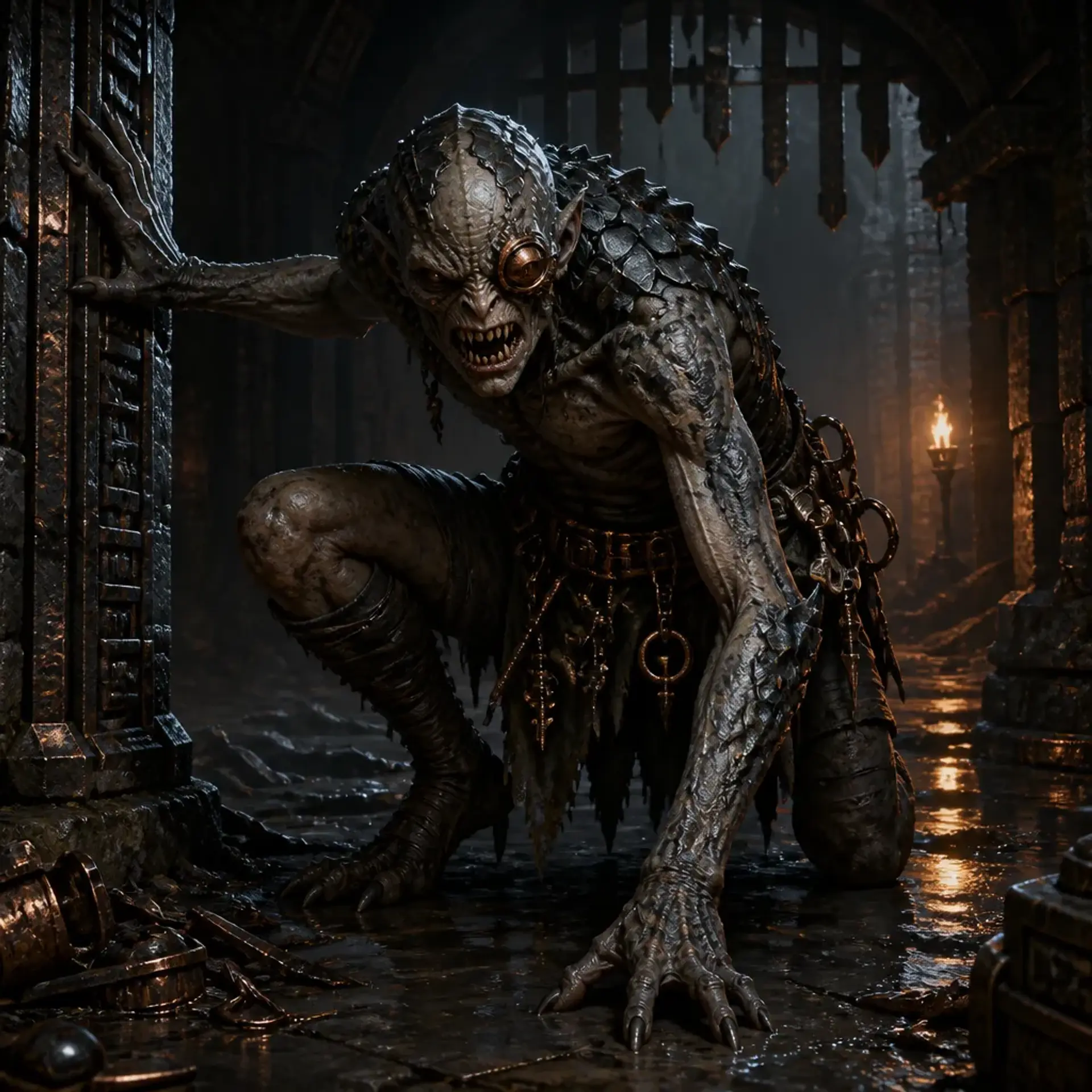
A cunning ore-scarred humanoid predator that prowls the middle corridors of Orebender Caverns, exploiting broken dwarven defenses and scavenging metal from abandoned guard stations.
AC16
HP85/85
CRMid-tier threat, approximately CR 5
Init
STR
DEX
CON
INT
WIS
CHA
ConditionsNone

Combat

AC 16 · HP 85 · Mid-tier threat, approximately CR 5

Rune-Snatcher

Medium humanoid (humanoid), neutral evil
Armor Class16, natural armor
Hit Points85 (10d10 + 30)
Speed
30 ft.,
Climb 30 ft.,
Can climb difficult stone surfaces without making an ability check
STR
DEX
CON
INT
WIS
CHA
Saving ThrowsDexterityWisdom
SkillsDeceptionInvestigationPerceptionStealthSurvival
Damage Resistances
Cold,
Necrotic
Immunities
None
Weaknesses
Thunder damage disrupts its mineral plates and prevents Stone-Crawler movement until the end of its next turn if it fails a DC 13 Constitution saving throw.
It becomes hesitant when confronted with an intact dwarven execution rune, requiring a DC 15 Wisdom saving throw before it can willingly move within 10 feet of that rune.
Its metal cache is psychologically and tactically important. Destroying or scattering it gives the rune-snatcher disadvantage on its next attack roll and Wisdom saving throw.
Senses
Darkvision 120 ft.,
Tremorsense 10 ft.,
Passive Perception 15
Languages
Undercommon,
Dwarvish
ChallengeMid-tier threat, approximately CR 5
Hit Dice10d10 + 30
Proficiency Bonus+3
Experience1,800 XP
Passive Perception15
Spell Save DC15
Spell Attack Bonus+7
Cavern Stalker. The rune-snatcher has advantage on Dexterity (Stealth) checks made in rocky terrain or among dwarven ruins.
Ward-Reader. The rune-snatcher knows the location and broad function of dwarven doors, traps, ward plates, and guard mechanisms within 120 feet. It cannot repair damaged mechanisms, but it can activate, deactivate, or redirect a functioning control if it can reach it.
Stone-Crawler. The rune-snatcher can move across stone ceilings and walls without needing to make an ability check. It does not fall while climbing unless it is incapacitated or chooses to release itself.
Predator of the Wounded. The rune-snatcher deals an extra 3 () necrotic damage to a creature that is missing any hit points.
Ore-Scarred Nerves. The rune-snatcher has advantage on saving throws against being frightened while within 30 feet of a dwarven ward or guard mechanism. It has disadvantage on saving throws against effects that deal thunder damage while underground.

Actions

Multiattack. The rune-snatcher makes two attacks, using Bite and either Claw or Chain Lash.
Bite. Melee Weapon Attack: to hit, reach 5 ft., one target. Hit: 8 () piercing damage plus 3 () necrotic damage. If the target is missing any hit points, it must succeed on a Constitution saving throw or have its speed reduced by 10 feet until the end of its next turn.
Claw. Melee Weapon Attack: to hit, reach 10 ft., one target. Hit: 9 () slashing damage. If the target is wearing metal armor or carrying a metal shield, the rune-snatcher can pull it up to 5 feet toward itself.
Chain Lash. Ranged Weapon Attack: to hit, range 30/90 ft., one metal object or creature. Hit: 10 () bludgeoning damage, and the target must succeed on a Strength saving throw or drop one held metal object of the rune-snatcher's choice. An unattended object is instead pulled up to 20 feet toward the rune-snatcher.
Echoing Mine. The rune-snatcher emits a convincing imitation of distant mining, collapsing stone, or a dwarven warning bell. Each creature within 60 feet that can hear it must succeed on a Wisdom saving throw or be lured up to 15 feet toward a point the rune-snatcher can sense. A creature that succeeds is immune to this rune-snatcher's Echoing Mine for 24 hours. The effect ends if the creature takes damage.
Mark the Wounded. The rune-snatcher targets one creature within 30 feet that is missing hit points. The target must succeed on a Wisdom saving throw or become marked until the end of the rune-snatcher's next turn. The rune-snatcher has advantage on attack rolls against a marked target, and the target cannot benefit from being invisible to the rune-snatcher.

Reactions

Metal Sense. When a creature within 10 feet picks up or draws a metal object, the rune-snatcher moves up to half its speed without provoking opportunity attacks and makes one Chain Lash attack against that creature if it is within range.
Exploit the Defense. When hit by an attack while within 5 feet of a dwarven control, door, or ward plate, the rune-snatcher can activate or deactivate that mechanism if it is functional. The mechanism behaves according to the DM's design and cannot be repaired by this reaction.
Role
Ambusher and corridor controller
Built for
Level 5 party, four characters

Gear

  • Stolen Metal Cache (Utility, 25 gp)A bundle of stolen keys, buckles, lockpicks, and small ward-plates. The bundle can open one ruined guard-station lock or provide advantage on one check to identify dwarven mechanisms.
  • Ward-Sense Chain (Wondrous object, 75 gp)A jagged length of blackened chain etched with incomplete dwarven warning runes. It functions as a mundane chain but hums within 30 feet of an active ward.
  • Ruined Guard Badge (Treasure, 10 gp)A copper badge bearing the crest of a long-disbanded guard company. It is worth little as coin but may identify the owner of the ruined station.

Feats

Ambusher
Dungeon Delver
Expert Tracker

Notes for the game master

The rune-snatcher is designed as a CR 5 custom monster for a party near level 5.
Chain Lash targets objects as well as creatures, but cannot disarm an object that is secured, magically bound, or held by a creature that succeeds on the Strength saving throw.
Echoing Mine is audible and deceptive rather than magical noise, so creatures immune to the charmed condition are not automatically immune.
The creature understands dwarven ward patterns but cannot repair damaged mechanisms.

Tactics

  1. Opening

    It begins hidden near a disabled guard mechanism, imitates distant mining sounds, and waits for the party to approach the ruined station. It targets the rear-most or already injured character, then uses Chain Lash to disarm a weapon, shield, key, or lantern.

  2. Mid-fight

    It marks wounded characters, separates them with Chain Lash, and uses Echoing Mine to draw explorers across hazardous tiles or into overlapping lines of fire. It focuses on characters carrying obvious metal gear and avoids attacking creatures that appear healthy and heavily armored until it has stolen their tools.

  3. End of the fight

    It seizes a key, shield, or other metal object and retreats through a warded passage, using the dungeon controls to close doors behind it. If cornered, it attempts to drop a ceiling brace or trigger a disabled defense rather than fight to the death.

  4. Retreat

    The rune-snatcher retreats when reduced below 25 hit points, when two of its stolen objects are destroyed, or when the party restores a major defense. It knows several crawlspaces and ward-safe routes unavailable to larger creatures.

How it fights

Hide near a disabled mechanism and use environmental cover rather than beginning in the center of the corridor.
Use Echoing Mine before combat to make the party split or approach a dangerous ward pattern.
Mark wounded targets, then pull them away from allies with Chain Lash.
Steal keys, shields, weapons, lanterns, and ward tools whenever possible.
Use vertical stone surfaces and narrow crawlspaces to attack from unexpected angles.
Retreat through corridors where only a single creature can follow at a time.

Who it attacks first

Wounded creatures
Characters carrying keys, shields, lanterns, or obvious metal tools
Spellcasters concentrating on area control
Characters attempting to restore dwarven defenses
Isolated scouts and rear-guard characters

Works well with

The upper wildlife predator may drive prey toward the rune-snatcher's corridor, creating a three-sided encounter.
Dormant dwarven ballistae, portcullises, alarm plates, and collapsing braces give the rune-snatcher additional control over positioning.
A deeper guardian can react to the rune-snatcher's warning sounds, causing the creature to flee or forcing the party to choose between pursuit and retreat.

How to beat it

Restore or redirect the dwarven ward controls to deny its escape routes and disable its preferred ambush points.
Use nonmetallic weapons, wooden shields, or spells to reduce the value of Chain Lash.
Keep wounded characters protected in the center of the formation and avoid following false mining sounds.
Bright, sustained light reveals the mineral plates on its back, preventing it from benefiting from hiding in dim stone recesses.
A successful DC 15 Intelligence (Investigation) check identifies its false mining sounds and the safe direction of travel.

Ways to avoid a fight

It can imitate a distant mining sound, a wounded dwarf, or a warning bell to redirect explorers.
It may trade stolen keys or a guard badge for safe passage if the party offers a valuable magic item or promises to destroy a rival predator.
It can lead the party around one active defense if they follow its hand signs, though it may later attempt to ambush them from behind.
A character who studies its metal cache can learn the sequence for one nearby ward control with a successful DC 15 Intelligence (History or Investigation) check.

Ecology

A lean, gray-skinned humanoid predator with elongated arms, chipped iron teeth, and one polished copper eye set into a socket scarred by old runes. Black mineral plates cover its shoulders and spine. Thin chains, key rings, broken spearheads, and stolen buckles hang from its belt and twitch when dwarven wards activate.

Behavior

It stalks wounded creatures, steals metal objects, and imitates distant mining sounds to lure explorers toward broken defenses. It recognizes doors, traps, ward patterns, and guard-post layouts, but cannot repair dwarven mechanisms. It tests intruders before committing, often observing from ceilings, cracks, or behind inactive portcullises.

How it lives

Rune-snatchers are solitary or loosely cooperative scavengers that colonize abandoned dwarven tunnels. They eat cave vermin, carrion, and the mineral-rich marrow of creatures slain near old ward engines. They prefer metal because its taste carries traces of enchantment, allowing them to sense which objects have recently interacted with dwarven defenses.

Lair

The rune-snatcher nests beneath a collapsed guard station overlooking three intersecting corridors. Its lair contains a dry crawlspace, a disabled alarm plate, a half-functional portcullis control, and a wall covered in stolen metal objects arranged according to the patterns of nearby wards.

Habitat
Middle corridors of Orebender Caverns, especially broken guard stations, ore chutes, abandoned patrol routes, and passages where dwarven ward lines intersect natural cavern tunnels.

Signs that it is near

Metal buckles, keys, spearheads, and shield bosses are missing from old corpses.
False mining sounds echo from passages that contain no active excavation.
Small piles of copper filings collect beneath disabled ward plates.
Wounded vermin are found alive but stripped of collars, tags, or metal harnesses.
Old guard posts show fresh scratches around control levers and portcullis chains.

Tags

dwarven ruins,
subterranean,
ambusher,
metal thief,
ward exploiter,
intelligent predator,
Orebender Caverns

Lore

Dwarven patrol records call this creature a rune-snatcher, though older miners believed it was once a guard who survived too long beneath the mountain. It learned to recognize the difference between dead runes, warning runes, and execution wards. The rune-snatcher avoids the deepest guardian, scavenging the remains of creatures that guardian drives upward. It also competes with the upper wildlife predator, stealing its kills and occasionally luring it into dormant dwarven traps.

What drives it

It seeks enchanted or recently warded metal, safe territory, and wounded prey. It wants to map the remaining dwarven defenses well enough to reach the deepest sealed vault without being detected.

After the fight

If defeated, the rune-snatcher's stolen metal cache can reveal which dwarven defenses remain active. If bypassed or driven away, it retreats toward the deepest corridors, warning the deeper guardian through imitated mining signals. The upper wildlife predator may later claim the abandoned lair, creating a second danger or an opportunity to track the party's rival.

“It learned to recognize the difference between dead runes, warning runes, and execution wards.”
From its lore

Variants

Copper-Eyed Pack: Two weaker rune-snatchers share a lair. Each has 45 hit points, AC 15, and loses Chain Lash, but they gain Pack Ambush, granting advantage when an ally is within 5 feet of the target.
Varrik the Hollow: An elite rune-snatcher with 112 hit points, AC 17, and one legendary action per round that can be used only to move, make a Claw attack, or activate a nearby dwarven mechanism.
Starved Rune-Snatcher: Reduce hit points to 60 and remove Cold resistance. It becomes reckless, gaining advantage on attacks against wounded creatures but disadvantage on Wisdom saving throws.

Hooks

Plot hooks

The rune-snatcher has stolen the final copper key needed to open a ruined guard station containing a dwarven map and a sealed cache.
It is fleeing the deepest guardian and may guide the party toward a dangerous shortcut in exchange for protection.
The upper wildlife predator has begun hunting near the rune-snatcher's lair, forcing the creature into increasingly aggressive raids on travelers.
The creature's stolen ward-plates reveal that one supposedly disabled defense is still active and points toward a hidden route.
A surviving dwarf clan wants the rune-snatcher captured because it has learned the pattern of their ancestral security doors.

How to use it

Use one rune-snatcher as a mid-tier solo threat for a party of four characters around level 5.
Use one rune-snatcher with two grimlocks, darkmantles, or cave predators for a difficult encounter in a corridor complex.
Place the encounter near a control room so clever characters can manipulate doors, counterweights, ward plates, or dormant ballistae.
Foreshadow the deepest guardian through the rune-snatcher's fear of certain runes and its refusal to cross a particular threshold.
Let the party bypass the encounter by restoring a guard-post mechanism, offering a valuable metal object, or following the correct ward pattern.

Treasure

The ruined guard station contains 180 gp in old trade bars, a dwarven patrol map showing two hidden maintenance routes, and a sealed coffer containing three potions of healing.
The rune-snatcher's metal cache includes a copper key that opens one lower-corridor door and a silvered dagger marked with a forgotten guard captain's initials.
A hidden compartment beneath the disabled alarm plate contains a dwarven ward-stone worth 250 gp to a collector, though removing it may reactivate a nearby defense.

Connections

Ancestry

Humanoid

Media

0 images

No images yet.

Visual sheet

Turn Rune-Snatcher into a sheet

A high-res, share-ready sheet you can post or print.