Skip to content
CreatePricing
Obsidian Tribunal Inquisitor - AI-generated fantasy Monster

Obsidian Tribunal Inquisitor

The Obsidian Tribunal is rumored to be a hidden order that believes truth is too fragile for ordinary law. Its inquisitors do not merely punish crime, but also unapproved history, forbidden marriages, unsanctioned magic, and any witness who might complicate the official record. Each inquisitor carries a personal doctrine carved into black glass, and those doctrines often become more absolute than the law they claim to serve.

Medium medium humanoid · CR 6 · Uncommon

Obsidian Tribunal Inquisitor

A black-robed judge-executioner who hunts guilt with crystal rites, weaponizing fear, silence, and legalistic curses.
AC16
HP110/110
CR6
Init
STR
DEX
CON
INT
WIS
CHA
ConditionsNone

Combat

AC 16 · HP 110 · CR 6

Obsidian Tribunal Inquisitor

Medium medium humanoid (human), lawful evil
Armor Class16
Hit Points110 (13d8 + 52)
Speed
Walk 30 ft.,
Can move through difficult terrain made of rubble or broken stone without penalty if it is not magically created
STR
DEX
CON
INT
WIS
CHA
Saving ThrowsConstitutionWisdomCharisma
SkillsInsightIntimidationInvestigationPerceptionReligion
Damage Resistances
necrotic,
psychic
Immunities
frightened
Weaknesses
Overconfidence in due process can make it slow to adapt to chaos.
Its legal focus makes it vulnerable to deception, decoys, and baited evidence.
Bright radiant sanctified spaces can disrupt its intimidation and ritual precision.
Senses
darkvision 60 ft.,
passive Perception 15
Languages
Common,
Infernal,
Celestial
Challenge6
Proficiency Bonus+3
Passive Perception15
Spell Save DC14
Spell Attack Bonus+6
Null Verdict. The inquisitor has advantage on saving throws against spells and magical effects.
Litigator's Eye. The inquisitor has advantage on Wisdom checks made to discern lies, guilt, or hidden motive.
Oath of Disclosure. The inquisitor can speak while wearing its mask, and creatures within 10 feet have disadvantage on checks made to lie convincingly to it.

Spells

Spellcasting (cantrip, abjuration). The inquisitor knows the following spells and uses Wisdom as its spellcasting ability.
Thaumaturgy (cantrip, transmutation). At will: thaumaturgy, sacred flame
Bane (level 1, enchantment). At will: bane
Judicial Rites (level 2, enchantment). 3/day each: command, detect magic, hold person
Silent Chambers (level 2, illusion). 1/day: silence

Actions

Obsidian Mace. Melee Weapon Attack: to hit, reach 5 ft., one target. Hit: 8 () bludgeoning damage plus 7 () necrotic damage. If the target is concentrating on a spell or effect, it has disadvantage on the concentration check.
Edict of Dread. Ranged Spell Attack: to hit, range 60 ft., one target. Hit: 13 () psychic damage, and the target must succeed on a Wisdom saving throw or be unable to take reactions until the start of the inquisitor's next turn.
Shatter Verdict. The inquisitor detonates a burst of black glass in a 15-foot cone. Each creature in that area must make a Dexterity saving throw, taking 14 () slashing damage on a failed save, or half as much damage on a successful one.

Reactions

Scathing Objection. When a creature the inquisitor can see within 30 feet casts a spell, the inquisitor forces it to make a Constitution saving throw. On a failed save, the spellcaster has disadvantage on the next concentration check it makes before the end of its next turn.
Role
Controller and interrogator
Built for
6

Gear

  • Obsidian Mace (weapon, 75 gp)Heavy ceremonial mace inset with jagged black crystal.
  • Tribunal Carapace (armor, 250 gp)Rune-etched armor of blackened plate and lacquered leather.
  • Ledger of Charges (wondrous item, 100 gp)A wax-sealed folio of accusations, warrants, and sworn confessions.

Feats

Advantage on saving throws against being frightened
Can maintain pressure on clustered targets with area damage and control
Expert at interrogation and battlefield intimidation

Augmentations

Obsidian-visored mask that dampens fear and obscures identity
Runed shoulder plates that store defensive wards
Crystalline gauntlets etched with oath-binding sigils

Notes for the game master

Challenge 6 assumes the inquisitor often has room to control the fight and may begin with cover, minions, or prepared ground.
If used alone against a larger party, give it 1 or 2 environmental advantages such as pillars, narrow corridors, or hostage pressure.
Against a weaker party, remove one of its at-will control options or reduce hit points to 95.

Tactics

  1. Opening

    It begins by casting bane or command, then advances behind cover or allies if present. It opens with Edict of Dread against clustered spellcasters or archers, then moves to engage the most dangerous visible opponent.

  2. Mid-fight

    It pressures the strongest melee combatant with Obsidian Mace while using reactions and commands to control the battlefield. It tries to isolate targets, break concentration, and deny reactions to keep the party fractured.

  3. End of the fight

    If bloodied, it becomes ruthless and efficient, using Shatter Verdict to punish clustered foes and Edict of Dread to stop escape or healing. It focuses on finishing a single enemy at a time to create an example.

  4. Retreat

    It withdraws only if reduced below one-quarter hit points and if its mission can be preserved through pursuit, testimony, or later retaliation. It prefers to fight to the death if it can still identify enemies for future reprisals.

How it fights

Uses intimidation and forced movement to split the front line from back line support.
Targets concentration casters first, then healers, then isolated damage dealers.
Stays near cover or allies until the party commits, then punishes clustering with Shatter Verdict.
Uses reaction timing to make enemy spellcasting unreliable.

Who it attacks first

Spellcasters maintaining concentration
Creatures trying to flee or hide evidence
The most visibly defiant or outspoken character
Anyone carrying sacred relics, forbidden tomes, or incriminating documents

Works well with

Pairs well with cult zealots, animated armor, or guard squads that can pin targets in place.
Works especially well in encounters with evidence, testimony, or a hostage it can threaten.
Combines with silence, darkness, and tight spaces to make the battlefield feel like a courtroom with no exits.

How to beat it

Spread out to reduce the impact of Shatter Verdict.
Break line of sight and force it into difficult terrain where its control options matter less.
Radiant damage and effects that end fear or charm are especially useful against its intimidation tactics.
Silence, grapples, or mobility denial can limit its spellcasting and positioning.
Concentration pressure weakens its control magic quickly.

Ways to avoid a fight

Interrogate prisoners with unnerving patience.
Forensic appraisal of crime scenes, forgeries, and magical residue.
Legal intimidation that can force nervous NPCs into compliance.
Can offer a grim bargain, trading silence or leniency for a confession.

Ecology

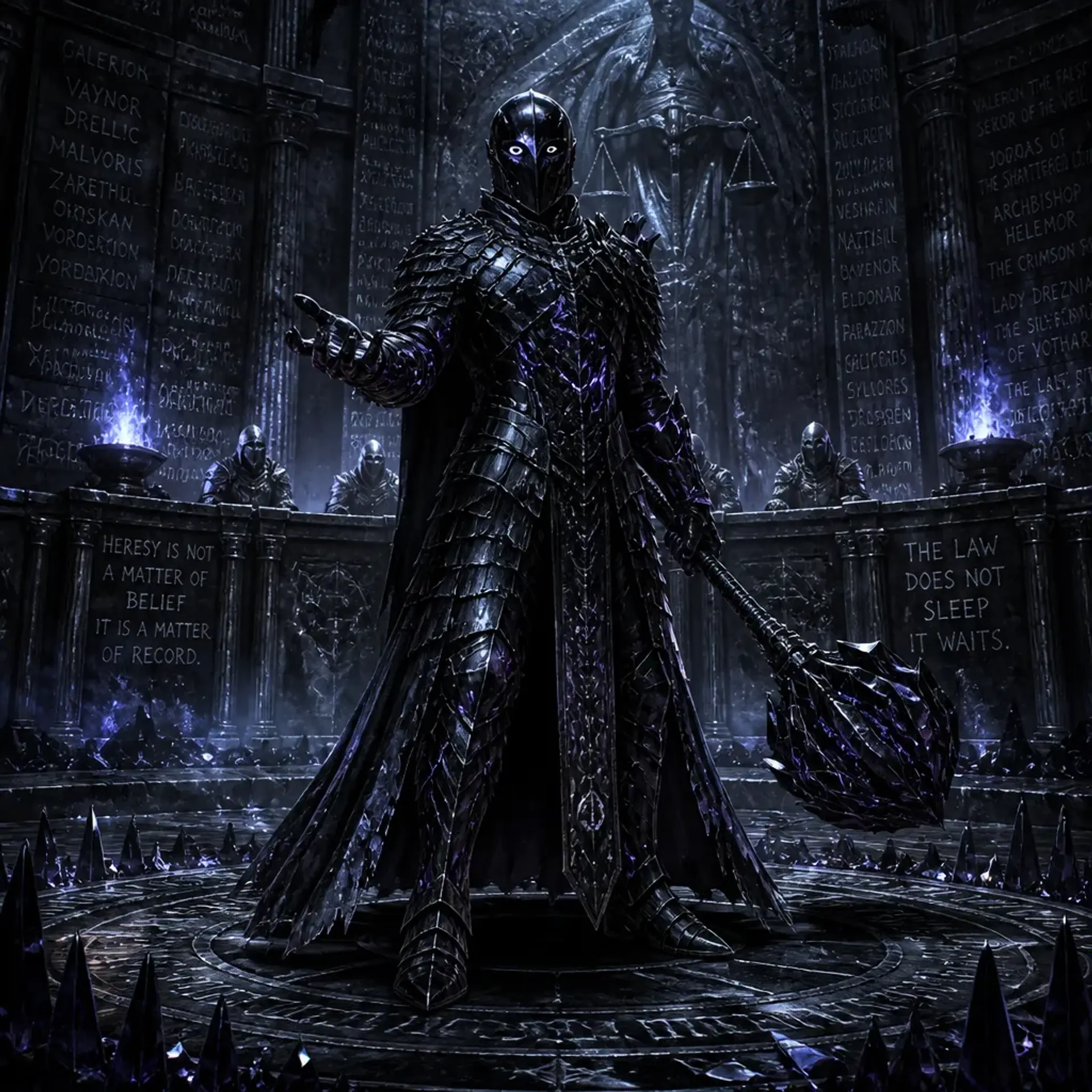
An Obsidian Tribunal Inquisitor wears a segmented black mantle of lacquered scale and a mirror-dark mask with a single silver slit for the eyes. Thin seams of violet light leak from the joints of its armor like trapped candle flame. Its gauntlets are stained with chalk, ash, and old blood, and every motion leaves a faint trail of glittering black dust as if the air itself is cracking around it.

Behavior

Cold, methodical, and ceremonial. It questions first, condemns second, and strikes third, all while speaking in formal charges and legal language. It regards mercy as procedural inefficiency.

How it lives

Obsidian Tribunal Inquisitors are forged or trained as enforcers of secret courts, sacred archives, and purges against heresy. They travel where confession must be extracted, evidence sealed, and examples made. In the wild, they are usually found as the visible hand of a hidden authority.

Lair

In its lair, black glass tablets protrude from the walls like teeth, each etched with names and sentences. Chimes of cracked crystal ring whenever lies are spoken aloud. The floor is often arranged in a circular tribunal pattern that grants the inquisitor excellent sightlines and makes escape routes obvious and punishable.

Habitat
Courthouses, inquisitorial vaults, basalt catacombs, old monasteries, lava-cut fortresses, and civic ruins stained by old trials.

Signs that it is near

Black glass fragments arranged in deliberate circles
Names written in chalk on walls or stones
The smell of hot stone, ink, and incense
Muffled chimes when lies are spoken nearby

Tags

humanoid,
lawful evil,
controller,
interrogator,
inquisitor,
necrotic,
psychic,
spellcaster

Lore

The Obsidian Tribunal is rumored to be a hidden order that believes truth is too fragile for ordinary law. Its inquisitors do not merely punish crime, but also unapproved history, forbidden marriages, unsanctioned magic, and any witness who might complicate the official record. Each inquisitor carries a personal doctrine carved into black glass, and those doctrines often become more absolute than the law they claim to serve.

What drives it

To uncover, seal, and punish hidden guilt before it spreads into public unrest.

After the fight

If defeated, the inquisitor's obsidian mask cracks open to reveal a glowing tribunal seal worth a modest sum to collectors, and any surviving witnesses may fear reprisal from the Obsidian Tribunal. A captured inquisitor can be interrogated for the names of local heretics, smugglers, or corrupt officials. In a campaign, its death may also trigger a purge, a manhunt, or a sudden drop in oppressive influence over the region.

“Each inquisitor carries a personal doctrine carved into black glass, and those doctrines often become more absolute than the law they claim to serve.”
From its lore

Variants

Ash Tribunal Inquisitor, a fire-scarred version that replaces necrotic damage with fire and uses smoke to mask movement.
Glass Tribunal Inquisitor, a mirrored executioner that swaps Edict of Dread for a short-range blinding beam.
High Tribunal Inquisitor, a stronger boss version with 135 hit points and one legendary action per round.

Hooks

Plot hooks

A village magistrate has vanished, and the inquisitor has arrived to continue a sealed investigation.
The party is accused of heresy, treason, or illegal magic and must clear their names before judgment falls.
A noble family hires the heroes to destroy an inquisitor before a confession ledger is read aloud in court.
The inquisitor is hunting the same cult as the party, but its methods are so brutal that the heroes may end up opposing it.

How to use it

As a boss for a level 5 to 7 party in a ruined courthouse, hidden monastery, or fortress archive.
As a commander supported by lesser cultists, guards, or summoned guardians.
As a recurring hunter sent after characters who steal evidence, shelter fugitives, or expose corruption.

Treasure

A sealed confession ledger containing names, crimes, and blackmail-worthy secrets
Rune-inscribed black crystal fragments usable as spell components or art objects
Tribunal seals, tokens, or writs that grant access to restricted archives
1d4 valuable interrogation tools, religious relics, or confiscated coin purses

Media

0 images

No images yet.

Visual sheet

Turn Obsidian Tribunal Inquisitor into a sheet

A high-res, share-ready sheet you can post or print.