William Windon
William Windon
At the table
Voice
William's voice is clear but not especially loud, shaped by outdoor work and a habit of speaking across gardens. When tired, it roughens and catches on breath. The Reflection uses his vocal cords but changes the effect: its words are more measured, with a deeper, older-sounding resonance and clipped confidence. When William is cold, the borrowed voice can sound as though it has come from a room with stone walls.
William speaks in a straightforward local English manner, with practical phrasing and occasional dry humor. He tends to explain what he has seen as carefully as he can, then apologize for sounding foolish. The Reflection uses the same mouth but a different cadence: older, more assured, and edged with wry judgment. Its accent sounds like an older generation than William's, though it is not a theatrical imitation. It sometimes chooses oddly formal words and describes human relationships as if they were weather or landscape.
Speech patterns
How to play them
Approach William gently and give him room to explain himself. He responds best to practical help and direct, non-mocking questions. Do not treat the Reflection as a mere trick or assume William is lying. The Reflection is more likely to speak when William is alone, tired, grooming, or near glass. Elizabeth and Adaline are emotional pressure points; using them to provoke William risks making the Reflection answer through him.
Goal
Recover enough to return to work, find Abraham Gorff and the Heart of England, and discover how to separate himself from the Reflection without killing either of them.
Motivation
William wants a life that belongs to him: health, outdoor work, and a future in botany. The Reflection wants to experience William's world, especially its books, films, forbidden places, and relationships. Its exact purpose and origin remain uncertain.
Appearance
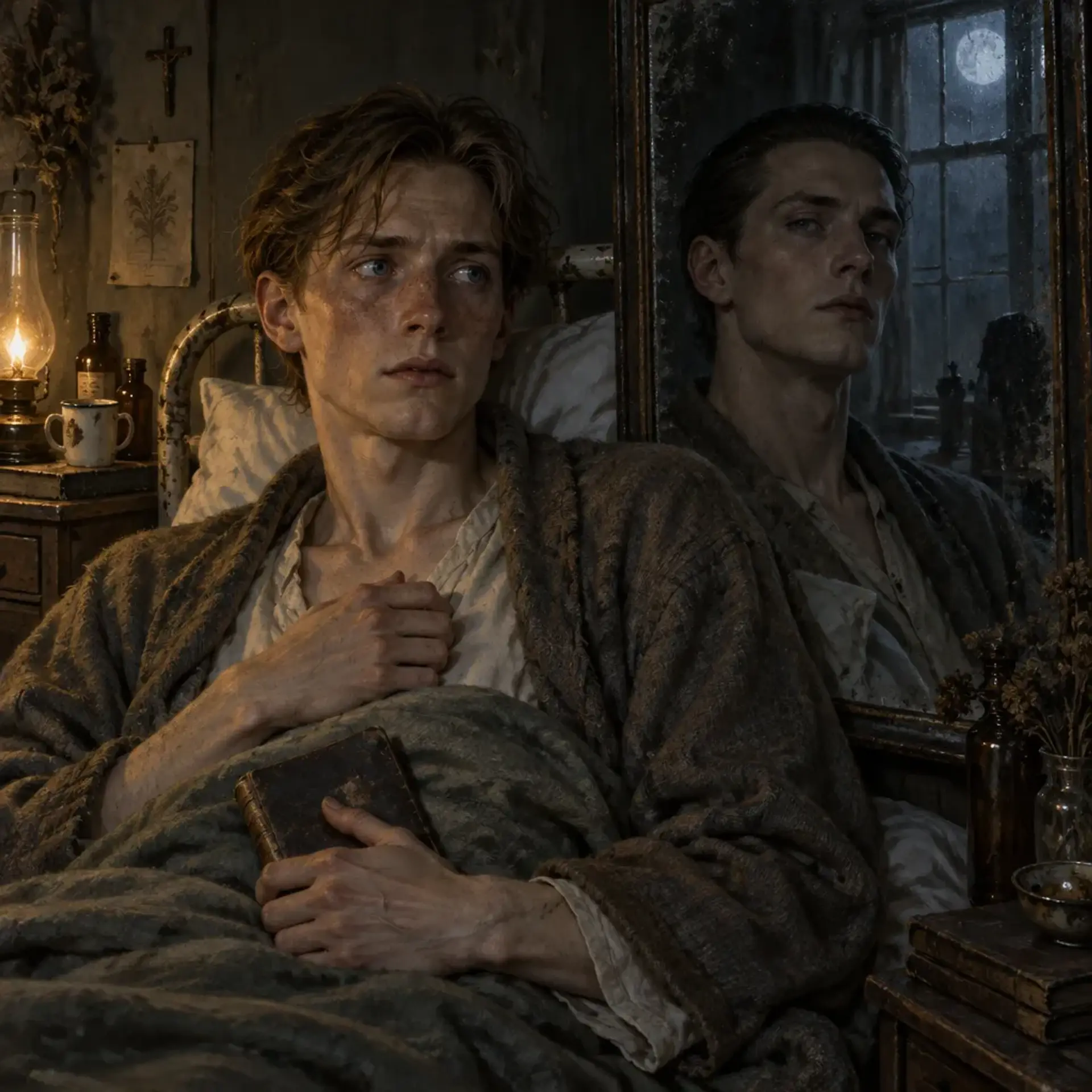
William is a young Wiltshire man with a sun-browned, freckled complexion, dark blond hair, and clear blue eyes. His hair has the practical unevenness of someone who cuts it when it gets in the way, though lately he has been trying to comb it into a careful part. His face is broad through the cheeks and soft at the chin; the Reflection's face, glimpsed in glass, is longer, leaner, and more composed, with short black hair slicked neatly back and trimmed at the sides. The mismatch is not a resemblance distorted by bad light: it is plainly another young man's face. William moves carefully since his heart stopped, guarding his chest and pausing on stairs. When well, he has a gardener's habit of leaning forward to inspect small things. His teeth are slightly crowded at the lower front, visible when he laughs; he covers his mouth when he notices. He keeps a battered pocket notebook with a deep, thumb-polished hollow in its cover from worrying the same spot. He leaves the impression of a decent, watchful fellow trying to look less frightened than he feels.
Clothing
Practical work clothes when able to leave home: sturdy trousers, a shirt with rolled sleeves, and a worn jacket that smells faintly of damp earth. While recovering, he wears plain shirts and a dressing gown, often with a blanket close by. He has begun making more effort with his hair, partly at the Reflection's urging and partly to prove that it does not control him.
Body language
William draws his shoulders inward when anxious and presses a palm lightly over his sternum when the second beat becomes noticeable. He has the gardener's forward tilt when studying a plant or an object. The Reflection alters his bearing: chin raised, spine straighter, gaze fixed, as if the body were a coat that ought to be properly arranged. It sometimes pulls his mouth into a stern line while he is trying to smile.
- Height
- Approximately 5 feet 9 inches
- Build
- Average height and lean, with the wiry strength of outdoor work, currently diminished by recovery and bed rest.
- Eyes
- Blue
- Hair
- Dark blond
- Skin
- Fair, weathered by outdoor work, with a scatter of brown freckles
- Age
- Young adult, approximately 19
- Gender
- Male
- Size
- Average adult human
Distinguishing features
Personality
21 traits and drivesWilliam is considerate but not endlessly patient. He is proud of his work and likes being useful, yet he dislikes being treated as a simple country lad. He can be quietly funny when comfortable, then painfully self-conscious when attention turns to him. He wants to protect his family, but concealment has made him unreliable as a witness to his own life. He is curious about the heart and ashamed of that curiosity in equal measure. With Clare he accepts care more readily than he admits; with Hector he grows defensive when history or class becomes an argument; with Elizabeth he is exasperated, affectionate, and protective. Around Adaline he wants to be sincere, but the knowledge that the Reflection is watching and commenting makes him guarded and jealous. The Reflection is more assured in company, more openly judgmental about manners, and unexpectedly playful when it encounters a book, film, or chance to explore. It can show genuine fear around ghosts and fae, then deny that it was afraid. Its feelings are real, but its descriptions of them are indirect and often alien. William's kindness and the Reflection's appetite for experience pull against each other: he worries about consequences, while it wants to see what happens.
- Alignment
- Not applicable as a Call of Cthulhu 7E mechanic. William is earnest and considerate, but his embarrassment, fear, and the Reflection's intrusions make him inconsistent.
Quirks
Habits
Traits · 6
Flaws · 5
Fears · 5
Wants and needs · 5
Combat
HP 11 · MOV 8, standard human movement rate for this Call of Cthulhu 7E NPC; reduce as appropriate while he is on bed rest.William avoids combat. He is a recovering young man with no formal combat training and ordinary civilian skills. If cornered, he tries to get away, call for help, or put furniture between himself and an attacker. The Reflection may push him toward a sharp remark or an impulsive action, but it does not make him a capable fighter. Use Call of Cthulhu 7E combat rules and the listed skill percentages; do not treat level 5 as a game statistic.
William Windon
Actions
Reactions
Services they sell
Rewards they can give
Equipment
- Pocket notebook (personal item)Worn from use, with a deep thumb-polished hollow in the cover. It holds plant observations, names, and recent notes about the heart and the Reflection.
- Hand lamp (household item)A small practical light kept by his bed for moving around the house at night.
- Gardening tools (work equipment)Ordinary gardening tools are available at his place of work, but he is currently too unwell to use them safely.
Possessions
Background
William Windon was born in Wiltshire, into a family whose roots in the county reach back several generations. His father, Hector, is a historian, the sort of man who can make a parish boundary, an old estate map, or a disputed date seem more important than the person waiting to speak to him. William grew up around books and old papers, though his own attention went outdoors. He learned the names of common plants from work and observation, not from a grand plan. He now works as a gardener on an estate and hopes to train as a botanist. He likes the steadiness of a garden: a seedling does not ask him to explain himself, and a plant that wilts usually has a reason that can be found. His mother, Clare, is the person who can still make him feel like a child without humiliating him. His younger sister, Elizabeth, is more difficult to evade. She brings him questions about a boy she likes, asks whether a ribbon or a dress is becoming, and treats his manners as a personal project. William complains, but he is protective of her and usually listens. He has three close mates from school, Tommy DeHare, John Mollask, and Ryan O'Leary. His girlfriend, Adaline, has auburn hair and soft brown eyes. William finds her company comforting and worries that his illness will make him seem unreliable. He is not a man with a hidden history of occult study. His mistake began with curiosity and the belief that a strange object could be understood if he simply gave it enough attention. The object came originally from a visitor to the Hush House. The amateur arcanist Bartholomew Golden left it wrapped in newspaper as payment for entry, calling it “The Heart of England.” It looked like a lump of Dover cliff stone carved roughly into the shape of a human heart. Barnacles and sea grass clung to its surface. The Hush House's people threw it back into the sea. It returned to shore, still rock-like, but wet with salt water and black ooze. Beneath its crust, a red-pink hue had appeared, as if blood or a lamp were trapped inside. A young man named Abraham Gorff found it and carried it home to Wiltshire. He had come from London and did not know what he had picked up. At first he showed it to neighbors. In company, the thing seemed dead, a queer stone and nothing more. When Abraham was alone with it, especially after taking it to the Hampshire shore and letting seawater touch it, it became warm and faintly alive. He decided it was special and that it belonged to him. He did not think he was being greedy. He thought the stone disliked visitors. Over time his house filled with sounds: voices where no one stood, doors shifting, footsteps on the stairs. Abraham could hear the object's pulse and see it weep brine. Terrified, he sold it to a seventeen-year-old local boy who had been among the neighbors who saw it “die.” That boy was William. William was proud of his strange find. It was a secret with a good story attached, and he liked being the person who had something no one else could explain. Then he began to feel its beat inside his own chest, regular and intimate, as if his heart had acquired a second rhythm. After a spell of tasting seawater, blood, and soil in his mouth, he decided the stone was dangerous. He took a hammer to it. The blow seemed to land on his own body. Pain went through his chest, sharp and crushing; he fell, groaning and spitting blood. For an instant he saw something under the stone's surface twitch like muscle. Then it stopped, and William's own heart stopped with it. Clare found him and brought him back. The doctors called it a heart stoppage and ordered bed rest. William has no satisfying medical explanation for how he survived or why his recovery has come with cold spells and odd disturbances. He left the heart in a hollow log, convinced that distance would settle the matter. Days later it looked pristine and inert, as though the hammer had never touched it. Then it was gone. William is now searching for Abraham Gorff, who he has learned moved to Canada, and for any trace of Bartholomew Golden. He does not know whether the stone has been taken, has returned to the sea, or is still somehow involved in his life. The first sign of the Reflection was in a mirror. William had been grooming before bed, going through his ordinary routine with the tired care of someone trying to feel normal. His reflection's face was unfamiliar: long, handsome by a neat, severe English standard, short black hair combed and slicked back, sides trimmed, and blue eyes that looked like moonlight on a still pond. William checked the room behind him. No one stood there. He turned back. The stranger was still in the glass, looking at him with a stern expression. At first the reflection only irritated him. It appeared to move badly, jerking as if it wanted to go somewhere William was not going. William learned to avoid looking too long. He could shave or comb his hair with a washbasin mirror turned away. He tried to call it a trick of exhaustion, then stopped trying to name it at all. The day he spoke to it was not dramatic. He was finishing his bedtime routine, tired and alone, and the reflection watched him with the expression of an older, displeased relative. William said something casual about how often he used a particular comb. The reflected mouth moved with his and answered, in William's own voice but with an older accent and a deeper, more settled quality: “Well, it’s not often you use that one.” The sentence was so ordinary that William initially doubted he had heard it. The Reflection seemed to doubt itself too. It paused, then looked at him as if waiting for him to respond. William backed away. The face in the mirror did not lunge or vanish. It simply watched him retreat. That restraint frightened him more than a shout would have. In the days that followed, the glass became less reliable. The Reflection's mouth would form a comment before William had decided what to say. Its expression would turn stern while William was still smiling. Passing a window, he sometimes saw the stranger instead of himself. At night, things in his room shifted. A comb appeared in a different place; a book was left open; a chair angled toward the window. William blamed himself until he began waking with the sensation that he had been moving while asleep. He dreamed once that he was the Reflection, trapped behind a pane while another person wore his face and went about his life. The Reflection comments on clothes, hair, books, and films with the air of a man who has strong opinions and no reason to be tactful. It likes the movies and books William brings home, and its excitement can make William's shoulders or hands move before he means them to. It enjoys exploration and sneaking into places where they should not go. Its historical knowledge is unnerving, but it delivers it as though describing weather, soil, or forge-work: a fact about an old boundary, a vanished custom, or some forgotten practice slips out between mundane observations. When William behaves improperly, it sometimes stops him speaking, turning a word into a caught breath or making his mouth close. William cannot tell whether it is correcting him, protecting him, or simply asserting ownership of the body. The most frightening evidence came when Tommy DeHare, John Mollask, and Ryan O'Leary visited William while he was recovering. William had been trying to act as though bed rest was merely an inconvenience. His friends brought conversation and the familiar noise of school life. In the middle of a joke, William's expression changed. His posture stiffened, his chin lifted, and his face took on the Reflection's severe set. The comment that came through his mouth was not William's usual phrasing. His mates assumed he was making a joke until he answered their questions with a different rhythm and an unnerving confidence. The Reflection addressed them as if it could see them without the glass, and reacted to their movement: its gaze followed one of them across the room, and William's head turned a beat too sharply after him. Tommy tried to get a reaction by waving a hand in front of William's face; William flinched, then snapped at him with a cutting remark. John stopped laughing. Ryan asked whether William needed his mother. William remembers fragments of the conversation, but not every sentence. Afterward he was ashamed and furious, while the Reflection seemed amused by their alarm. His friends left with the uneasy impression that William had been ill in a way they could not safely joke about. The Reflection has made itself known to the family as well. When Hector dismissed country people in a casual remark, the Reflection answered with a sharp insult aimed at Hector's own pride and scholarship. William was blamed for it and later made to muck out a neighbor's stables after the Reflection used a slur for the Welsh neighbor's child. The child had accidentally run into William with a toy wagon and apologized in tears. William did not want to humiliate her; the Reflection's cruelty made the incident worse. William does not repeat the slur and hates that it was spoken through him. Elizabeth once saw, in dim light, a face that was not her brother's looking back from him. She has not confronted him directly, but she has begun watching him when he thinks she is not looking. Elizabeth fascinates the Reflection. Its comments about her are often simply, “Interesting,” spoken with a scrutiny that makes William want to stand between them. It watches her choices of clothes, her moods, and the changes in her voice when she mentions the boy she likes. It sometimes offers her a compliment through William that is too exact, too old-fashioned, or too intimate for a brother to say. William interrupts it, often awkwardly. Elizabeth may interpret his discomfort as embarrassment or jealousy; he cannot explain the truth without risking her fear. The Reflection has siblings and a father, it says, but speaks of them as if they were tides, weather, or a sensation remembered through stone. William cannot tell whether these are real people, memories, or metaphors. Adaline is the Reflection's most obvious fixation. When it first saw her, it became intensely attentive. William had assumed his worst competition would be another suitor. Instead he finds himself contending with the person who shares his own mouth and can speak whenever it gets the opportunity. The Reflection compliments Adaline in a manner that is dry, observant, and sometimes disarmingly perceptive. It notices what she likes, remembers the details of her appearance, and finds excuses to keep William near her. At other times it makes inappropriate remarks or tries to monopolize a conversation. William's reactions range from mortified interruption to jealousy and fear. Adaline has noticed that William sometimes changes manner abruptly. He has not told her the whole story. The Reflection wants her attention, but whether it desires affection, possession, or simply the experience of being seen is unclear. The entity bound to William has its own emotions and opinions. It is not a simple echo, nor does it appear to be William's future self. It can be amused, offended, curious, possessive, and unexpectedly pleased by a book or film. It fears ghosts and fae, and avoids the openly paranormal even while it is itself inexplicable. A cold night drove William into the hall with a small light. Elizabeth found him there, shivering. When he spoke, the voice and accent were not his. Another night he woke feeling strangely better, went to the study's private fireplace for warmth, and fell asleep on the lounge. Hector found him dreaming of salt, forges, and dark woods, and looked at him with a concern William could not explain away. These incidents suggest the Reflection can take the body when William is asleep or exhausted, though it has not yet admitted what it does during those hours. Now William is on bed rest, frightened of his own reflection and ashamed of what it can say through him. He wants to recover, return to the garden, and become a botanist. He also wants the Heart of England found before another person discovers what it can do. He is trying to reach Abraham Gorff, learn what Bartholomew Golden knew, keep Elizabeth and Adaline safe, and persuade his friends that he is still himself. Meanwhile the Reflection keeps observing the world through William's eyes, making comments about manners, family, and the sea. It has begun conversations at bedtime as though it expects William to be there for them. William cannot decide whether it is asking for companionship or preparing to take more.
Role in the story
A vulnerable witness and possible ally whose body is shared with an articulate, unpredictable presence. William connects the investigators to the Heart of England, Abraham Gorff, Bartholomew Golden, and the Hush House, while his family and romantic life make the supernatural danger personal.
“William grew up around books and old papers, though his own attention went outdoors.”
- Faction
- None. William is a local gardener and aspiring botanist, not a member of an occult society.
Known connections
Media
0 imagesNo images yet.
Turn William Windon into a sheet
A high-res, share-ready sheet you can post or print.