Peer Ludvik
Peer Ludvik
At the table
Voice
A breath-controlled, rough-edged voice shaped by cold nights, woodland labor, and years of concealing what he knows. He speaks in clipped phrases when tired. When rattled, his breathing becomes audible and a low growl vibrates under his words; he can regain control, but not always before others notice.
Peer's speech carries the clipped rhythm of someone used to talking through cold air and saving breath for work. His words are plainly chosen, with practical nouns and few flourishes, though a clever comparison slips out when he is relaxed. He can shape his voice to sound convincingly human, but strain pulls a low, gravelly growl beneath it. When agitated, he does not whisper; his breath catches, his consonants scrape, and the growl roughens the ends of his words.
Speech patterns
How to play them
Peer initially presents himself as a tired woodsman and asks what the other party needs before revealing anything about his past. Practical kindness earns trust faster than praise. He reacts badly to being called a troll, though he may tolerate the word if it is spoken without contempt. Give him time to answer personal questions; he is more honest while working beside someone than while facing them. If the party offers news of his wife, brother, or cousin, his practiced restraint can crack.
Goal
Find a way to protect his wife and unborn child without bringing the trolls or his pursuers to them, and learn whether the troll king truly died.
Motivation
Peer wants to be a husband and father, not a folk tale or a troll's servant. He is driven by love for his family, shame over his choices, and a stubborn belief that cleverness can still find a way through.
Appearance
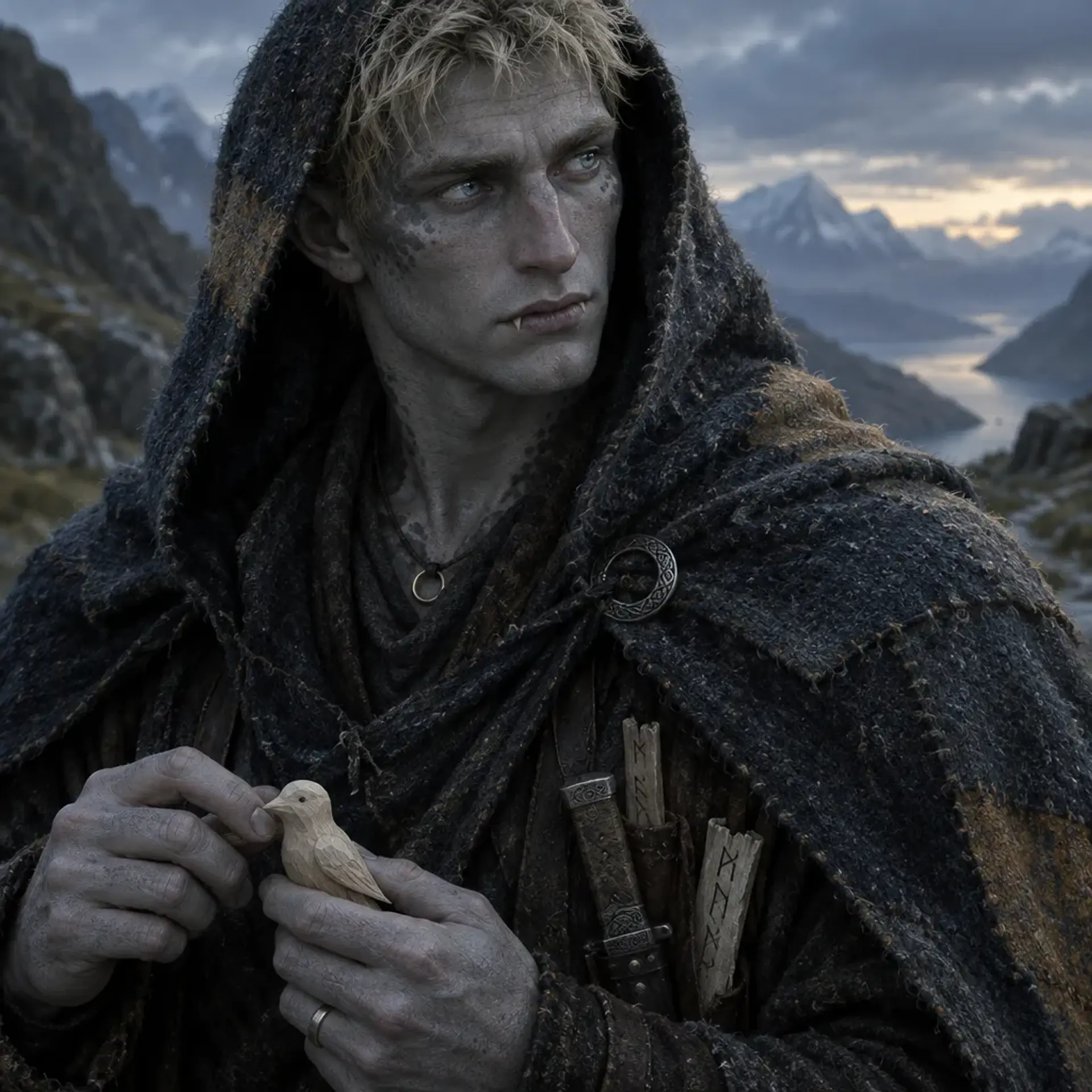
Peer is taller than he remembers being, with a long, rangy frame that seems built to stoop beneath branches and then unfold all at once. His pale gray skin has the dry, uneven texture of stone exposed to frost, with shallow ridges along his knuckles and the bridge of his nose. His nose has lengthened, his canine teeth sharpened, and his ears taper to points. His eerie silver-blue eyes are fixed in color and catch light like ice over deep water. His blond hair is no longer golden; it grows at a startling pace, coarse and straw-dry, so he keeps it cropped close. He walks with a slight hitch, guarding the side where the cold iron wound still throbs. Even when standing still he takes shallow, measured breaths through his nose, as if scenting for food or danger. When rattled, those breaths become rough and his next words arrive on a gravelly growl. He winces at hard sunlight and leaves the impression of a man trying to occupy less space than his body allows. Unexpectedly, for a former celebrated swordsman and current troll-shape, he keeps a tiny collection of carefully mended bird nests, carrying them gently when he finds them fallen.
Clothing
A thick, weather-dark wool cloak with a deep hood, layered travel clothes, patched leather boots, and wraps over his forearms. He keeps his hair close-cropped and carries a plain belt knife. His wedding band is wrapped in cloth and worn under his shirt.
Body language
He keeps his shoulders tucked beneath the cloak and favors the side of his old iron wound. His walk has a guarded hitch, but his hands are quick and controlled. He often becomes unnervingly still when listening. Under stress his nostrils flare, his breath rasps, and his jaw works as though he is trying to hold back a growl.
- Height
- About 6 feet 5 inches
- Build
- Tall, rangy, and hard-muscled, with a newly heavy, stone-like solidity
- Eyes
- Silver-blue
- Hair
- Coarse, fast-growing blond, now a dull straw shade
- Skin
- Pale gray, with a dry stone-like texture and faint ridges
- Age
- Young adult, 21 years old
- Gender
- Male
- Size
- Medium
Distinguishing features
Personality
20 traits and drivesPeer is clever in ways that can look like laziness and lazy in ways he insists are cleverness. In a crisis he notices the one loose beam, the shallow stream, the bad hinge, or the frightened face that everyone else has overlooked. He can turn a room's attention toward a useful detail and make a risky plan sound like the only sensible one. Yet he will sometimes spend an hour searching for a shortcut to avoid ten minutes of honest effort, then work through a freezing night to repair the consequences. He is proud of his ingenuity and ashamed of how often he has used it to dodge responsibility. When he is rested, he can laugh at himself. When he is hungry or sore, every suggestion that he should simply try harder sounds like an accusation. He wants people close and keeps them at arm's length. Peer remembers the cabin years as a time when the boys survived because they depended on one another, but he also remembers how often he disappeared into the woods to trade with trolls rather than face his family’s anger. He calls Emil and Bjorn his brothers without hesitation. He would cross a frozen river for either of them, yet he has not gone back to find them because he cannot bear the idea of seeing disgust in their faces. His affection is practical: he watches whether people have eaten, fixes their gear without being asked, and positions himself between them and a dangerous path. He rarely says, 'I missed you.' If he does, he usually follows it with a question about their boots or provisions. Peer’s old confidence has not vanished. It has been bent out of shape. Before his transformation he could accept praise as proof that he had finally escaped poverty. He enjoyed being called a hero, and he let the story of the troll king become cleaner and grander than the truth. He remembers the trick he used, the fallen stone, the moment the king lost his footing, and the head coming free. He is proud that he survived and disturbed that people mistook a brutal, opportunistic victory for a shining feat of swordsmanship. Now he distrusts compliments, especially those about his looks or courage. He may contradict a compliment with a joke, but later he will remember it word for word. His moods have distinct weather. At ease, Peer is quick-witted and dry, with a habit of tossing out an observation that makes a tense situation seem briefly ordinary. When he is worried, he grows busy: sharpening a tool, checking a knot, moving stones around a fire. When frightened, he becomes very still and watches hands, doors, and shadows. When embarrassed about magic, he changes the subject to the practical outcome of a spell or explains the rune marks as ordinary craft. If someone mocks him as a woman’s worker, a troll’s pet, or an emasculated man, his answer is not a formal argument. His breath turns rough, his shoulders lift, and the words come with a growl he cannot fully control. He may walk away, but the effort costs him. Peer is not a gentle man in every circumstance. He has a savage streak that rises from fear and hunger rather than a love of cruelty. When he believes a friend is about to be taken from him, he can attack with frightening force and keep going after the immediate danger has passed. He dislikes that part of himself and tries to treat it as an animal intruder, which makes it harder to understand and govern. He is capable of mercy, but he does not always trust mercy to be safe. He will spare an enemy who is frightened, cornered, or clearly being used, then keep a weapon ready in case the mercy is exploited. Magic complicates his pride. Peer believes his craft is his own, not proof that he is a troll, a woman, or a failed man. He accepts that trolls taught him some of it, and he will tolerate being called a troll changeling if the speaker means it plainly rather than as a slur. He dislikes sarcasm when he practices, especially from people he loves. A joke about his runes can make him stop mid-gesture and fold the materials away. In private, he is curious and patient with magic. He repeats a working until he understands why it failed, and he remembers the material details better than the dramatic ones. He hides this diligence because he fears that being seen practicing will invite a label he cannot control. He has a soft, almost embarrassing fondness for fragile things. He repairs small bird nests he finds damaged, and he is careful with eggshells, cracked cups, and other objects that seem useless to anyone else. This is not a broad gentleness that makes him harmless. It is a chosen counterweight. He fears becoming only appetite and strength, so he handles small things as evidence that he can still choose how much force to use. He also keeps his wedding band close, touching it through his shirt when he needs to remind himself that his life did not begin and end with the transformation. Peer's deepest conflict is between wanting to return and believing he has forfeited the right. He worries constantly about his wife and their unborn child, but the thought of arriving at her door in this body fills him with shame. He tells himself that distance protects her. Some of that is true; some is an excuse that lets him postpone the moment when she might reject him. He wants his cousin to find him and resents the certainty that the cousin will make a grand adventure out of his misery. Peer can be affectionate with him one hour and angry the next, especially if the cousin calls him a boy or tries to wrestle him as they did when they were children. Underneath the resentment is a hope Peer will not admit: that his cousin will still call him family after seeing him clearly. He can be difficult to recruit because he does not believe a promise until he sees what it costs the speaker. He can also become a steadfast companion once he decides someone has chosen him without needing him to be handsome, heroic, or useful. He offers no polished moral certainty. He will bargain, conceal, and take a crooked path. But when the price is paid by someone weaker than himself, the old boy from the cabin returns: watchful, stubborn, and unwilling to let another person be abandoned in the woods.
- Alignment
- Neutral Good, though hunger and fear can drive him into selfish, dangerous choices
Quirks
Habits
Traits · 5
Flaws · 5
Fears · 5
Wants and needs · 5
Combat
AC 14 · HP 38 · 30 ft.Peer prefers to choose the ground before a fight, using cover, narrow passages, and loose stone to limit how many foes can reach him. He opens with a control or concealment spell, then uses his axe against isolated enemies. He fights defensively while wounded and will retreat rather than risk being pinned in sunlight or struck by cold iron. If a companion is threatened, his judgment can collapse into a sudden, brutal charge.
Peer Ludvik
Spells
Actions
Reactions
Services they sell
Rewards they can give
Equipment
- Work axe (weapon)A plain, well-used handaxe with a repaired haft. Peer uses it as a weapon and a tool.
- Hooded wool cloak (clothing)A heavy wool cloak that hides his changing body and offers protection from wind, but not sunlight.
- Wedding band (personal keepsake)A wedding band wrapped in cloth and kept close to his chest.
- Trollkarl's craft kit (spellcasting focus)A small bundle of rune-marked stones, charcoal, bone needles, and carefully knotted thread used for custom troll craft.
- Travel ration kit (supplies)A dented waterskin and a small pouch of dried food, usually too little for his growing appetite.
Possessions
Background
Peer Ludvik was born into a family with more winters than provisions. When his parents died, his uncle took Peer, his younger brother Emil, and two cousins into an old cabin in the forest, then abandoned them there with a worn axe, blankets, and the assurance that someone would come back. No one did. The boys learned to trap, gather, and endure. Peer learned something else: he could make a bargain sound like a clever shortcut. He was bright, observant, and good at finding what a person wanted to hear. He was also lazy in the particular way of someone who believes a difficult task can always be delayed until tomorrow. Rather than spend days hunting, he began trading labor and favors with trolls for food, tools, and scraps of strange craft. He did bring supplies home. He also ignored Emil and his cousins when they warned that every gift came with a debt, and that troll bargains were not made in the same moral weather as human ones. Peer discovered that he could work magic, though he had no clean name for it. A troll taught him how to set a sign into a stone, coax a spark from wet tinder, and make a shadow hesitate at a threshold. He practiced in secret. In his home society, magic was often dismissed as women's work, claimed as troll power, or treated as an emasculating trespass by men who feared what they could not control. Rune carving was tolerated, so Peer learned to hide the stranger parts of his craft behind acceptable marks and practical excuses. He resented the judgments, but he did not challenge them. He told himself he was being sensible. The tale that made him famous began with a raid and ended with a severed head. Peer was wounded by cold iron in a fight with raiders, and the wound weakened him badly. The trolls he had dealt with had taught him enough to recognize their king's habits, and Peer used that knowledge, a cramped passage, and a fall of stone to defeat the troll king. He remembers the moment clearly: the king's weight shifting, the ground giving way, the single opening Peer had made for himself. He used the surroundings and his sword, and the king's head came free. It was not a clean heroic duel. It was a trap that worked. People preferred the simpler story of a handsome young swordsman who slew a monster by courage and skill. Peer believed it too, at first. He let the songs give him a place in the world he had never had. He gained fame, then wealth, then the hand of a rich man's daughter. For the first time, meals arrived without a bargain. His wife loved the quick mind beneath the heroic story, and Peer loved her for seeing him as a person rather than a useful boy. When she became pregnant, he began to imagine an ordinary future: a warm home, a child who would never sleep hungry, and a father who did not have to barter with trolls. He did not tell her everything about his magic or the bargains that had preceded his rise. He thought he could leave the past behind by behaving as if it were finished. The cold iron wound never healed as it should have. After the fight, Peer grew hungrier and colder, and his temper began to arrive before his thoughts. His body changed slowly enough that he could make excuses for each piece of it. Then one night the disguise of his human nature failed. His skin went gray and stony, his eyes fixed to silver-blue, his teeth sharpened, and his ears pointed. His hair turned rough and began growing faster than he could comfortably manage. The change came with a rage that felt less like anger than a door slamming shut inside his mind. The people who had praised him as their hero saw a troll in their midst. They drove him out. His wife and unborn child remained behind, while Peer fled into the woods with his wedding band hidden against his chest. He is now an exiled thane in everything but any formal recognition. He hides his face with a heavy wool cloak and uses a limited magical disguise when he must approach strangers. The disguise does not soothe his hunger, the wound, or his fear that his transformation binds him to troll law. He believes the trolls have a claim on him and have demanded that he serve them. He is no longer fond of them, but knowing a thing is dangerous does not make it easy to escape its reach. His cousin, the older brother Peer wishes he had, has not abandoned him. That cousin is a true Viking berserker and regards this exile as an opportunity for a proper adventure: gold, glory, and a chance to make Peer into a 'real man.' Peer both loves him and dreads the jokes, the wrestling challenges, and the certainty with which he assumes Peer can simply be dragged back into life. The cousin is sailing with his family and a ranger from Kvanland/Ostland named Lalli, who may be better at following Peer quietly than any of them. Peer thinks often of Emil and his second cousin Bjorn, whom he calls his brothers, but he has no idea whether they remember him with affection, anger, or disgust. The matter he cannot put away is the troll king. Peer cut off the king's head but did not burn the body. Trolls can recover from wounds that ought to make death final, and Peer knows this. His clever trick may have ended a reign without ending a life. It may also have made him kin to the thing he thought he had defeated. Peer is surviving day by day, nursing an iron wound, rationing food, and practicing his hidden craft when he is alone. His problems are not only monsters and pursuers. He must decide whether to seek his wife, whether to trust the cousin coming after him, whether to accept help from Lalli, and whether the person who returned from the forest is still the man who left it.
Role in the story
An exiled folk hero whose transformation turns a celebrated victory into an unresolved horror. Peer can be a hunted ally, a difficult guide, a family-reunion catalyst, or the living clue that the troll king may have survived.
“Peer learned something else: he could make a bargain sound like a clever shortcut.”
- Faction
- Formerly welcomed as a local folk hero and thane; currently an exile with no secure allegiance. Troll law may claim him as kin, a claim he resists.
Known connections
Media
0 imagesNo images yet.
Turn Peer Ludvik into a sheet
A high-res, share-ready sheet you can post or print.