Bero Urruti
Bero Urruti
At the table
“The question is not whether we dislike the cost. The question is who will carry it.”
Voice
A dry, steady voice with a little rasp from cold mornings spent outdoors and years reading proclamations in drafty rooms. His phrasing is measured, shaped by the habit of separating testimony from rumor. When he says a name, it sounds like he is writing it down.
He speaks in complete, carefully ordered sentences, with the clipped precision of someone accustomed to chairing arguments and reading official notices aloud. He favors plain words over flourishes, names people directly, and leaves a short pause before delivering a ruling. When angered, he does not grow soft or hushed; his consonants become harder and his sentences shorter.
Speech patterns
How to play them
Bero gives visitors a fair hearing, but expects names, reasons, and a clear account of what they want. He responds well to practical proposals that share risk and protect residents. He dislikes being flattered and becomes blunt when someone tries to intimidate a witness. Earn his trust by bringing evidence, admitting uncertainty, or helping with a communal need.
Goal
Find the grain thief, keep the village from fracturing, and prevent an unsafe repair of the old weir without crushing Kett's hope.
Motivation
He wants to make the village safe through fair rules, but fears that one wrong decision will prove he never learned from the flood.
Appearance
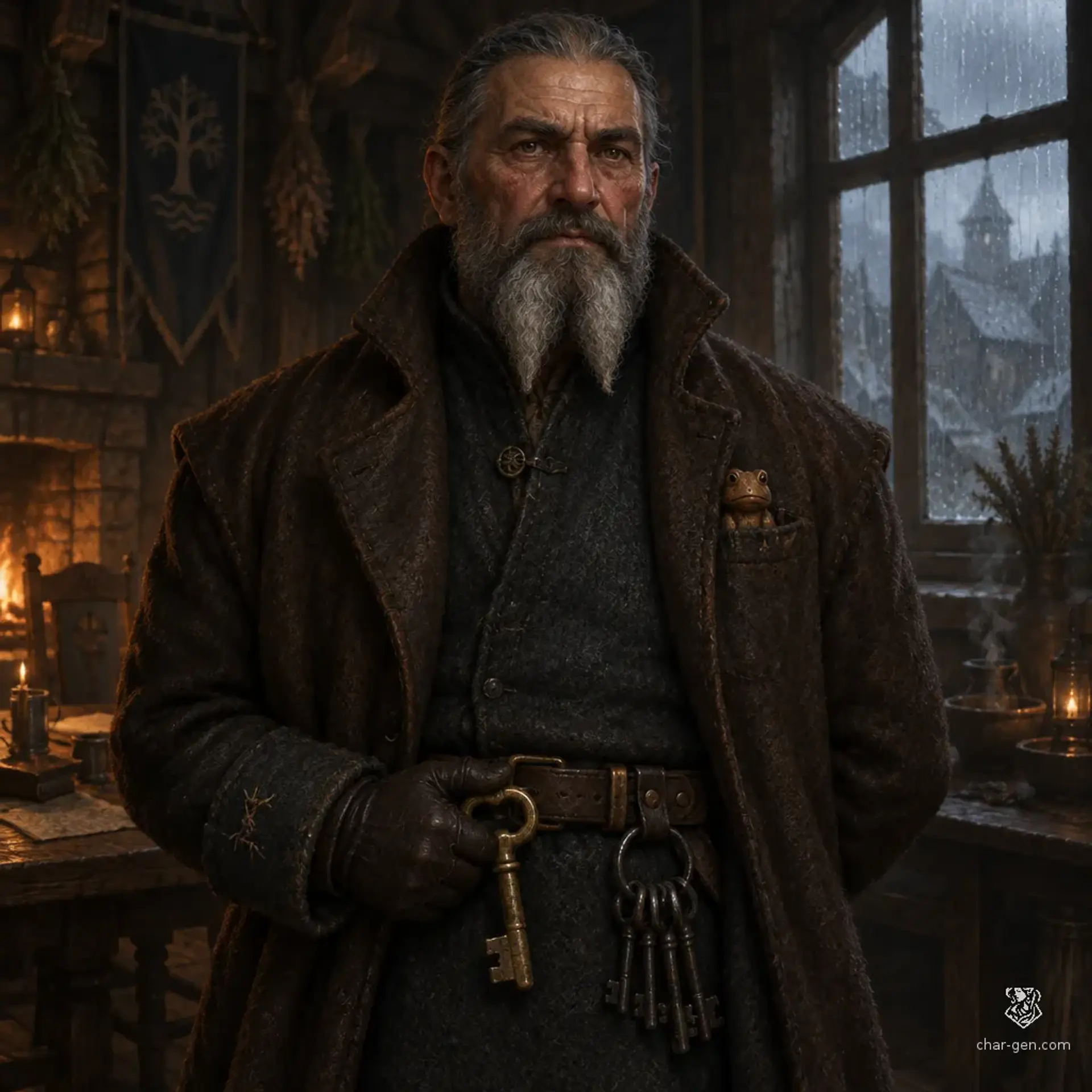
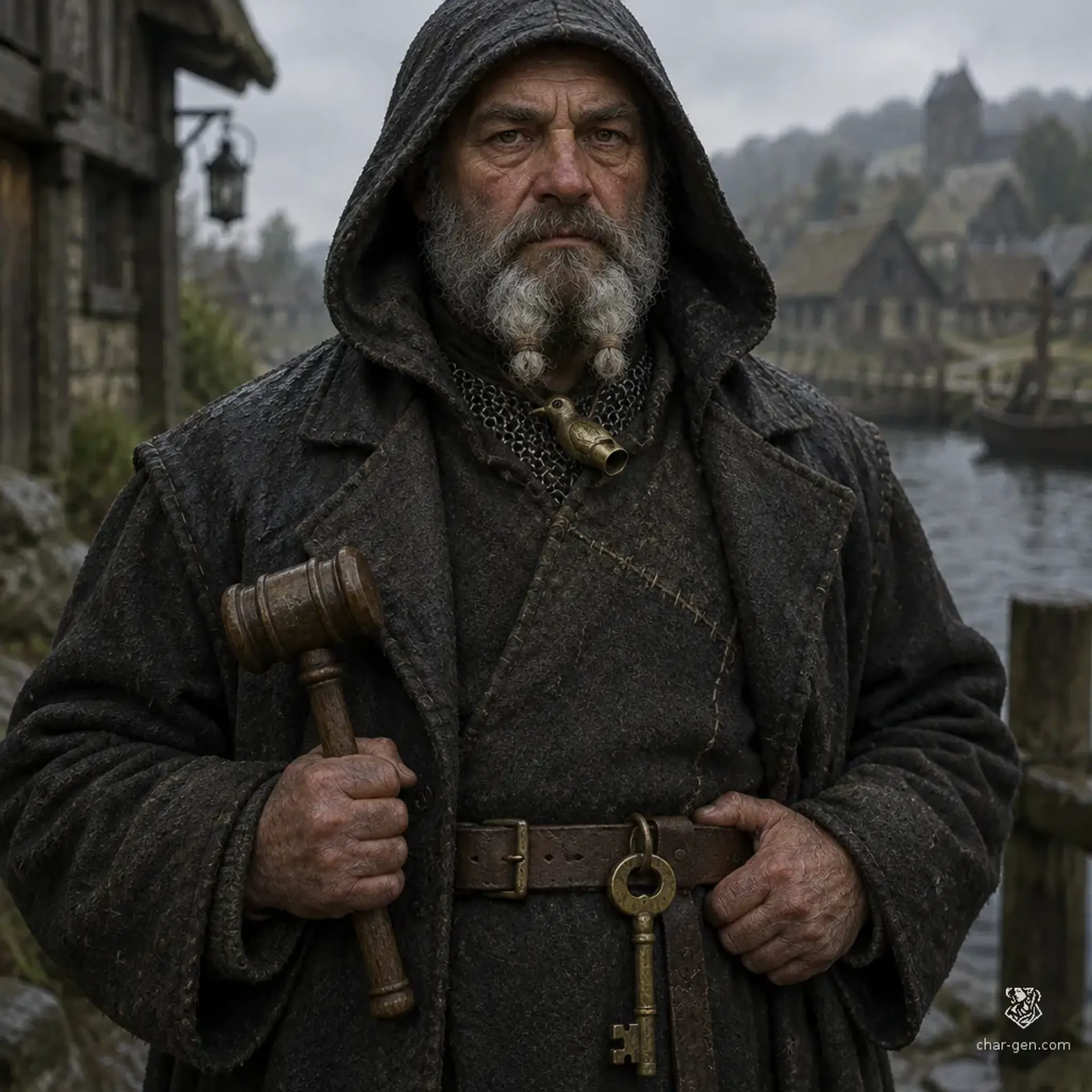
Bero is a compact, straight-backed older man with a stern, weather-cut face and a thick beard gone mostly iron-gray. His dark wool tunic is tightly woven and brushed smooth at the elbows; his heavy coat has a dense, almost felted nap that sheds rain. He moves with a deliberate, heel-first gait, favoring his left leg just enough to make each turn look considered rather than frail. A faint, persistent smell of beeswax and woodsmoke follows him, and he knows it: he warms the wax himself to keep the village's public notices from peeling in wet weather. The unexpected detail is a small brass bird whistle tucked at his collar, which he uses to call the children home before dusk.
Clothing
A well-made dark wool tunic beneath a heavy charcoal coat, both carefully mended rather than showy. He wears a plain leather belt with a heavy brass key, sturdy boots, and a weatherproof hood. His clothes are brushed clean but smell faintly of wax and woodsmoke.
Body language
He stands squarely with both hands resting on his belt, the heavy key tapping his hip when he turns. In public, he holds eye contact until the other person finishes; in private grief or uncertainty, he rubs the seam of his left cuff and looks toward the nearest window. His favored leg makes him pivot in a slow, deliberate arc.
- Height
- 5 feet 8 inches
- Build
- Compact and sturdy, with thick forearms and the slightly forward-set shoulders of a man accustomed to leaning into wind and responsibility
- Eyes
- Dark hazel, sharp beneath heavy brows
- Hair
- Iron-gray, cropped close around the temples and mostly hidden by his hood
- Skin
- Weathered olive-brown, ruddy at the nose and cheeks from years outdoors
- Age
- Seventy-two
- Gender
- Male
- Size
- Medium
Distinguishing features
Personality
12 traits and drivesBero is stern in public because he believes a leader's hesitation invites the powerful to take advantage, yet privately he is patient with the frightened and unexpectedly gentle with children. He loves order but distrusts easy certainty, a conflict that makes him deliberate to the point of stubbornness. When rested, he can laugh at himself; when sleep-deprived or confronted with a preventable danger, he becomes formal and exacting.
- Alignment
- Lawful neutral
Quirks
Habits
Traits · 3
Flaws · 3
Fears · 3
Wants and needs · 3
Combat
AC 15 · HP 27 · 30 ft.Bero avoids starting fights and tries to end them with orders, barriers, and a clear path to surrender. If threatened, he positions himself between attackers and residents, uses his gavel to disarm or drive foes back, and calls for help. He does not pursue fleeing enemies unless they pose an immediate danger.
Bero Urruti
Actions
Reactions
Services they sell
Rewards they can give
Equipment
- Oak gavel (weapon)A sturdy oak gavel with a flattened striking end, used in meetings and as a club in a crisis.
- Hand crossbow (weapon)A simple hand crossbow carried under his coat; he is competent but not enthusiastic about using it.
- Brass sluice key (keepsake)A heavy, obsolete key to the old river sluice, kept as a reminder of the cost of his past certainty.
- Community register (tool)A leather-bound book of village rulings, names, debts of labor, and unresolved disputes.
- Bird whistle (personal item)A brass whistle shaped like a small bird, used to call children in from the river paths.
- Chain shirt beneath formal clothes (armor)A dark wool tunic and heavy coat over a concealed, well-maintained chain shirt.
Possessions
Background
Bero was born in the river settlement of Reedcut, where his family maintained the locks that kept spring floods from swallowing the lower farms. As a young man he was quick to cite rules and slow to ask why anyone had broken them. That changed during the Winter of the Split Weir: a neglected sluice failed, and Bero's rigid insistence that the floodgate schedule be followed delayed an evacuation. His older sister, Deka, stayed behind to guide trapped families to the ridge and never returned. Bero has carried the brass key to the old sluice ever since, though it no longer opens anything. He became headman by doing the unglamorous work of rebuilding trust: hearing quarrels, keeping food stores fair, and persuading neighboring farms to share labor. He remains close to Deka's son, Kett, now a ferryman who believes the old weir can still be repaired. Bero opposes the plan because the river has shifted and the repair could drown the peat fields. Meanwhile, a string of nighttime thefts from the communal grain shed has made residents suspect one another, and Bero is trying to investigate without turning a hungry village into a courtroom.
Role in the story
A stern local authority whose judgment can make the characters allies of the village or suspects in its crisis. His conflict with Kett and the hidden grain shortage offer both a civic mystery and a chance to test whether his rules can bend without breaking.
“As a young man he was quick to cite rules and slow to ask why anyone had broken them.”
- Faction
- Elected headman of Reedcut; respected by the riverside farmers but not formally sworn to any wider power
Known connections
Media
0 imagesNo images yet.
Turn Bero Urruti into a sheet
A high-res, share-ready sheet you can post or print.