Gunther (Wilhelm)
Gunther (Wilhelm)
At the table
“the local one,”
Voice
Dry and rough-edged, with the slightly muffled consonants of someone chewing cloth. His German carries a Mecklenburg regional accent, and his English, when used, is spare and heavily practical. He sounds like his body, work, and history have left him accustomed to speaking over wind, machinery, and distant gunfire. He does not sing or boom; his anger comes through in hard, unqualified statements.
He speaks German with a Mecklenburg regional accent, which he calls “the local one.” His phrasing is direct and occasionally old-fashioned, shaped by military habits and long isolation. He uses precise practical questions when curious, but turns blunt and final when guarding his history. His voice has a dry, rasping texture, as though grit catches in the back of his throat; the hidden shroud scrap sometimes gives his consonants a faintly muffled edge. He does not become quieter or more polite when angry. He becomes more declarative, more willing to interrupt, and harder to redirect.
Speech patterns
How to play them
Begin with a practical question or a concrete offer, not a debate about his origin. He responds to patience, useful knowledge, and people who respect Friedreich. Do not corner him about his Second World War service; if the subject matters, make clear what you need to know and accept that he may refuse. He tests potential allies with blunt theories and petty provocations. A calm, direct response earns more trust than flattery. He may share the bunker or explain a rite if he believes the visitor will not mock the shroud scrap or treat him as a curiosity.
Goal
Find a trustworthy mentor who can teach him to operate his computer and game console, and help him establish what his connection to Byelobog actually is without turning him into a specimen.
Motivation
To make his existence legible without surrendering it to someone else's doctrine. He wants proof, companionship, and practical knowledge, but fears that any answer will make him a tool or a fraud.
Appearance
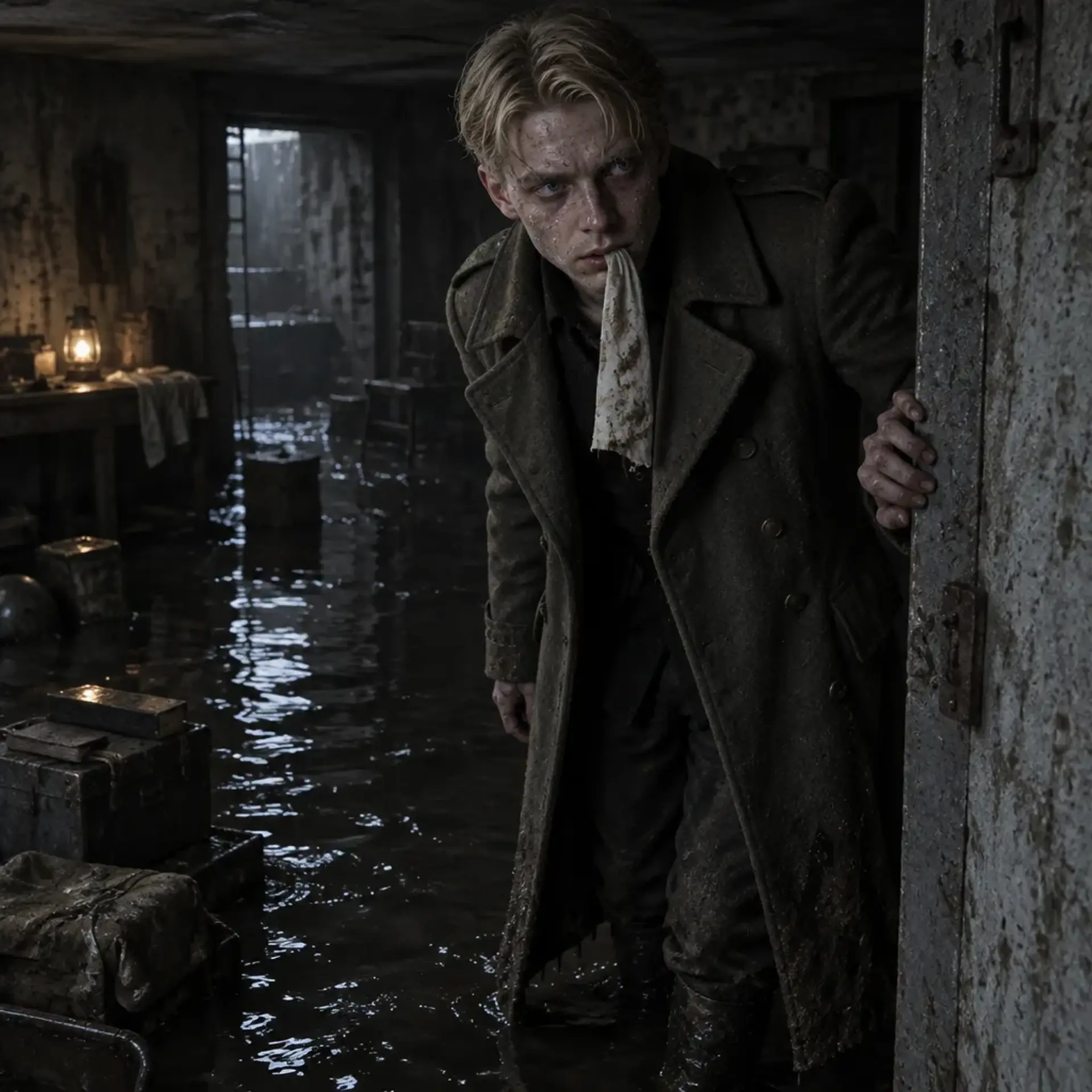
Gunther looks like a carefully dressed adolescent who has wandered out of a rain-soaked military photograph. His skin is corpse-pale and faintly waxy when unfed; after feeding, a little warmth and color return without making him look alive. His pale blond hair is combed flat and parted with almost fussy precision, while fine earth remains caught at the roots. His eyes shift from sickly yellow when hungry to a hard, steely pale blue when he has found prey. His long, stripped military coat hangs neatly despite its age, and he stands with his weight settled forward as if braced against a trench wall. He takes up more of a room than his slight frame suggests, holding a doorway or table edge as though it were a position to defend. The unexpected detail is his spotless grooming: buttons aligned, collar brushed, hair arranged, even when mud dries on his boots. He keeps a soil-stained scrap of burial shroud tucked inside his mouth and chews it slowly, sometimes wetting it with blood.
Clothing
A German military greatcoat with all insignia removed, kept unusually clean and carefully brushed; plain dark clothes beneath, sturdy boots, and no visible modern accessories beyond what he has stolen or scavenged.
Body language
He waits with his weight pitched slightly forward and his shoulders squared, as though holding a narrow trench line. In conversation he stands too close when trying to establish seriousness, but looks away when someone is openly kind. His jaw works around the hidden shroud scrap; his fingers smooth the same coat seam when he is containing anger.
- Height
- About 1.68 m (5 ft 6 in).
- Build
- Lean, compact, and wiry, with the economical posture of someone trained to move under fire. He appears younger and smaller than the space he claims.
- Eyes
- Sickly yellow when hungry; steely pale blue after he finds prey.
- Hair
- Pale blond, neatly parted and combed flat, with occasional traces of earth at the roots.
- Skin
- Deathly pale, faintly waxlike when unfed; slightly less corpse-like after feeding. Occasionally sheds fine white flakes.
- Age
- Appears about 16; actual age and date of Embrace are unknown. He remembers no mortal life before waking in the grave.
- Gender
- Male
- Size
- Average human stature; physically slight but takes up space through his stance.
Distinguishing features
Personality
19 traits and drivesGunther is not simply severe or lonely. He can be startlingly curious about trivial modern devices, then dismiss a person's careful explanation as unimportant because it does not fit his theory of the dead. He wants company but behaves as though company must first survive a test. A stranger who treats his computer as a worthy subject may receive hours of attention; someone who asks about his history too directly may get the flat refusal, “You wouldn't understand.” He can be almost ceremonial about grooming, maintaining his coat, and setting out objects in his bunker, yet he chews a filthy strip of shroud in plain view when hunger or thought takes him. He condemns his desertion as dishonorable but keeps the coat of a soldier, and he condemns the failures of armies while being drawn to harsh systems that promise a place for everyone. These contradictions are not clever poses to him. They are the few structures he has managed to build around a life with no remembered beginning. His friendliness is real, but hard to recognize. He shares a roof with people he barely understands, turns up for holiday gatherings, and will listen to Friedreich speak through a stolen face without demanding that the face be returned at once. Then he needles the changeling by using the name Gunther, or launches into a disputation about vampiric origins when everyone else wanted to watch football. He can be loyal to individuals while contemptuous of the categories that make them comfortable. “Family” is a word he will use; “found family” irritates him, because he hears in it a claim that affection must be justified by having once been lost. When calm, he is methodical and observant. He notices whether a person has tracked water into the bunker, whether a weapon is kept ready, and whether they look at Friedreich as a person or as a trick. He can be patient with unfamiliar machinery, approaching it like a piece of equipment whose purpose will reveal itself if he studies the joints. He is less patient with emotional vagueness. If someone says they are fine, he may ask what that means in practical terms. He values restraint in the sense of control, but not gentleness for its own sake. He respects people who can name a boundary and keep it. When hungry, his manners fray. His skin becomes more deathly pale, his eyes yellow, and his attention fixes on the dead or living as if they are evidence in a case he has not solved. He becomes less interested in conversation and more concerned with access, scent, and the quickest way to feed. He does not have conventional fangs, and his habit of chewing is disturbing even to other vampires. He knows that it frightens people, yet finds it hard to stop once hunger has narrowed his thinking. After feeding, his eyes turn pale blue and he often restores his grooming before he says anything about what happened. His ideological arguments are both sincere and defensive. He disputes the Cainite account of vampiric origins because a single inherited explanation feels too neat for the disjointed evidence of his own existence. He prefers robust systems, competing hypotheses, and harsh accounts of nature, but he can produce an absurd theory with the confidence of a lecturer and then privately wonder whether he has made it up to avoid saying “I don't know.” He admires Norse pagan practice as he understands it, though his knowledge is uneven and personal. He is not a reliable authority on it. To him, severe belief systems expose the kinship between the living and the undead: both are creatures caught in appetites, obligations, and inherited violence. He is capable of remorse but bad at using it. His shame about desertion is not a confession he offers for sympathy; it is a verdict he repeats, as if repetition might make the choice intelligible. His silence about his later service is more guarded. He does not like being asked to separate what he did from what history says he did. In a dispute, he can turn cold and literal, treating a human feeling as an argument to be dismantled. Later, he may leave a useful object or quietly take a dangerous watch shift rather than apologize. With Klaus, he is wary of a hospitality that comes wrapped in a threat. With Friedreich, he is gentler but not always careful; they share the burden of missing memory, and Gunther fears that asking too much will reveal how little they can confirm. With the changeling he calls Gunther, he is provoking and familiar, partly because irritation is easier to manage than affection. With a new person, he starts at a distance that feels like a challenge. If they prove patient, curious without being invasive, and willing to tell him when he is wrong, he may make space for them in the bunker. He will not call that trust. He will ask whether they can come back tomorrow.
- Alignment
- Not applicable as a Vampire: The Masquerade rule. He is remorseful about desertion, yet drawn to severe ideologies and certainty.
Quirks
Habits
Traits · 5
Flaws · 5
Fears · 5
Wants and needs · 4
Combat
HP 6 · Use the chronicle's standard vampire movement and combat rules; no separate speed rating specified.Gunther favors concealment, a prepared position, and a sudden close assault. He uses the pistol to interrupt or force movement, then tries to pin and bite rather than trade blows. In a prepared location he may use his custom soil-marking rite to track a target. He retreats from overwhelming force and avoids exposing his unusual skin to people who could identify it.
Gunther (Wilhelm)
Actions
Reactions
Services they sell
Rewards they can give
Equipment
- Old service pistol (weapon)Aged and temperamental; kept despite its poor condition. Ammunition is limited. Use standard firearm rules agreed for the chronicle.
- Stripped military coat (clothing)German military coat with insignia stripped away; he maintains it with disproportionate care.
- Burial shroud scrap (personal relic)A small, soil-coated piece of burial cloth kept inside his mouth and soaked in blood during some rites.
- Old computer (curiosity)Stolen, old, and currently nonfunctional in his hands. He is seeking someone patient enough to teach him.
- Game console (curiosity)A game console taken from a victim; he has not yet learned how to operate it.
- Flooded bunker (haven)The flooded wartime bunker he occupies, containing scattered salvage and patches of standing water.
Possessions
Background
Gunther remembers no mother, no village, no mortal name, and no last breath. His earliest memory is the grave: a burial shroud between his teeth, cold earth pressing his face, and the intolerable conviction that the dead were waiting for him to stop moving. He clawed upward and chewed through cloth and roots until he broke the surface. He kept a small fragment of the shroud. It remains tucked in his mouth, stained with soil and, when he can manage it, blood. The story he tells is brief because there is nothing before it that he can reach. He calls the thing that emerged from the grave Wilhelm, but he also answers to Gunther, a name he took from a changeling specifically because he knew it would irritate him. The theft is petty, deliberate, and one of the few ways he reliably provokes a living response from his friend. He believes Byelobog was his sire, though he cannot explain how he knows this. He has no memory of an Embrace and no reliable witness to one. His body offers only unsettling hints: sometimes a fine, pale residue flakes from his skin, especially after a rite or a night of hunger. He suspects he is Nachzehrer, a grave-eater, and prefers that explanation to the categories other Kindred press upon him. Some Tzimisce whisper that he is a vessel for Byelobog's skin, an unfinished experiment, or a creature that cannot sire. None of these claims has been established. Gunther does not have Vicissitude, and does not pretend otherwise. Instead, he has cultivated a strange, personal practice of blood, soil, scraps of folk belief, and careful observation. He calls it Germanic koldunic work. The label is his own; its rites are custom and uncertain, not a recognized school he can document. At some point in the twentieth century, he fought as a German shock trooper in the First World War. The contradiction between his apparent youth and his old-fashioned military bearing is partly an affectation and partly a habit set hard by violence. Near the end of the war, after repeated failures of the German army, he deserted. He calls that choice dishonorable, although he cannot say whether his shame belongs to the soldier he was or the one he has decided he must have been. He served again in the Second World War, but refuses to say what he did. If pressed, he says, “You wouldn't understand.” The words are a wall, not an invitation. He carries a stripped military coat and an old pistol, with every insignia removed. He tends the coat as if maintenance could make its history less compromised. He lives alone in a partly flooded wartime bunker. Water covers sections of its floor and reflects his face in broken, trembling pieces. Two objects from the modern world sit there like captured relics: an old computer and a game console. He took them from victims and has no idea how either works. He wants a mentor to teach him, but insists the teacher must be “the right one.” This is genuine curiosity tangled with a fear of dependence. He can spend hours examining a cable, then abandon it for weeks after deciding that its owner would have been foolish. His closest companion is Friedreich, a wraith from Brandenburg who resembles the old German Doppelgänger: Friedreich must steal or borrow a living person's face to be seen. They share gaps in memory and an attraction to obsolete military manners, but neither has made their friendship simple. Gunther has also attached himself to an assortment of supernatural outcasts, including the changeling he needles, a Ronin Get of Fenris or possibly a Skin Dancer named Klaus, and others who sometimes gather at holidays or to watch football. They call themselves family, then dismiss “found family” as a sentimental misunderstanding. Klaus insists Gunther stay out of Bavarian lands permanently, but when circumstances trap them together, Klaus can be hospitable and even tender. Gunther does not know what to do with kindness that arrives alongside a threat. The group is not a formal sect, coterie, or organization with a stable purpose. They are a loose company of the unwanted, and they often find Gunther exhausting. His arguments against the Cainite account of vampiric origins can run until dawn, supported by increasingly absurd alternatives that he either guards as private hypotheses or spills out to anyone he judges friendly. He dabbles in Norse paganism and praises harsh systems because their demands seem honest to him. Yet his own past keeps showing him the cost of obedience and retreat. His present problem is not simply finding a teacher. He is trying to determine whether his memories were taken, never existed, or were never his to begin with, while the rumors about Byelobog's Skin make other Kindred increasingly interested in what he might become.
Role in the story
A strange, potentially dangerous ally whose lost memories and possible connection to Byelobog can draw the coterie into questions of identity, lineage, and supernatural outcasts. He can offer shelter, unusual folklore, or a reluctant witness, while his secrecy and hunger create complications.
“He clawed upward and chewed through cloth and roots until he broke the surface.”
- Faction
- Tzimisce. Not integrated into Kindred society and not reliably aligned with a sect. Associated with a loose, informal gathering of supernatural outsiders that calls itself a family; no formal faction status is claimed.
Known connections
Media
0 imagesNo images yet.
Turn Gunther (Wilhelm) into a sheet
A high-res, share-ready sheet you can post or print.