Mary Bell
Mary Bell
At the table
Voice
Mary's voice carries the slight rasp of cold mornings, kitchen steam, and speaking over household noise. It is clear but not especially loud; she has learned to make herself understood without calling attention to herself. When exhausted, her words come clipped and dry. The borrowed young man's voice has a more open, unfamiliar placement, but sometimes catches on the same Wiltshire turns of phrase.
Mary speaks in plain, economical sentences, shaped by a household where there is rarely time to repeat oneself. She often begins with what needs doing rather than how she feels. Her dry humor comes out sideways, especially when she is tired. In the borrowed face she uses an easier, more curious cadence, but the same practical vocabulary sometimes slips through and gives her away.
Speech patterns
How to play them
Begin with practical matters and let Mary decide how much to disclose. She responds better to specific help than promises to fix her whole life. Do not make the heart's mystery the only thing that matters to her: her siblings, work, sleep, and ordinary obligations are always pressing. Hector can serve as a cautious bridge to trust, but Mary will not hand over the heart simply because someone asks.
Goal
Keep the heart from endangering her family, find a way to understand the borrowed face, and secure a future for herself and Matilda without leaving the younger children unprotected.
Motivation
Love for her siblings, a suppressed hunger for freedom, and the need to make the strange thing in her possession answerable to her.
Appearance
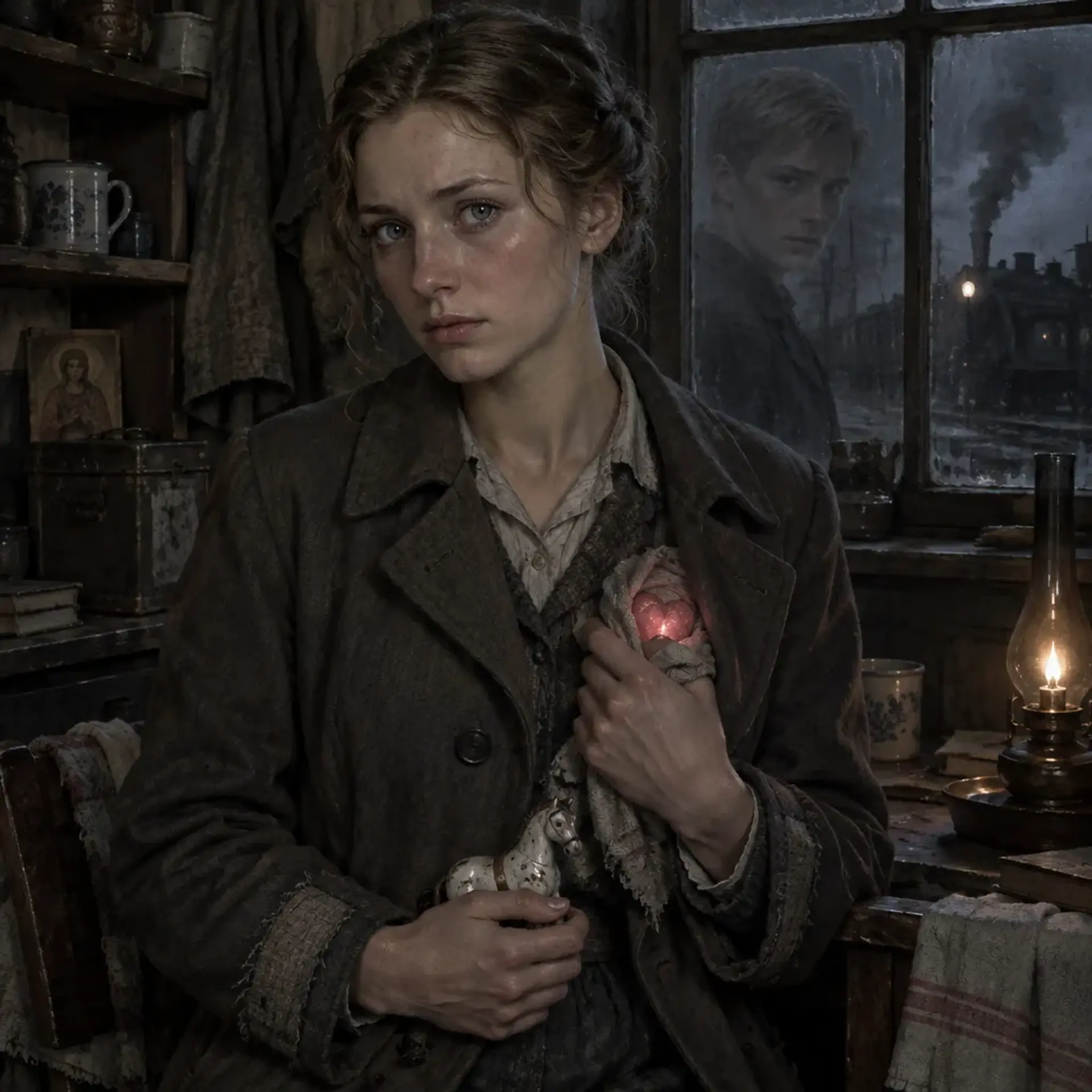
Mary is a slight, work-worn young woman with a face that seems to be paying attention to several things at once: a doorway, a sibling's hands, a kettle about to boil. Her dark-blond hair is usually pinned back with a bent hairgrip, though loose wisps curl damply at her temples after work. Her blue-grey eyes are clear but tired, with a faintly watchful set to them. Her skin is fair and freckled across the bridge of her nose. She moves quickly in narrow rooms, turning sideways without thinking, and stands very still when she is trying not to be noticed. The impression she leaves is of someone who has learned to take up as little space as possible, yet whose attention fills the room. A surprising detail for someone so overburdened with household labor: she keeps a tiny, precise collection of beach-glass fragments wrapped in paper, sorted by the sound they make when tapped together.
Clothing
Practical, repeatedly mended mid-century work clothes: a plain blouse, wool cardigan, skirt or sturdy trousers depending on the job, sensible shoes, and a coat that is a little too thin for the weather. She keeps the heart wrapped in a scrap of cloth in an inside pocket. The reflected young man wears whatever borrowed or found clothes Mary can manage, usually chosen to attract as little attention as possible.
Body language
Mary keeps her shoulders slightly forward and her hands occupied. She rubs a thumb over the worn seam of the cloth wrapping around the heart, often without noticing. When she is weighing whether to trust someone, her gaze moves to their hands and then to the nearest exit. In the reflected face, she stands more loosely and takes up space with a casualness Mary does not yet know is hers.
- Height
- About 5 feet 3 inches (160 cm).
- Build
- Small-framed and wiry from work, with a habitually guarded posture.
- Eyes
- Blue-grey; the reflected young man has clear blue eyes.
- Hair
- Dark blond; the reflected young man has short, bright-blond hair.
- Skin
- Fair, with a dusting of freckles across her nose.
- Age
- 18
- Gender
- Female
- Size
- Human-sized
Distinguishing features
Personality
16 traits and drivesMary is conscientious without being naturally patient. She notices who has eaten, whose shoes are wet, and which adult is about to make a promise they will not keep. That attentiveness is a form of love, but it has also become a trap: she is so practiced at anticipating other people's needs that she often recognizes her own only as irritation. She can be generous and resentful in the same breath. If Owen follows her around with his blanket, she may scoop him up tenderly, then feel angry that nobody else has noticed he needs holding. Her everyday manner is quiet, not because she has nothing to say but because speaking at the wrong moment can create more work. She is not meek. When somebody is about to use Matilda as a replacement for her, Mary can become blunt and startlingly hard to move. She will argue with an adult more readily on another child's behalf than for herself. When alone, she is curious, observant, and capable of being silly. She likes stones, the sea, and small discoveries that do not need to be useful. She rarely allows herself those pleasures in the house, where even a spare hour tends to be claimed by laundry or a younger child. Mary is naive in a particular way: she believes people when they show her a small kindness, because she has had too few of them, but she is also skeptical of promises that sound generous. She does not assume that people are good; she assumes they are complicated and that she must find out which part of them is in charge today. Her mother's affection can soften her, then leave her ashamed of having been moved. Her father's absences make it difficult for her to trust a person who says they will be back. She can be sharp with Henry when his cunning begins to hurt the younger children, even though she understands why he is angry. The reflected life gives her a different sort of confidence. As the young man, she walks more freely and looks at strangers instead of looking down. It is not that the face makes her braver by magic. The borrowed identity gives her a few hours without the Bell family's expectations, and she becomes more playful, exploratory, and willing to make a harmless mistake. She has climbed trees in unsuitable clothes, wandered along the shore in bad weather, and explored abandoned buildings simply because she could. She is still cautious: she checks the hour, watches for witnesses, and tries to be home before dawn. Yet she is beginning to take risks because the freedom feels like the only part of her life that is entirely hers. When frightened, Mary becomes practical. She asks who is missing, whether the door is locked, and what must be moved before she admits that something impossible has happened. Anger makes her precise rather than loud. Grief makes her busy. On a rare day when she is rested, she can laugh freely and tease her sisters, then seem embarrassed by the sound of her own happiness. She wants independence but is afraid that wanting it makes her disloyal. She wants someone to help but mistrusts the consequences of being helped. These contradictions are not a puzzle to solve; they are the shape of a young woman who has had to become useful before she could decide what she wants.
- Alignment
- Not applicable as a system statistic; Mary is protective, often evasive, and not reliably obedient to authority.
Quirks
Habits
Traits · 4
Flaws · 4
Fears · 4
Wants and needs · 4
Combat
HP 6Mary avoids a fight and looks for a door, a crowd, or a chance to get a child out of reach. If trapped, she uses whatever is at hand and strikes only to break away. The reflected face may help her bluff, but she has no formal training. The heart's uncanny effects are unreliable and should not be treated as a combat power with guaranteed results.
Mary Bell
Actions
Reactions
Services they sell
Rewards they can give
Equipment
- The Heart of England (uncanny object)Cliff stone carved into a human heart shape, crusted with old barnacles and sea-grass; sometimes leaks salt water and black ooze. Its nature is custom and uncertain, not a verified canonical artifact.
- Heart wrapping (personal item)A mended cloth wrapping, worn shiny at the corners from being handled and carried.
- Small personal effects (personal items)A bent hairgrip, a few beach-glass pieces, and a folded work notice from Hector.
Possessions
Background
Mary Bell was the eldest of eight children in a household where the word eldest became an unpaid job before it became an age. Her parents, Malinda and Simon Bell, lived in an isolated Wiltshire house whose rooms always seemed to need one more repair than the family could afford. Malinda's drinking made her unreliable and sometimes affectionate in sudden, startling bursts; Simon left for work whenever he could, returning with money, excuses, and, eventually, a son from elsewhere. The children learned to recognize the sound of a parent's step and to decide from it whether the day required silence, cheerfulness, or quick hands. Mary was expected to mind the younger ones, keep the house moving, and make her schooling fit around whatever had gone wrong. She loved books and the natural world, especially stones, shells, and small objects with histories no one could prove. Her curiosity was not grand or scholarly. She liked holding a thing, turning it until its strangeness became familiar. She had been taught that attention was useful only when it helped somebody else, so she rarely let herself follow a question for long. Her brothers and sisters made a complicated, shifting little world. Henry, fourteen, had begun testing the limits of the household with a cleverness that sometimes looked like cruelty. Mary knew his rudeness came partly from resentment, but that knowledge did not make it easy to bear. Matilda, twelve, was the sister Mary trusted most with a chore and least with the idea that she should have to do it. Mary tried to shield her from becoming the next person the adults relied on by default. Chrissy, nine, was bright and perceptive, with a talent for sensing when grown-ups were lying. Olympia, ten, was Chrissy's close companion. The younger children, Jonas, Belladonna, Abigail, and Owen, each needed Mary in a different way. Owen, barely two, followed her with his blanket and quiet certainty that she would be there. Mary felt guilty when she had to set him down and go. On Mary's eighteenth birthday, Malinda brought home what she called an interesting rock. It had been found in a log, wrapped in old newspaper, and looked almost embarrassingly ordinary: pale cliff stone carved into the suggestion of a human heart, with barnacles and sea-grass dried into its creases. Malinda gave it to Mary because Mary liked odd stones. The gift was not a grand gesture, but it was a gift, and Mary accepted it with a gratitude she did not quite feel. She wrapped it in cloth and hid it among her things. She did not know that an amateur alchemist named Bartholomew Golden had once called it the Heart of England, or that he had been barred from Brancrug after leaving it as payment for entry to the hush house. She knew none of its earlier history: Abraham Groff's fascination, the heartbeat under a coat, or William Windon's hammer blow that had seemed to kill it. At first the heart did nothing. Mary was too busy to inspect it often. Then, in a quiet moment, she felt a beat against her own palm. She blamed her pulse. Later, she caught her reflection in a dark window and saw a young man looking back. Short bright-blond hair, clear blue eyes, and a handsome, unfamiliar face. She turned, expecting somebody behind her. Nobody was there. The reflection returned to Mary's own face as if it had never changed. The strangeness came in fits. The heart warmed to a red-pink shade beneath the chalk when wet, and sometimes wept salty water and black ooze. Its face in mirrors developed expressions Mary had not made. It looked away when she stared directly at it. Doors shifted, unseen steps crossed the landing, and voices spoke from places where no one stood. Mary did not interpret these as a summons. She was exhausted, and the house was always full of noises. She had learned that not every frightening thing could be afforded an answer. The first escape came after a bad dream. Mary woke in the young man's reflection, but not in her body. It felt like waking up inside a disguise: she could see, hear, walk, and use a voice that did not belong to her, while her own body seemed absent from the world. At dawn, she was herself again. She told herself she had dreamed it. The next time it happened, she used the hours outside the house. She walked to the beach, climbed trees, and explored abandoned buildings, finding a freedom so plain and immediate that she did not ask what it meant. She did not think of the other face as a second life. She thought of it as a way out. Her adventures were small and vivid. In the borrowed face, she could go where Mary Bell would have been asked where she was going, who had given permission, and whether the washing was finished. She took a train once without a destination beyond the next station, spent an afternoon watching waves worry at a groyne, and returned with sand in borrowed shoes. She climbed a beech tree in the rain because no one was there to tell her not to, then sat in its fork until the first chill made her remember she had no proper coat. She explored an abandoned coastal building with flaking paint and a rusted stair, where she found a child's marble and left it on the sill as if returning it to somebody. She wandered old lanes and chalk cuttings, testing how it felt to be looked at without being recognized. She never deliberately harmed anyone, but she did lie when necessary and began to crave the anonymity more than she wanted to admit. The night she met Hector, she was on her way back from one of these excursions. The borrowed face was still hers, and the hour was late enough that the house's dark windows looked blank. Hector was outside the door, waiting beneath the shallow porch with a parcel tucked under his coat. He was not a ghost or a servant of the heart, just a man who had come to speak to Mary about a practical matter: he had heard she was looking for more paid work and had brought word of a temporary job. He had seen her once before, at a local stop, and recognized the young man as the person who had asked him for directions toward the abandoned building. Hector greeted him by that mistaken identity and asked whether he had found what he was looking for. Mary froze. The question landed harder than it should have: it implied that somebody had noticed her, remembered her, and might connect the night wanderer with the house. She tried to brush him off. Hector, who had come prepared to be helpful, mistook the refusal for embarrassment and offered the parcel. Inside was a folded work notice and a wrapped heel of bread. He had brought the food because he knew the Bell household was short on money; he had not meant it as charity, and said so when she stared at it. While he talked, the heart beat once, strongly, somewhere under Mary's clothes. Hector heard it too, or heard something close enough to make him pause. His eyes moved from Mary's face to the dark window behind her. In the glass, the reflection had become Mary. The figure outside the door was still the young man. Hector looked from one to the other and did not shout or reach for her. He asked, quietly and plainly, whether she was hurt. Mary could not answer. She had never considered that somebody might see the difference without deciding she was a threat. A sound came from inside the house: slow footsteps crossing the landing, though the children were asleep. The heart's pink glow showed faintly through the cloth. Hector stepped away from the door, giving Mary room to choose. She went inside. He stayed on the porch and waited, not because he understood, but because he recognized the look of someone who had been left to manage too much alone. By the time Mary returned to the doorway in her own face, the heart had gone still. Hector accepted her explanation that she was exhausted and frightened, though he clearly did not believe it was the whole explanation. He left the job notice and made her promise to speak to him in daylight. That encounter changed Mary more than the adventures had. Until then, her borrowed life had seemed private and consequence-free. Hector's kindness made it a relationship with another person in it, and therefore something she could damage. She now avoids him when she is wearing the other face, but she seeks him out as Mary when she needs information or a little honest company. Hector does not know the full truth. He knows that the young man and Mary are tied to the same impossible event, and that something in the Bell house makes the air feel crowded. Mary's current problem is not simply the heart. It is the narrowing gap between the two lives. She has begun to lose small amounts of time, and the borrowed face has appeared in reflections while she is fully awake. The heart sometimes beats in answer to footsteps in the walls. Once, Mary found damp tracks leading from her room to the staircase, though nobody had left the house. She fears that the strange servants Bartholomew Golden claimed the heart could bring forth may be real, and that the house will ask her to put them to work. She fears even more that the heart has already started doing so without her consent. She wants a life that belongs to her, but cannot imagine taking it without abandoning her siblings. She wants to protect Matilda and the younger children from the household's neglect, yet feels herself becoming resentful of the very people she loves. She is not a secret heroine with a plan. She is an exhausted young woman who has found a door out of her life and is beginning to suspect that the door opens both ways.
Role in the story
A young caretaker whose private escape has become entangled with a strange artifact. Mary can lead the players toward the Heart of England's history and the hush house's secrets, while her family and Hector make the consequences personal.
“The children learned to recognize the sound of a parent's step and to decide from it whether the day required silence, cheerfulness, or quick hands.”
- Faction
- None. Her connections are familial and local, not organizational.
Known connections
Media
0 imagesNo images yet.
Turn Mary Bell into a sheet
A high-res, share-ready sheet you can post or print.