Kent
Kent
At the table
Voice
Mary's sound is shaped by breath spent calling children from one room to another and by speaking while her hands are busy. Kent's voice has a deeper, more settled body to it, with a careful polish he associates with being respectable. When strained, he does not whisper or soften; his words become brisk and exact, as if a correct sentence could restore control.
Mary's voice carries the worn breath of hurried chores and too little sleep. She speaks in practical bursts, often beginning an answer while already turning to the next task. Kent's voice is naturally deeper and more resonant, with a careful, middle-class English self-presentation that sounds practiced rather than inherited. His consonants are neat when he is trying to impress and blunt when frustrated. He does not become quieter when angry: he speaks more firmly, with clipped emphasis and a sudden willingness to correct people. The name Kent has a plain, worn sound when he says it, like a name learned by use rather than chosen for ceremony.
Speech patterns
How to play them
Approach with patience and concrete choices. Do not demand that Kent explain what he is or insist that Mary can simply be recovered. Ask about the children, Trudy, and what he wants to do next. Kent responds to courtesy but dislikes being treated as a curiosity; Mary responds to practical help but may refuse help that costs someone else. Respect privacy around mirrors and bathing. A promise to help with college or keep the children safe is more persuasive than a grand offer.
Goal
Keep the children safe, help Trudy and Mary reach college if any part of Mary remains, and discover why strangers are looking for Kent before the sea-woman brings the others.
Motivation
Mary's accumulated love and obligation toward her siblings pulls against Kent's urgent wish to become a person with preferences, privacy, proper clothes, and a life beyond the Bell household.
Appearance
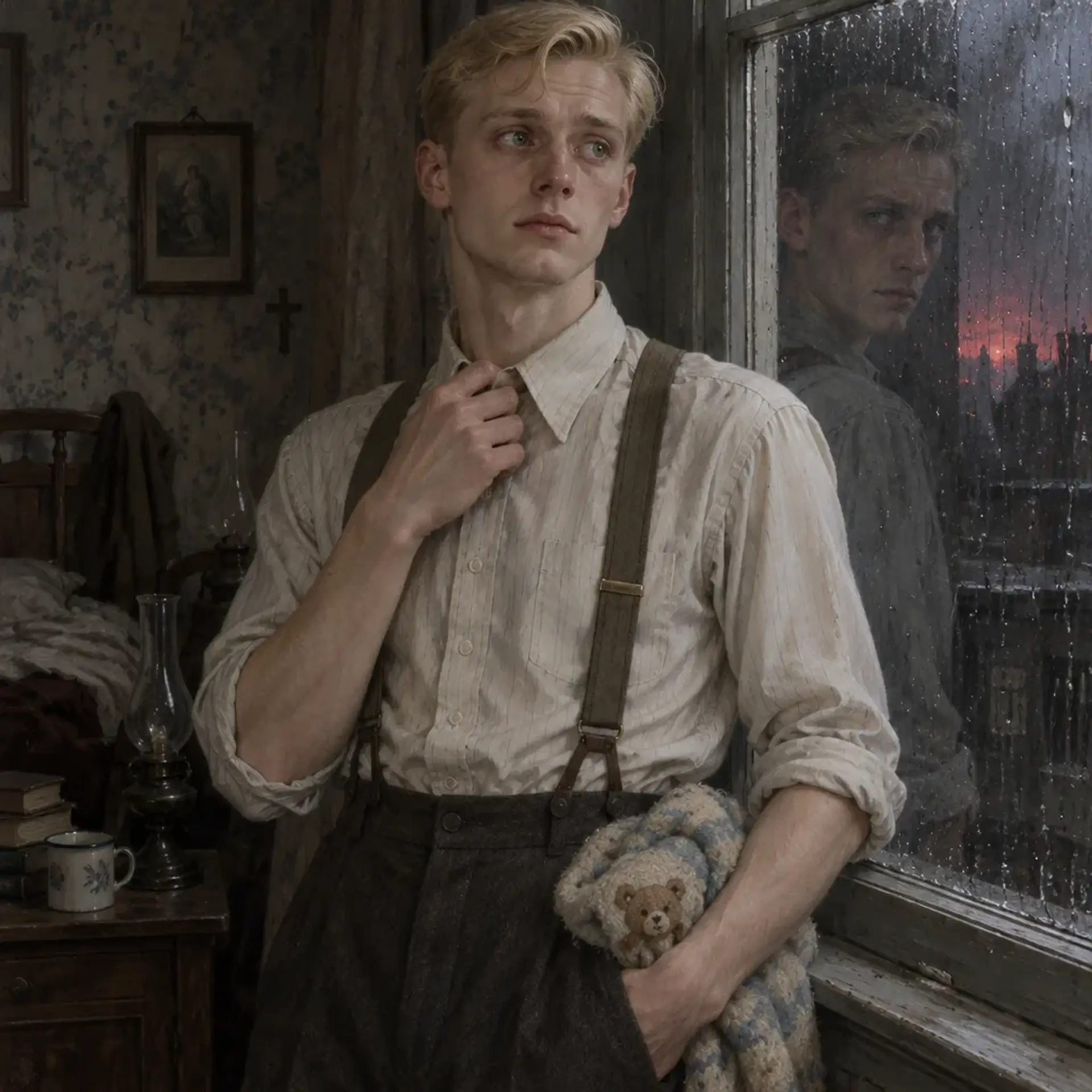
Kent appears to be a tall young man with a handsome, open face, short bright-blond hair, and malachite-green eyes. His likeness is not quite stable: in glass or water the eyes may seem older, and his expression can change a moment after the person he resembles has stopped moving. He carries himself with a stiff, self-conscious care, as if trying to look respectable in clothes that were never made for his shoulders. His grooming is deliberate and increasingly vain: he smooths his hair with wet fingers and worries at a collar until it sits correctly. His unexpected detail is an old, child-sized blanket, folded into a neat square and tucked into a pocket when he can manage it. The blanket is worn soft along one hem from repeated rubbing.
Clothing
Mary's practical, mended everyday clothes are often a poor fit for Kent's larger frame. Kent wants better-cut shirts, clean collars, and respectable trousers, and has begun collecting second-hand garments. If a shift catches him in Mary's clothing, seams pull at the shoulders and he becomes sharply self-conscious. He keeps a worn child's blanket folded away when he can.
Body language
Mary's old posture folds inward from habit, shoulders angled toward the nearest child or chore. Kent stands taller, keeps his elbows close, and arranges his clothes as if under inspection. When their impulses conflict, the body pauses mid-gesture: one hand reaches to comfort someone while the chin turns toward an exit.
- Height
- Mary is below average height; Kent is distinctly taller than Simon Bell.
- Build
- In Kent's aspect, tall and lithe with more strength and breadth than Mary; in Mary's, short, undernourished, and slight. The changes may arrive without warning, leaving clothes ill-fitting or strained.
- Eyes
- Mary: blue-grey. Kent: vivid malachite green.
- Hair
- Mary: dark blond. Kent: short, bright blond.
- Skin
- Light, with the signs of fatigue and insufficient food more visible in Mary's ordinary appearance.
- Age
- 18
- Gender
- Female in Mary's ordinary appearance; Kent presents as a young man. Their identity is in an unstable, increasingly blended state.
- Size
- Human-sized; Kent is taller and broader than Mary.
Distinguishing features
Personality
20 traits and drivesMary was not simply gentle or selfless. She could be patient with children and abruptly sharp with adults, especially when she saw someone making Matilda carry too much. She was naive about how badly people might treat her, yet perceptive about the small shifts that warned a younger sibling to leave the room. She wanted an education but had learned to treat wanting as indulgence. When tired, she became brisk and practical; when a child sought comfort, she softened almost against her will. She could be grateful for a small kindness and angry that it had to count as a rare event. Kent pulls in a different direction. He is shy in company but hungry for recognition; he wants to be thought respectable and can be snobbish about clothes, manners, and the disorder of the Bell household, though he has little right to judge it from outside. He is a homebody who enjoys tea, pictures, and familiar rooms, yet he takes over an outing if Mary has left him any room to do so. He dislikes being treated as a woman and resents feminine clothing and expectations, but he is not simply bold or traditionally masculine. He can be vain about his hair, easily embarrassed by attention, and surprisingly nervous around flirtation even while wanting to pursue women. He may want intimacy that Mary does not, and this conflict leaves both of them unsettled. Their moods do not divide cleanly. In a dangerous moment, Mary's protective habits can take over and Kent will put himself between a child and harm before he has formed an opinion. In a quiet hour, Kent's preferences can surface with irritating certainty: the tea is wrong, the coat is shabby, the afternoon should be spent at the pictures. Mary may agree with the cinema and hate the way he dismisses a sibling's request. Kent can feel affection for the children without having Mary's history of raising them, and sometimes mistakes her exhaustion for weakness. Mary, when she remains present, resents his freedom to want things while she has been trained to meet needs. The more Kent becomes himself, the less he behaves like an obedient reflection. He has begun to speak and react without waiting for Mary, and he is increasingly frustrated when confined to her body or clothing. He can be curious and almost boyishly delighted by a television or a motorcar, then defensive if anyone notices his wonder. He is not cruel by intention, but self-assertion is new enough to come out as stubbornness. He will change plans, seek a better shirt, or linger at a shop window, then feel guilty when the children are left waiting. Mary's deepest contradiction was that she loved her family and needed to escape them. Kent's is that he wants independence but is becoming attached to the domestic life he criticizes. Neither is wholly brave nor wholly cowardly. They can be resourceful when there is a clear task and evasive when the task is to explain themselves. They are capable of tenderness, vanity, resentment, curiosity, and fear in the same afternoon. By the time Mary became Kent on 30 May, those opposed traits had begun to coexist without a clear boundary between them.
- Alignment
- Not applicable as a canonical Secret Histories statistic; morally conflicted, protective in some moments and selfishly self-asserting in others.
Quirks
Habits
Traits · 5
Flaws · 5
Fears · 5
Wants and needs · 5
Combat
HP 0Avoids a fight. He uses doors, crowds, darkness, and reflective distractions to escape, and will put himself between danger and a younger child. Kent may act with pride when insulted, but is not a trained combatant. The actions listed are custom narrative features, not canonical Secret Histories combat rules.
Kent
Actions
Reactions
Services they sell
Rewards they can give
Equipment
- Worn blanket (personal keepsake)A folded child's blanket, softened by handling along one hem. It belongs to Oswald's comfort and has become a private talisman.
- Changing clothes (clothing)A few borrowed or second-hand clothes chosen by Kent for a respectable fit; the collection is incomplete.
- Missing heart (unresolved object)The crudely carved, barnacle-marked heart is no longer in Kent's possession. Its whereabouts are unknown.
Possessions
Background
The story of Kent begins with a stone that should have stayed lost. Bartholomew Golden, an amateur alchemist with more confidence than judgment, brought a crudely carved object to Hush House as payment for entry. It was shaped like an anatomical heart, its chalky surface crusted with barnacles and sea grass. Golden called it the Heart of England and claimed it could call laborers from the shadow of the land. The people at Brancrug were not impressed enough to let him return. The heart was thrown into the sea. It came back to shore looking no more important than a piece of Dover cliff. Salt water ran from its fissures. Black ooze clung to its underside. Beneath the pale rock, however, a muted red-pink glow had appeared, like blood or a lamp seen through closed eyelids. Abraham Groff, a young man travelling home to Wiltshire, found it and put it in his pocket. It beat against his coat after he boarded the train. He did not tell anyone that part at first. Abraham showed the object to neighbours. In company it seemed to die: no glow, no pulse, no sign of anything but carved stone. When he carried it alone to the Hampshire shore and let it touch seawater, the pink returned. Abraham decided it was his, not from greed so much as a growing conviction that the thing disliked strangers. In time his house filled with disturbances: footsteps on empty stairs, voices behind doors, doors opening without hands. He sold the heart to William Windon, a local seventeen-year-old who had once seen it. William had hidden it in a log and struck it with a hammer. It stopped beating. That silence was not an ending. Mary Bell grew up in Rochester, Kent, in a family that looked comfortably middle class from the street and felt neglected from the kitchen. She was the eldest of eight children and learned early that being the eldest meant noticing what was missing: a meal, a clean shirt, a younger child who had gone quiet. Her parents, Malinda and Simon, spent more energy hurting each other than tending the house. Simon took work far away when he could. Malinda drank and left Mary to keep the younger children fed, washed, and moving toward school. Mary tried to study in the gaps between chores. She was kind without being worldly, and tired enough to mistake endurance for a plan. Her siblings gave the house its daily weather. Henry, fourteen, was growing cunning and resentful, especially when Mary tried to protect the younger ones from their parents. Matilda, twelve, was Mary's sweetheart and ally, quick to help and too ready to take on work herself. Olympia, ten, was Chrissy's closest friend. Chrissy, nine, was bright-eyed and watchful, with a father whose identity was not known. Abigail, four, was red-haired and favored by Simon for resembling his grandmother. Jonas, five, was Simon's son by another relationship, and his presence sharpened old wounds. Belladonna, five, had a different unknown father. Oswald, two, followed Mary with his blanket, asking for comfort she could seldom afford to give for long. Mary's parents' treatment of the children was uneven and often cruel in its carelessness; the children learned to read a room before they learned to trust it. On Mary's eighteenth birthday, Malinda found a queer stone in a log and brought it home as a present. Mary was grateful because gratitude was easier than asking whether her mother had remembered the occasion soberly. She put the rough, heart-shaped thing aside. It was not jewelry, and she had no idea what it was. When it began to beat in time with her own heart, she thought it was a trick of exhaustion. Then came the reflection. In mirrors Mary saw a short-haired blond young man with green eyes and a handsome face where her own should be. At first she was repulsed. She had chores, a part-time job, and children following her through the house; she had no space for a haunting. She tried to ignore it. The image watched her when she was alone and looked away when she caught it doing so. The heart was no longer in her possession by then, but its disappearance made the strange presence more active, not less. The first night Mary woke in the young man's body after a bad dream. The room was unfamiliar in the bodily sense: different height, different weight, a deeper voice caught in her throat. Panic gave way to a practical question. Could she get out of the house? Before dawn she found she could. She slipped through the sleeping household and out into the Kent night, discovering that the change offered a brief escape from the work and scrutiny that bound her as Mary. She explored the streets, a beach, trees, abandoned buildings, and the edges of places she had never had time to visit. She did not think of it as a double life. It was a borrowed night. Her first return journey nearly exposed everything. Simon came home unexpectedly while she was out as Kent. Mary had to make her way back to Rochester and past the places where neighbours might recognize her. A passing car frightened her with its speed and closeness; then, at a distance, the same machine seemed marvellous, polished and purposeful. She kept to alleys and hedges, learning that Kent's taller frame could move quickly but could not make her invisible. On reaching home, she found Simon awake and the house lights on. She invented a clumsy explanation for being outside, using a name and voice she had not yet learned to make convincing. Simon questioned her about where she had been. Mary answered too sharply, then regretted it. His suspicion did not settle into proof, but for weeks afterward he watched the door more carefully. On another night, Malinda caught her trying to leave. Drunk and furious, Malinda saw a young man dressed in Mary's clothes and demanded to know who he was. Mary tried to explain, then tried to pass. Malinda grabbed the sleeve; the seam strained against Kent's broader shoulders. There was a moment when Mary could have pushed past. Instead she froze, seeing her mother not as an obstacle but as the person who could punish Matilda and the younger children in the morning. She let Malinda pull her inside. Malinda searched the house for an intruder and found no one. Mary slept little, listening to her mother mutter at the stairs. The episode taught her that every escape could leave a cost for someone else. At first Kent was mostly a reflection, a bodily mood and a cluster of impressions. He seemed shy and status-conscious, preferring respectable clothes, proper tea, and quiet rooms to the rough freedoms Mary had expected from an escape. Mary found this ridiculous, then unsettling. Kent was a homebody who wanted to be seen as a gentleman, but he also wanted to go out, meet women, and make plans without asking Mary. He disliked being kept in her body and disliked feminine clothes and expectations. His preferences were not Mary's. Sometimes she agreed with him; sometimes she found herself thinking in his turns of phrase before she noticed. The pub adventure made the difference impossible to dismiss. Mary, out as Kent, went in intending only to sit somewhere warm and hear people talk. She had not planned to drink. Kent steered her toward a table with a clean view of the door, corrected the way she held her cup, and asked for tea made to his exact preference. When a man made a crude remark about the young stranger's clothes, Mary wanted to leave. Kent wanted to answer with icy dignity. He did, and the man laughed. Kent's face reddened, but he did not retreat. He made a stiff, pointed remark about the man's manners, then asked the barman about the wireless and the pictures showing at the cinema. He was curious about new things, particularly a television set in the corner, yet startled when a car backfired outside. On the walk home he took the longer route so he could pass a shop window and inspect his reflection. Mary was embarrassed by his vanity and secretly pleased he had wanted something for himself. Henry saw Kent near the town and began watching. At first he recognized only a resemblance to Mary in the set of the shoulders. Later he saw the young man turn away from a window before Mary could have arrived there. Henry kept silent, not out of kindness alone but because he wanted to understand what leverage the secret might give him. Trudy, Mary's friend, noticed the exhaustion and the sudden shifts in Mary's plans. Trudy was a short, skinny young woman with dirty-blond hair, hazel eyes, and a self-declared rebel's collection of alternative clothes. Her family had little money; she had a working-class certainty that people like them had to make opportunities rather than wait for permission. She insisted that Mary should go to college and said she would go too. Trudy helped with the children when she could. One evening Trudy followed Mary to a shop window and saw Kent's reflection move after Mary had stopped. Mary tried to dismiss it. Trudy did not let her. She watched the reflected man turn his head and appear to look directly at her. Later, in a quiet place, Mary told Trudy enough to make the facts undeniable. Trudy was frightened, but she did not mock Mary. She asked what Kent wanted, then asked what Mary wanted. Mary had no answer ready. Trudy's knowledge made the secret safer and more dangerous at once: Mary had an ally, but someone else could now be threatened by whatever had begun. The changes became less predictable. They happened at night and, increasingly, during the day. Kent began to speak without Mary lending him her mouth, although few people could hear him. He appeared in windows and water, and he had opinions about Mary's family. He disliked Simon's absences and Malinda's drinking, but his judgments were not Mary's: he could be contemptuous where she felt pity, and protective where she felt exhausted. He became fascinated by televisions, shop displays, and cars, watching them with frank wonder until a car came too close. Bathing became difficult because the water reflected him. Mary tried to ignore his scrutiny and he began to insist on how the tea should be made, which route to take, and what they should do with a free afternoon. A stranger arrived at the shoreline: a woman who looked like a drowned ghost, with straw-like blond hair and eyes so dark they seemed nearly black. She came only at night, independent of the people searching for the blond young man with green eyes. She called for Kent and claimed to be his sister. She said she would bring the others. Mary did not know whether to believe her. Kent reacted with a recognition he could not explain and a fear he tried to hide behind irritation. Neither Mary nor Kent knew what the other group wanted, or whether the woman meant rescue, kinship, or possession. Four months after the heart vanished from their lives, Mary began to lose details. Small ones first: which child had said a particular thing, the exact face of an old neighbour, the sound of her own name called from another room. Kent's habits entered hers. She started to care whether a collar sat straight, then found the preference had no clear owner. Her siblings noticed she seemed changed. Henry watched closely. Trudy tried to keep Mary's memories anchored in ordinary things: school plans, shared errands, stories from the children. On 30 May the distinction gave way. The day began with ordinary demands and a household already short of patience. Mary meant to get through her work, check on the children, and speak with Trudy about college. By afternoon she was correcting tea, resenting a blouse, and thinking of herself as Kent without recognizing the thought as an intrusion. Her reflection no longer waited for her to look away. It occupied the glass with the same immediacy as the person standing in front of it. Mary could still remember the kitchen, the children, the birthdays, and the work, but the memories had begun to arrange themselves around Kent's sense of self. When Matilda called her Mary, she turned, then hesitated as if the name belonged to a person in the next room. That evening, on 30 May, there was no clean moment of possession or dramatic collapse. There were chores unfinished, a cup left beside the sink, and a family asking questions. Mary tried to answer and found that the answer had become Kent's. Her old name went missing from the place where a name is known before it is spoken. By the end of the day, the family could see the young man they had never met standing where Mary had stood. He remembered Mary's life, though some of the memories felt like inherited photographs. The person left was Kent, with Mary's childhood and obligations threaded through him. The household still needed supper. The children still needed someone to notice them. The heart remained missing, the sea-woman still called, and strangers still sought the blond young man. Kent had become more alive, but not more certain of what that meant.
Role in the story
A vulnerable, shifting protagonist and potential ally whose family obligations, changing identity, missing heart, and pursuit by unknown people can draw the party into domestic mysteries and uncanny investigations.
“Bartholomew Golden, an amateur alchemist with more confidence than judgment, brought a crudely carved object to Hush House as payment for entry.”
- Faction
- No confirmed faction. The heart's previous connection to Hush House and the unknown searchers are unresolved; do not assume any formal membership.
Known connections
Media
0 imagesNo images yet.
Turn Kent into a sheet
A high-res, share-ready sheet you can post or print.