Oskar Bialy
Oskar Bialy
At the table
Voice
A young man's voice with a newly low, slightly rough edge, as if his throat has not yet learned its own size. It carries the clipped clarity of northern Swedish speech and occasional breathy catches when he is tired or startled. Years of explaining images make him articulate, but sudden laughter can crack into an unguarded snort.
Oskar speaks with local northern Swedish phrasing and a direct, conversational rhythm. His vocabulary still has the precision of someone accustomed to describing images, but his sentences sometimes snag as he adjusts to a lower voice and unfamiliar resonance. He jokes to fill awkward silences, then becomes careful and concrete when discussing boundaries or family. He does not sound like an old giant; he sounds like a young man trying to make a strange day understandable.
Speech patterns
How to play them
Treat Oskar as a capable, unsettled adult rather than as a spectacle. He responds well to sincere questions about his drawings and past, but do not make his changed body the punchline. If romance comes up, he will be frank about wanting not to pressure his friend and may need reassurance that restraint is a choice, not cowardice.
Goal
Help Seven at the Warning Roof survive, understand the physical arrival of myth, and discover whether there is any path to his former family without sacrificing the friendships he has now.
Motivation
To make meaning from a world where the stories he loved have become tangible, while keeping his grief and new feelings from making decisions for other people.
Appearance
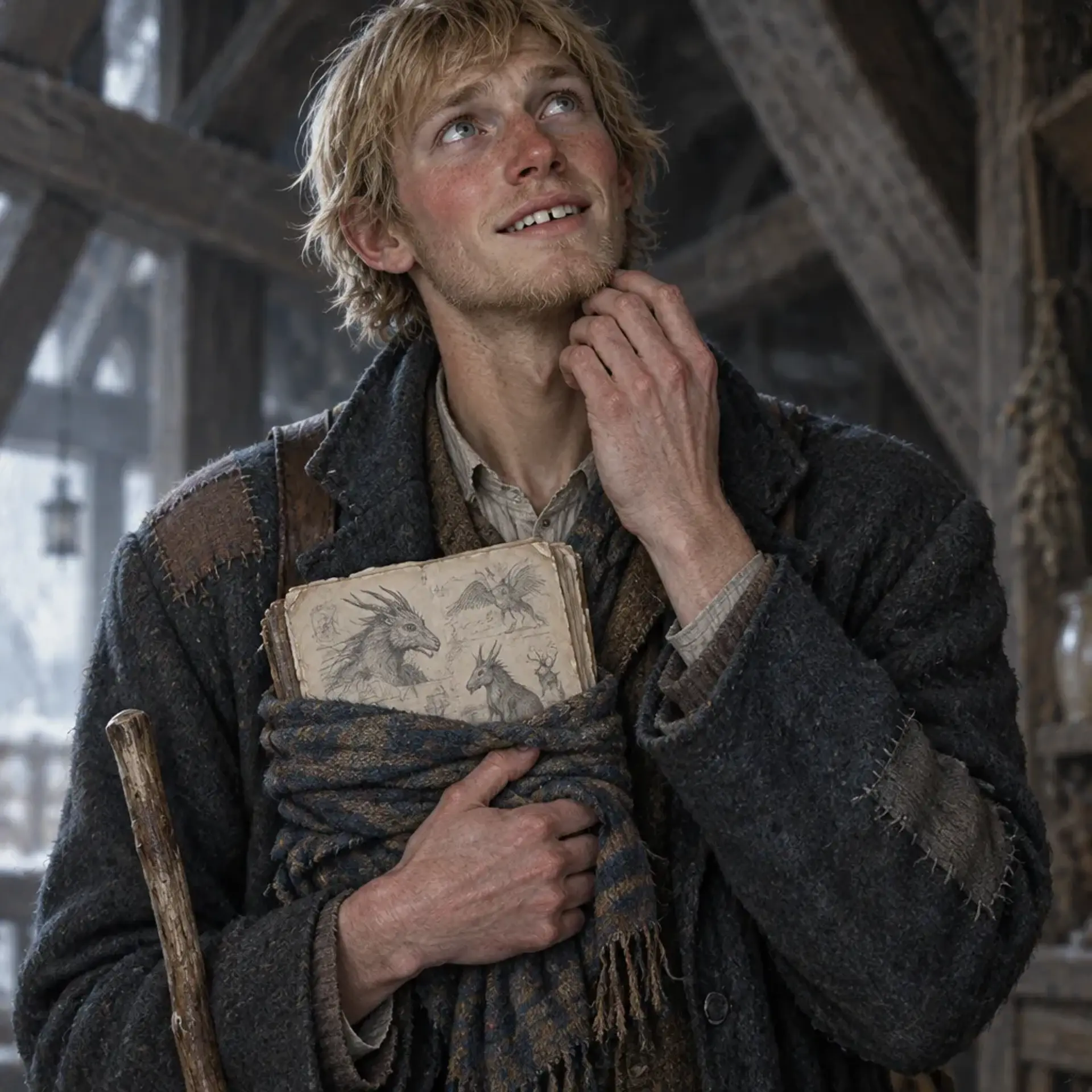
A newly grown Swedish young man, tall enough to keep misjudging doorways, with pale skin that reddens quickly in wind and a blunt, expressive jaw. His eyes keep measuring the room's rafters, exits, and distances as if he were sketching a scene for a folktale. He has an unexpectedly broad, delighted grin that shows a small gap between his front teeth; when nervous, he chews slowly and watches people's faces for signs they are laughing with him rather than at him. His sandy hair grows unevenly around his ears, and fine blond stubble darkens his jaw. He moves with a careful, slightly overlong stride, then sometimes startles himself by lifting or hauling something far heavier than he intended. He leaves an impression of a thoughtful illustrator who has wandered out of a giant's story and is still learning how much space he takes up.
Clothing
A borrowed wool coat, patched trousers, thick socks, and boots that still feel too small despite being new. He keeps a scarf wrapped around his sketchbook rather than his neck, and wears a belt adjusted repeatedly as his body changes.
Body language
His gaze travels to ceilings and doorframes before settling on faces. He holds his shoulders slightly inward to make himself seem smaller, but his long arms keep knocking objects out of place. When embarrassed, he rubs the back of his neck and presses his jaw shut; when genuinely amused, his whole face opens into that toothy grin.
- Height
- About 188 cm (6 ft 2 in), a height he still misjudges in cramped rooms.
- Build
- Long-limbed and newly broad through the shoulders, with strength that arrives in startling, uneven bursts rather than practiced control.
- Eyes
- Grey-blue
- Hair
- Sandy blond, growing in unevenly around the ears with fine blond stubble along his jaw.
- Skin
- Fair, with a wind-reddened nose and cheeks and a few pale freckles across the bridge of his nose.
- Age
- Appears to be eighteen; remembers a former life as an adult.
- Gender
- Man; formerly lived as a woman and remembers that life.
- Size
- Medium
Distinguishing features
Personality
16 traits and drivesImaginative and sensitive, Oskar can make strangers laugh with a sharp observation, yet is easily wounded when the group turns his unfamiliar body into a joke. Around danger he becomes curious and attentive, almost thrilled by the sight of myth made real; afterward, alone, the same wonder can curdle into fear. He is learning to inhabit a body that brings stronger appetite, desire, and anger than he expects. He does not pretend those impulses are harmless, and works to keep them from becoming someone else's responsibility.
- Alignment
- Neutral good
Quirks
Habits
Traits · 4
Flaws · 4
Fears · 4
Wants and needs · 4
Combat
AC 10 · HP 7 · 30 ft.Avoids fights when possible and uses positioning, cover, and a walking stick rather than seeking to hurt anyone. If a companion is in immediate danger, he may attempt one astonishing feat of strength, then withdraw while the resulting pain catches up with him. He is inexperienced and should not be treated as a trained combatant.
Oskar Bialy
Actions
Reactions
Services they sell
Rewards they can give
Equipment
- Walking stick (weapon)A plain walking stick, useful for travel and an untrained, improvised defense.
- Sketchbook (tool)A small, battered book of blank and partly used pages for sketches, notes, and remembered stories.
- Travel clothes (clothing)A patched wool coat and sturdy boots, both borrowed or scavenged by the fellowship.
Possessions
Background
Before the world began to resemble the stories he used to draw, Oskar Bialy made pictures for a living. He worked freelance, taking commissions that paid the rent and leaving the rest of his hours to the subjects he loved: old gods, impossible beasts, folktale heroes, and the strange corners where one world touched another. He kept books of mythology and folklore within reach of his desk. Their pages smelled of paper, dust, and ink, a familiar scent he can still summon with painful clarity. His home had its own quiet rhythms. Oskar had a husband and children, and his days were shaped by small routines: meals, errands, conversations, the ordinary negotiations of family life. He remembers them not as a distant dream but as people whose voices and habits remain sharp in his mind. He does not know whether they survived the upheaval, where they might be, or whether the world that held their household still exists in any recognizable form. That uncertainty follows him even when he is busy. It is part of why he keeps recording what the fellowship sees. A record is not a rescue, but it is something he can make with his hands. The change came amid the upheaval that brought myth into the physical world. Oskar woke to find himself in the body of an eighteen-year-old Swedish man. He was not the only one in the fellowship to undergo such a transformation. Another former woman changed as well, while their closest companion remained the group's only woman. In the confusion, the three of them shared a room, cold and drunk and unaware that their bodies had changed. There was no grand revelation, only the bewilderment of waking in a body that seemed to belong to someone else, then the slow, practical work of understanding what had happened. The new body made itself known in details Oskar could not ignore. He was taller, stronger, and hairier than he had ever been. Hunger arrived with a force he had not expected, as did desire and anger. These feelings could rise before he had found a name for them, which unsettled him more than their mere presence. He does not believe that unfamiliar impulses excuse careless behavior. When he feels anger gathering, he tries to step back before it spills onto anyone nearby. When desire enters a friendship, he tries to treat it as his own matter to handle rather than a debt another person must repay. That care matters most around the woman who shared those first bewildered days with him. Oskar has begun to feel a crush on her, a discovery that brings more embarrassment than hope. They were close before, but their closeness was never romantic, and he does not want to rewrite it simply because his body and feelings have changed. He is careful with boundaries, sometimes so careful that he becomes awkward. He would rather carry the discomfort privately than make her responsible for soothing it. The old ease between them still matters to him, and he hopes to protect it without pretending nothing inside him has shifted. His body carries another mystery. Oskar has a Jotun fae inheritance, though he is still trying to understand what that means. Cold sits strangely lightly on him. At times, he can endure weather that leaves others shivering, and he finds himself alert where he ought to be miserable. His dreams are more unsettling. In them, he stands among mountains that seem small enough to lift or push aside, as if the landscape were a collection of toys laid out for his inspection. He wakes with the impression of enormous scale and a faint, lingering dread. The dreams feel less like stories he once illustrated and more like some part of himself trying to speak in a language he does not know. The first time his strength broke through, a fallen beam had trapped a companion. Oskar moved it. For a brief moment, the task seemed almost simple. Then it was over, and the shaking began. He spent the next day sore and exhausted, unable to pretend that the feat had cost him nothing. He remembers the fear on the trapped person's face, the impossible weight beneath his hands, and the thrill of discovering that his body could do what he had not thought possible. The thrill was real. So was the fear that came after. That mixture of wonder and unease is familiar whenever myth appears before him in the flesh. Oskar once drew creatures he could only know through books, imagination, and argument. Now beings and forces from the old stories move through a world that is no longer willing to keep them on the page. Around danger, he becomes intent and curious. He watches closely, looking for patterns, details, and anything that might help the fellowship survive. It can feel like witnessing a story come alive. Later, when he is alone, the same wonder can curdle into fear. The resemblance between folklore and his own bloodline is difficult to dismiss. If the stories were right about some things, what else might they be right about? Oskar belongs to Seven at the Warning Roof, a displaced fellowship trying to endure a world transformed beyond recognition. He helps them observe, remember, and make sense of what they encounter. His old skills still matter: a quick sketch can preserve a feature that words miss, and his eye for composition can make a chaotic scene legible. He is learning that drawing the impossible is different from standing near it, but he keeps drawing anyway. Each mark is an attempt to understand, and perhaps to leave evidence for someone who comes after. For now, he has no route back to his family and no proof that they are alive. He carries them in memory while he learns the limits of a body that feels both powerful and unfamiliar. He tries to be useful without letting fascination make him reckless, and to be honest about his impulses without making them anyone else's burden. The world has become one of the tales he used to illustrate. Oskar is still deciding whether that makes him fortunate, cursed, or simply very far from home.
Role in the story
A displaced survivor, lore interpreter, and emotionally grounded witness to the world's transformation. Oskar can help the party recognize patterns in mythic threats, but his memories and uncertain Jotun heritage make him a person to protect and consult, not merely an exposition source.
“He kept books of mythology and folklore within reach of his desk.”
- Faction
- Seven at the Warning Roof, a displaced survival fellowship.
Known connections
Media
0 imagesNo images yet.
Turn Oskar Bialy into a sheet
A high-res, share-ready sheet you can post or print.