Eber Waldner
Eber Waldner
At the table
Voice
Eber's voice has a faint rasp from years of breathing workshop dust and damp island air. It carries a dry, measured clarity, with a slight catch when he speaks after eating. He does not raise his voice to sound imposing; instead, he articulates with the clipped precision of someone accustomed to giving careful instructions over the clatter of tools.
He speaks with the careful economy of someone used to explaining measurements and the evasions of someone tired of being examined. His words are clever, exact, and sometimes unexpectedly dry. Around family his phrasing loosens and gains teasing warmth; with strangers he chooses each word as if setting a small gear in place.
Speech patterns
How to play them
Treat Eber as a capable young craftsperson rather than a medical curiosity. Ask before examining his scales, teeth, or tail, and do not make his meals a spectacle. He warms to people who respect practical boundaries, notice his inventions, or help his family without expecting gratitude as payment. If pressed about his body or his family, he deflects first and speaks honestly only after trust has been earned.
Goal
Develop affordable tools and household fittings that let high-blood Marshwake eat, sleep, dress, and work comfortably without surrendering their privacy to outsiders.
Motivation
To make a useful place for himself in his family and community without pretending that his body, appetite, or needs are the same as theirs.
Appearance
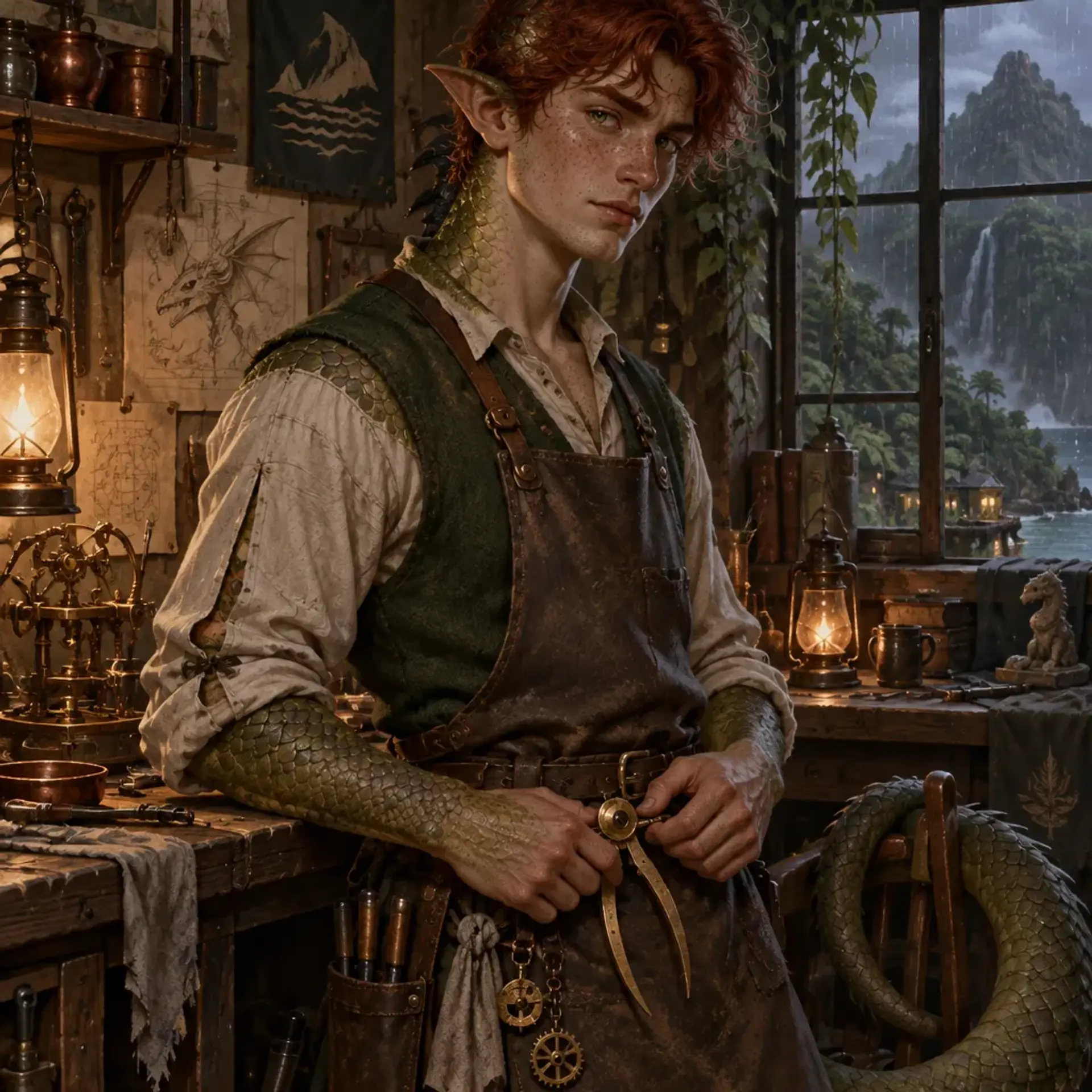
Eber is a young man built too large for the halfling rooms he grew up in: five feet ten inches, long-limbed, and strong through the shoulders from carrying timber and iron in the family workshop. Olive-green scales lie in irregular, flexible patches over fair, freckled skin, paling around his throat and deepening to bottle green along his spine and tail. His red hair is thick, wind-tossed, and often caught beneath a work cap. His sharply tapered ears and green-dragon eyes give his otherwise familiar freckles an unsettling contrast. His long tail moves independently of his posture, testing the air or curling protectively around a chair leg. His teeth are sound but narrow and pointed, made for gripping rather than chewing. He smells distinctly of wet cedar, machine oil, and the smooth stones he keeps in a little pouch; he knows the oil smell, but not how strongly the stones' mineral dampness clings to him. Rain has roughened his knuckles and forearms, and fine scratches from wire and wood dust stipple his scales. He moves with a careful, watchful balance, as if every room might have a low beam. The unexpected detail is that he keeps a pocket-sized book of pressed flowers and sketches each one with patient precision, despite his practical, tool-stained appearance.
Clothing
Practical craftsman's clothes with strong German-inspired workwear elements: a short wool jacket, linen shirt, broad leather belt, reinforced trousers, and thick-soled boots. His sleeves are altered to clear his scales and his waistcoat has a slit and tie for his tail. Most pieces are patched or adapted from older family clothes.
Body language
Eber stands with one shoulder slightly turned, making himself narrower than he is. His eyes track movement before his head does, and his tail gives away what his face conceals: it flicks when he is irritated and curls around a chair leg when he feels safe. When embarrassed, he busies his hands with a tool or smooth stone. He rarely reaches for anyone first, but stays close when a relative is distressed.
- Height
- 5 feet 10 inches
- Build
- Tall for his family, long-limbed and sturdy through the shoulders, with a flexible, muscular tail.
- Eyes
- Bright green with a narrow, draconic focus
- Hair
- Red
- Skin
- Fair skin with freckles, overlaid by irregular olive-green scales
- Age
- 19
- Gender
- Male
- Size
- Medium
Distinguishing features
Personality
16 traits and drivesEber is caught between wanting to be treated as ordinary and wanting people to recognize that his needs are not ordinary. He dislikes being stared at, yet sometimes uses his unnerving eyes and polished words to make a curious stranger feel watched in return. He misses the casual closeness of his parents' halfling-sized household, but bristles when they fuss over him as if he were still a child. Around his siblings he is more playful and lets dry humor show; with strangers he is controlled, observant, and inclined to answer questions with a question of his own. He is clever without being effortlessly wise. He can see three ways to repair a hinge and miss the obvious reason a brother is upset. When he is calm, he is patient with mechanisms, careful about measurements, and unexpectedly attentive to small things, such as a flower pressed flat in a book. When anxious, he counts exits, sorts objects by size, and reaches for his pouch of stones. When angry, his voice gains a hard, cutting precision; he does not become soft or gentle, but chooses exactly which truth will sting. He is not eager to threaten anyone, and afterward he often regrets how naturally intimidation comes to him. Eber's love of shiny objects is both a new draconic appetite and a simple craftsperson's delight in a well-polished surface. He rationalizes every little treasure as a useful component, though some are plainly just beautiful. He wants to be generous, but has learned to protect his scarce time and food. He can seem aloof because he is wary of being pitied, not because he lacks affection. He is most at ease when working alongside someone without being asked to explain himself. His central contradiction is that he longs for a place in the family exactly as he is, while quietly resenting how much of his life has to be redesigned around that fact.
- Alignment
- Neutral Good
Quirks
Habits
Traits · 4
Flaws · 4
Fears · 4
Wants and needs · 4
Combat
AC 17 · HP 17 · 30 ft.Eber prefers cover, distance, and a clear retreat route. He uses Faerie Fire to expose hidden threats or Grease to spoil a pursuer's footing, then fires his crossbow from behind sturdier allies. He uses his shield and rapier only if cornered, and his draconic presence is a last resort to create space rather than dominate a foe. He protects relatives instinctively, sometimes placing himself between them and danger before he has a plan.
Eber Waldner
Spells
Actions
Reactions
Services they sell
Rewards they can give
Equipment
- Reinforced craftsman's coat and shield (armor)A practical protective coat reinforced with leather panels; treated as a breastplate for statistics, with a small shield.
- Rapier (weapon)A plain, well-maintained blade he keeps sheathed unless there is no safer option.
- Light crossbow and 20 bolts (weapon)A compact crossbow with a padded stock and a case of bolts.
- Tinker's tools (tools)Small files, pliers, awls, wire, chalk, and a folding clamp for delicate repair work.
- Gizzard stones (personal)A cloth pouch of smooth, carefully chosen stones used to aid his painful digestion.
Possessions
Background
Eber Waldner was born the eighth child of Trogi and Wilma Waldner, into a family whose workshop sat beside the muddy lane that led down to the island's fishing stream. The Waldners were stout-halfling descendants, and their house had been built for compact bodies: low doors, narrow beds, close benches, and a kitchen where a family could eat elbow to elbow. Eber learned early that being the youngest meant being handed tools only after every older sibling had shown him how not to lose a finger. He liked the workshop's regular sounds: Trogi's rasp, the ticking watches Kasper repaired, Karl's gears clicking into place, and the cluck of Wilma's chickens just beyond the back door. His childhood was ordinary by Marshwake standards, which is to say it carried a quiet uncertainty. The island people were descendants of castaways who survived a dragon-haunted wilderness by accepting the blood of a wounded green dragon. Some families retained mostly halfling traits; others changed more dramatically as they grew. Eber watched the older generations treat this inheritance as both survival and debt. He heard different explanations at different tables: a blessing, a hazard, a history that should not be poked. His parents did not pretend there were easy answers. They made sure the children ate, mended what they could, and kept the shop open. At adolescence, Eber's body changed with a speed that frightened him. His height surged; scales spread across his skin; his ears sharpened, his eyes turned draconic, and a tail grew long enough to knock over a stool. His mouth changed most painfully. His teeth remained strong but no longer met in a way that let him chew. At first he tried to eat as before, then choked and retched in front of his siblings. The first healer who examined him could offer little beyond a cautious explanation: his body seemed to be developing the green dragon's strange reliance on swallowed stones to grind food in a second stomach. The stones helped, but the sensation was harsh, and the adaptation made every meal a reminder that he was no longer built like his family. Wilma took to cutting his food into tiny pieces and making broth, though she could not bear the sight of him struggling. Trogi built him a higher bed and widened a doorway, muttering that it was temporary even as he measured every frame in the house. The family had no spare rooms. Eber and his high-blood brothers sometimes slept in the dining room or kitchen, where the rafters smelled of smoke and the floorboards remembered every footstep. There was not enough cloth for well-fitted clothes, not enough food to make the larger appetites easy, and no simple way to make the old house feel like it belonged to them all. His siblings became his first uneasy teachers in how to live in a changing body. Windle, the oldest, kept his worries quiet and practical. He already had two young children and feared they might inherit the high-blood changes. Karl made Eber small mechanical toys and never asked him to discuss his teeth unless Eber brought it up. Yonda, the only sister, loved him warmly and repeatedly urged him to visit her friends, even when company made him feel like a curiosity. Alder invited him into town but was often distracted by merriment. Kasper treated the problem as a repair challenge, asking what tools or habits might make daily life easier. Rodrick, the older high-blood brother, teased Eber about his eating and called it honesty; the teasing stopped when Eber's anger became too sharp to dismiss. Ignatz, closest to him in age and temperament, stayed near during the worst of the changes, though he was plainly frightened too. The event that altered Eber's understanding of his family came on a wet evening in the workshop. Ignatz, then struggling with new claws and hunting instincts, had killed a chicken with his bare hands. Eber found him crouched beside the coop, horrified at what he had done. Rather than call for their parents, Eber sat with him in the mud and helped clean the blood from his hands. Ignatz had once been confident he would be the best of the high-blood brothers; after that night he became ashamed of his own strength and stayed close to the workshop. Eber realized that fear did not always make a person cruel. Sometimes it made them hide, and sometimes the kindest thing was simply to stay beside them. That realization did not make Eber comfortable in his own skin. He resents how naturally his parents reach for each other and how their warmth can seem to surround him without quite including him. He misses sharing their meals, their beds, and their easy halfling-sized home. He envies his low-blood siblings their familiar shapes, then feels ashamed of the envy. His new aloofness is partly self-protection: if people are going to stare, he would rather make them work to understand him. Cleverness became his shield. He learned to answer intrusive questions with polished little turns of phrase that give away nothing. The workshop became a place where his changing body could be useful. Eber learned to sort tiny springs by touch, make fittings for larger hands, and devise clamps that let him hold a piece of work without crushing it. He gravitated toward craft not because he was naturally patient in every part of life, but because tools offered honest problems. A gear either meshed or did not. He began studying simple magical mechanisms and learned enough artificer work to make small useful enchantments. His curiosity is strongest when he can take something apart, though he is trying to ask before doing so. The family still argues about what comes next. Windle is expected to inherit the workshop, but there is little room to expand it. Rodrick wants work outside the family business and boasts about his sorcery. Ignatz is afraid that his instincts will return. Trogi says he wants to retire, then arrives before dawn to open the shop. Wilma tends the garden and chickens, and still goes fishing with Trogi when they can spare an afternoon. They are grateful for their children and grandchildren, but the high-blood generation's needs make every winter provision a difficult calculation. Eber's attention has also been drawn by healers who want to study his unusual digestion. Some offer careful help; others see a curiosity whose consent is an inconvenience. He has not decided whether understanding his body is worth letting strangers inspect it. He keeps a small collection of polished stones and bright scraps of metal, partly because the dragon-blood in him delights in shine and partly because stones are now a daily necessity. He dislikes how easily those motives blur together. Now Eber is a level-two artificer, still part of the family workshop but increasingly determined to make useful things for high-blood bodies: sturdy beds, adjustable clothes fasteners, safe eating tools, and equipment that does not assume everyone is halfling-small. He wants those inventions to help his family before outsiders turn them into proof that the Marshwake are becoming something other than a people. He loves the Waldners, though their affection can feel like shelter built for someone else. He is learning that belonging may need to be rebuilt, much like a house, with measurements that fit the people who actually live there.
Role in the story
A young craftsperson trying to make daily life safer and more dignified for the changing high-blood generation. Eber can offer practical repairs, a window into Marshwake family tensions, and a personal stake in stories about dragon inheritance, healers, and the island's future.
“Eber learned early that being the youngest meant being handed tools only after every older sibling had shown him how not to lose a finger.”
- Faction
- The Waldner family and its workshop; part of the Marshwake community, without formal allegiance to a political faction.
Known connections
Media
0 imagesNo images yet.
Turn Eber Waldner into a sheet
A high-res, share-ready sheet you can post or print.