Alice
Alice
At the table
Voice
Her voice has a dry, warm rasp from smoke, steam, and long days of talking over household noise. It carries clearly without sounding grand. When she is frightened, her breath becomes briefly shallow and creates a faint catch at the end of a phrase; when she is angry, the breath steadies and the words turn brisk and exact.
She speaks in a practical, measured rhythm, shaped by years of calling over boiling kettles and giving instructions in cramped rooms. Her consonants are crisp, her vowels plain, and her sentences often begin with a question that can be answered immediately. When rattled, her breath catches audibly before she forces it steady; she does not lower her voice when angry, but clips each word as if setting tools in a row.
Speech patterns
How to play them
Alice responds best to directness and useful questions. Show that you can respect grief without turning it into a spectacle, and she will offer food, local knowledge, or quiet practical aid. Do not press her to promise outcomes she cannot control.
Goal
Persuade Oswin to open the chest containing Rose and Edward's keepsakes and speak about them without treating their memory as a danger to Alice.
Motivation
To make care tangible and keep grief from becoming a family inheritance of silence.
Appearance
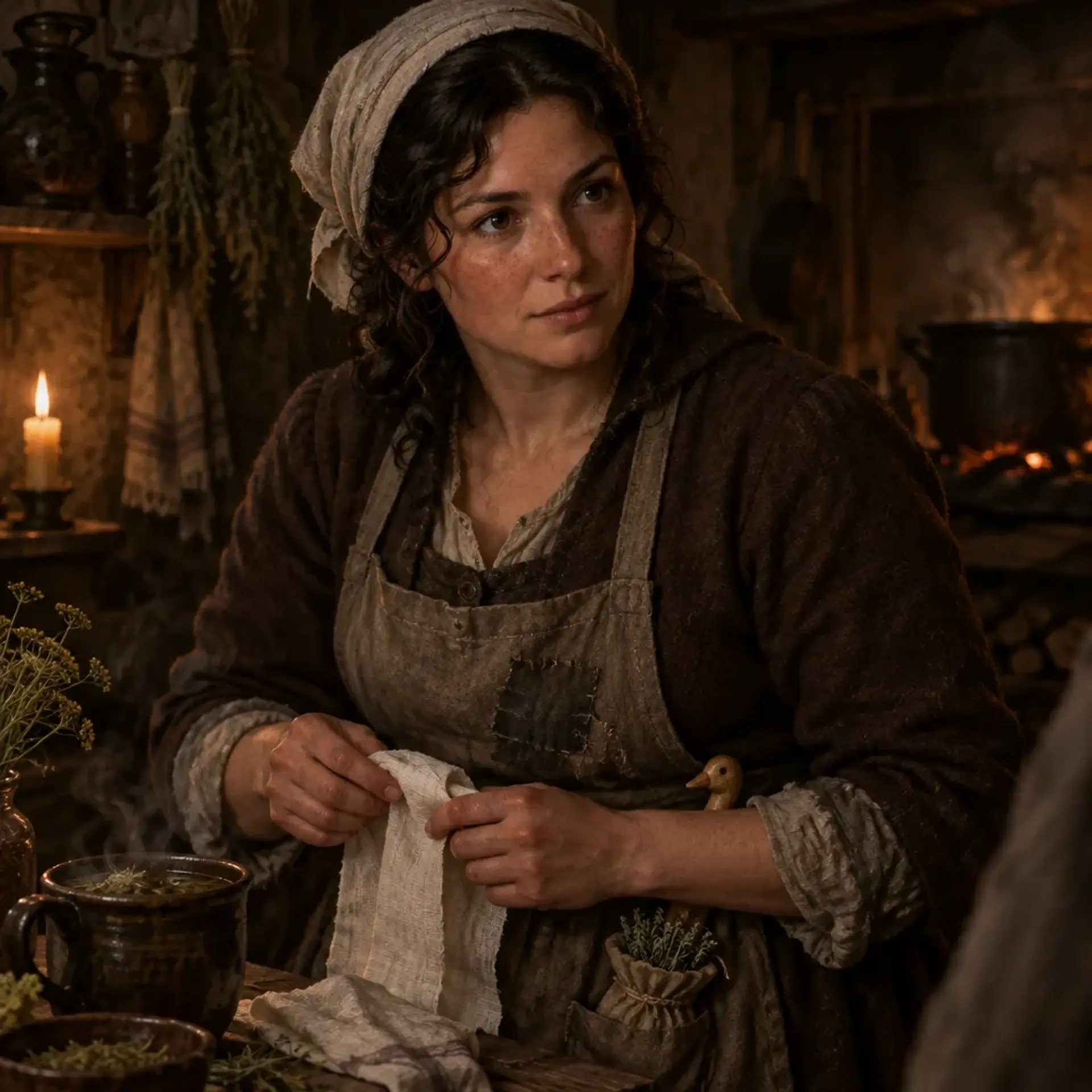
Alice has a pale, freckle-dusted face and a practical, watchful expression that can soften suddenly when someone is frightened. Her dark hair is pinned under a folded linen scarf, but fine curls escape at her temples when the air is damp. She walks with a steady, heel-first tread learned from carrying hot water without spilling it. A minute in her company reveals the warm smell of fennel, soap, and woodsmoke clinging to her sleeves; she knows about the soap and believes the fennel is simply part of the house. Unexpectedly for a keeper of a somber household, she collects silly wooden whistles and can make them sound like a flock of geese.
Clothing
A soot-brown wool dress, patched apron, linen scarf, and sturdy boots. Her cuffs are often damp from washing and her apron pockets hold a twist of clean cloth, fennel seeds, and a whistle.
Body language
Alice keeps her shoulders squared and her hands occupied, folding cloth or sorting herbs while she listens. When rattled, she draws one shallow breath, then deliberately releases it through her nose before speaking. If someone is in pain, her stance turns toward them at once, even when she is arguing with them.
- Height
- 5 ft. 2 in.
- Build
- Compact and sturdy from carrying water, laundry, and baskets of herbs.
- Eyes
- Warm brown
- Hair
- Dark brown, nearly black
- Skin
- Fair, with freckles across her nose and cheeks
- Age
- 29
- Gender
- Woman
- Size
- Medium
Distinguishing features
Personality
12 traits and drivesAlice is candid about practical matters but evasive about her own grief. With strangers she is brisk and helpful, sometimes using humor to keep people at ease; with family she can become stubborn, especially when she thinks silence is doing harm. In a crisis she is steady and focused, but afterward she may shake with delayed fear and refuse to admit she needs rest.
- Alignment
- Neutral good
Quirks
Habits
Traits · 3
Flaws · 3
Fears · 3
Wants and needs · 3
Combat
AC 10 · HP 4 · 30 ft.Alice is a level 0 civilian, not a trained combatant. She tries to get between danger and an injured person only long enough to guide them toward an exit, call for help, or use the room's furniture as cover. She flees rather than pursue.
Alice
Actions
Reactions
Services they sell
Rewards they can give
Equipment
- Wooden pestle (tool)A worn kitchen pestle, more useful for grinding herbs than fighting.
- Linen cloths (medical supplies)Clean folded squares for bandaging or wiping a fevered brow.
- Herb pouch (supplies)A small pouch of fennel, mint, and dried chamomile, used for ordinary household remedies.
- Goose whistle (keepsake)A small wooden whistle carved into the shape of a goose.
Possessions
Background
Alice is the surviving daughter of Oswin Hirst and the sister Rose and Edward never got to meet for long. Rose died before her first winter; Edward was born sickly, with reddish eyes, and lived only a few days. Alice arrived years later, after the family had nearly stopped preparing a cradle. Her mother kept the old children's names spoken aloud, but Oswin could not bear to hear them. As a child, Alice learned to read the pauses at the dinner table as carefully as other children read books. At seventeen, she assisted a village midwife through a difficult birth that ended in loss. The experience changed her: she stopped believing that kindness alone could prevent grief, and began learning practical care instead. Now she tends the Hirst household, carries remedies to neighbors, and quietly tries to reconcile her father's protective silence with her mother's insistence that the lost children remain part of the family. Oswin is her closest relationship and her most persistent conflict. He wants her to leave the old house behind; Alice fears that leaving would turn Rose and Edward into secrets rather than family.
Role in the story
A grounded connection to Oswin Hirst and the lost children Alice, Rose, and Edward. Alice can give the party access to the Hirst household, reveal the emotional cost of its silences, or become a quiet ally who offers care without pretending to be a hero.
“Rose died before her first winter; Edward was born sickly, with reddish eyes, and lived only a few days.”
- Faction
- No formal faction. She is known among the households that rely on the village midwife and her practical help.
Known connections
Media
0 imagesNo images yet.
Turn Alice into a sheet
A high-res, share-ready sheet you can post or print.