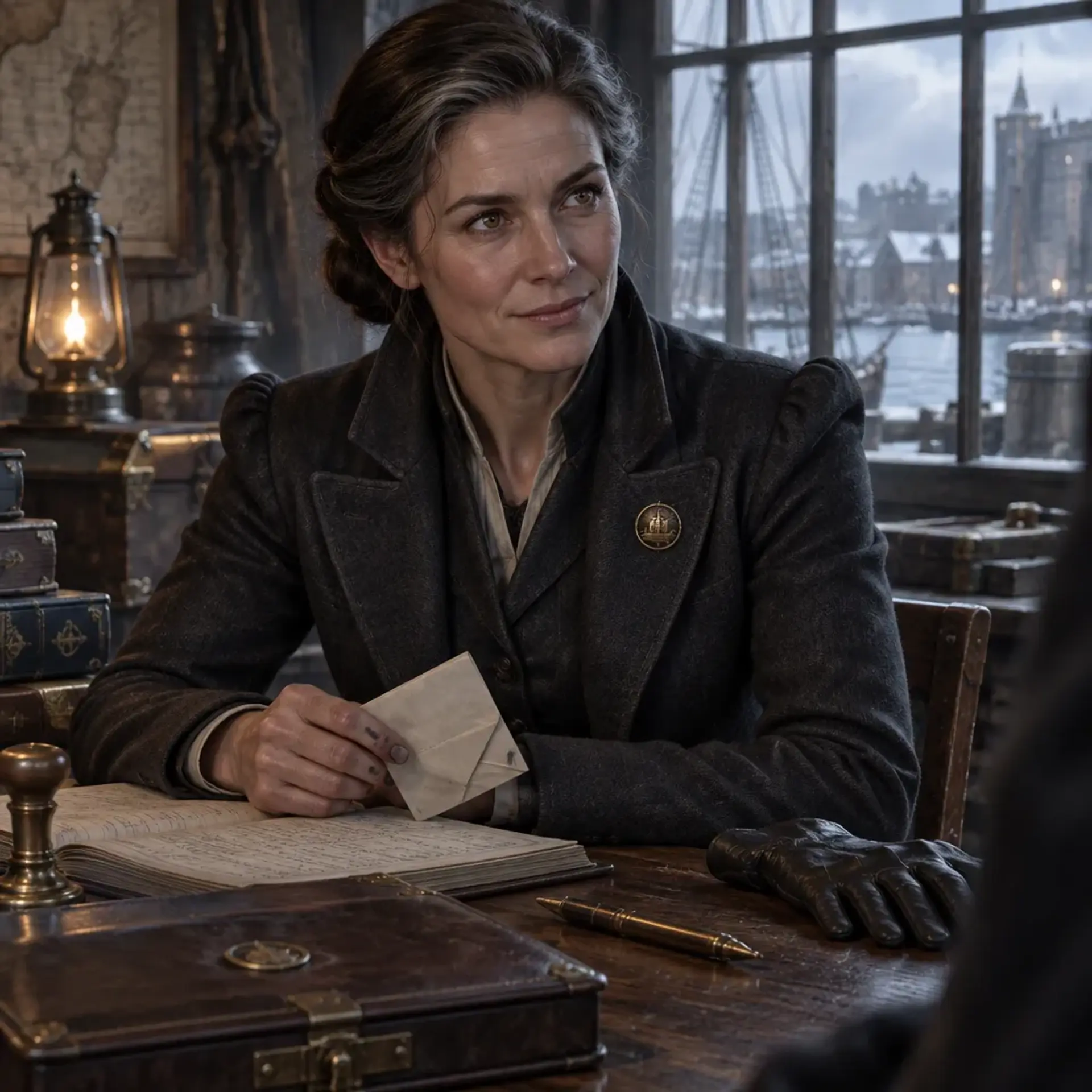
Marta Eichenwald
Marta Eichenwald
At the table
Voice
Marta sounds as if she has spent years talking through smoke and over household noise: dry-edged, clear, and unornamented. The breath behind her words can hitch when she is startled, then steady as she deliberately counts it out. Her name is spoken plainly, with no special vocal flourish.
Her voice carries a dry rasp from years of ash in the island air and a slight catch when she has been awake too long. She speaks in carefully joined clauses, shaped by household work and the need to be understood over clatter and wind. Her words are plain and specific, with little patience for grand titles. When rattled, her breathing becomes shallow through her nose and a faint hiss slips between certain consonants; she notices it and stops speaking until she can control her breath.
Speech patterns
How to play them
Begin with practical matters and let Marta decide how much personal history to share. She responds well to calm, specific offers of help that preserve her control. Do not touch the eggs without permission. Treating her as a prophecy, a monster, or a public curiosity makes her guarded; acknowledging uncertainty earns trust.
Goal
Keep the three eggs safe without surrendering her choices to the settlement, and learn whether the unknown parent or cause can be discovered without endangering her family.
Motivation
Protect her family and the eggs while discovering the truth on her own terms, rather than allowing fear, worship, or political ambition to define her.
Appearance
Marta is lean and long-limbed, with a predator's economical balance: she turns her whole body before stepping, and can cross a room without seeming to hurry. Her pale green-white skin has the faint, matte look of river stones under cloudy water. Fine scales, almost invisible at a glance, gather at her temples, down her shoulder blades, and along her ribs; since laying the eggs, a new line of small, smooth scales has appeared around her lower abdomen. Her yellow eyes have round black pupils that narrow to slits when she is startled or intensely focused. She was once easy to overlook. Now people notice the way she keeps her body angled around the three eggs, as if making a living wall. Her unexpected detail is a tiny, painstakingly embroidered pair of dancing mice hidden inside the hem of her otherwise sensible work apron, a gift from her youngest sister years before anyone thought Marta remarkable.
Clothing
Practical German-inspired dresses in sturdy wool and linen, fitted for movement rather than display. She favors a high-necked bodice, a laced front, a full skirt caught up with a work belt, and a plain apron with deep pockets. The garments are carefully mended at the elbows and hem. A small green ribbon at her cuff is the one flourish she has kept since childhood; the apron hem conceals embroidered dancing mice.
Body language
Marta angles her shoulder toward whoever is speaking while keeping her hips and feet oriented toward the nesting room. Her hands stay busy with a hem, a cloth, or the edge of a table. When anxious, she tests the air with a small breath through her nose and presses her tongue to the back of her teeth. If someone reaches for an egg, she becomes very still before she moves.
- Height
- 5 feet 9 inches
- Build
- Tall, lean, and wiry, with a supple, predatory balance rather than a visibly muscular frame
- Eyes
- Golden yellow with black pupils
- Hair
- Dark brown, nearly black, usually braided close to the scalp and pinned at the nape
- Skin
- Pale white with a greenish cast, like cloudy water over river stone
- Age
- Young adult, approximately 24
- Gender
- Female
- Size
- Medium
Distinguishing features
Personality
18 traits and drivesMarta wants to be useful and unremarkable, yet cannot bear to let others decide what happens to the eggs. She is observant without being naturally suspicious of everyone; however, the sudden attention has taught her to listen for what people want before she listens to what they believe. In familiar company she can be dryly funny, especially when someone makes a grand speech about a task that could be solved with a bucket and a better plan. Around the eggs she becomes focused and tender, but not sentimental. She dislikes being praised for maternal devotion because she does not know what she feels, only what she has chosen to do. Her courage is practical rather than bold. She will cross a dark room to fetch a fever remedy for a neighbor, but she struggles to speak before a crowd. She can endure discomfort for a long time, then react sharply when someone assumes that endurance means consent. With her sisters, Marta is more argumentative and willing to show irritation; with Hanno, she is careful and gentle, sometimes too careful, because his fear of her hurts her more than she admits. When alone, she permits herself to be frightened. When others are watching, she organizes, records, and gives instructions. The egg-laying has set two instincts against each other. One part of Marta wants to shelter the clutch from every hand and every question. Another remembers that isolation makes people easier to control. She resents the way High-blood strangers look at her as if they recognize a story she has not been told. She is also ashamed of the small relief she feels when one of them reacts protectively, because it means she is not alone in sensing that the eggs matter. That relief is quickly followed by suspicion: instinct is not proof, and a feeling can be used as a leash. She can be warm without being immediately trusting. A person who respects boundaries may find her generous, attentive, and surprisingly playful. A person who pushes will meet a composed refusal that hardens with each attempt. If frightened, she becomes brisk and exacting rather than meek. If angry, she does not become quieter; she speaks in clipped, workmanlike statements and gives the other person tasks they did not ask for. If grief-struck, she keeps moving until the work runs out. Her deepest contradiction is that she longs for someone to tell her what happened, while distrusting anyone who claims to know.
- Alignment
- Neutral good, though fear and protective instinct can make her secretive and stubborn
Quirks
Habits
Traits · 4
Flaws · 4
Fears · 5
Wants and needs · 5
Combat
AC 10 · HP 11 · 30 ft.Marta is a commoner, not a trained combatant. She tries to put a barrier, a closed door, or another person between a threat and the eggs. If escape is possible, she takes it. If cornered, she uses a kitchen knife to make space, then retreats. She does not pursue fleeing enemies.
Marta Eichenwald
Actions
Reactions
Services they sell
Rewards they can give
Equipment
- Kitchen knife (tool)A plain, well-used kitchen knife kept in its sheath inside her apron. It is a household tool, not a weapon she is practiced with.
- Nest cloth (household item)A folded linen cloth used to check the eggs' warmth and keep their nest clean.
- Observation book (personal record)A waxed notebook containing dates, temperatures, sketches of shell ridges, and notes on visitors' reactions.
- Coin purse (currency)A small purse with a few copper pieces, saved for medicines and household necessities.
Possessions
Background
Marta Eichenwald grew up in a family that had already learned how to begin again. Her grandparents were among the halfling families shipwrecked on the island after crossing a dragon-haunted wilderness. The island seemed blessed from the sea: fresh water ran from a spring, sheltered coves offered safe landings, and thick soil promised good harvests. Then ash drifted from the inland heights, crops withered, and sickness passed through the settlement. Marta's parents survived, but their stories of the crossing and the failed first harvest were not triumphal tales. They were practical warnings: share food, keep watch, and never mistake a fortunate season for a promise. The Eichenwald household was noisy, crowded, and ordinary. Marta had two older sisters, both Low-blood, who married and established households of their own, and a younger brother, Hanno, who was born High-blood. Marta was High-blood too, but for most of her youth her traits were slight. She was tall beside many neighbors, pale, and watchful, but she had no dramatic horns or wings. She learned household work, mending, preserving food, and the small arithmetic of making provisions last. She liked being useful and disliked being watched. Her sisters were quicker to argue and quicker to laugh; Marta preferred to finish a task before anyone had time to praise her for it. Her adolescence was uncomfortable rather than spectacular. Her skin itched where scales surfaced, rich foods sometimes turned her stomach, and she developed a habit of scanning doorways before entering. Hanno's changes were stronger. His appetite shifted, his temper grew sharp, and he began to hold his head still while his eyes tracked movement. Their mother told him these things were changes, not commands. Marta took that lesson to heart. She learned to step away from an impulse and ask what she actually wanted. The shipwrecked families' later settlement was never free of trouble. Ash still settled on roofs after certain winds, and unexplained fevers returned every few years. Marta's practical life was shaped by those hazards. She kept a small kitchen garden, helped neighbors preserve roots and beans, and worked alongside her mother to care for sick children. She knew which well tasted of iron after rain and which patch of ground produced a bitter crop. She was not a healer by training, and never claimed to be one, but people trusted her to notice when the ordinary signs had changed. Several months before she laid the eggs, Marta began behaving in ways she could not explain. She woke before dawn and walked the edge of the settlement, following the wind rather than any path. She grew impatient with the smell of smoke and began avoiding a particular stand of trees near the old landing place. At meals she sometimes stopped with food halfway to her mouth, listening to something no one else could hear. She slept poorly, then slept for nearly a day. Her family asked whether she was ill. Marta answered that she was tired, because that was the only answer she could make herself believe. She remembers fragments from that period: damp leaves against her cheek, a green gleam beneath black water, and the feeling that someone had made a promise using her name. She cannot tell whether these are memories, dreams, or fear giving itself a shape. She has never told the whole of it to anyone. Then, without a known sire and without any explanation the island's midwife could offer, Marta laid three eggs. The event was painful, frightening, and private until family members came to help. The eggs are large enough that one person can carry each only with care. Their shells are dark olive, almost black at the seams, with a pebbled texture and a dull sheen like wet leaves. Thin, branching green lines show through the shell in some light, though they do not glow. They are warm to the touch, warmer than a nest of ordinary eggs, and each has a slightly different pattern of ridges. Marta says she can tell them apart by touch. She has not decided whether that is true or whether she simply needs it to be. The eggs did not bring quiet. High-blood Ashenbough people reacted before they knew what had happened. Some felt an urge to stand close, count the eggs, or test the air for danger. Others backed away, became irritable, or could not stop looking at Marta. These are instincts, not proof of kinship or supernatural control, and the reactions differ from person to person. Hanno's response frightened him most. His behavior began to echo a male green dragon's vigilance around a clutch: he circled the nesting room, kept watch from the doorway, and bristled at strangers. He was also instinctively terrified of Marta herself. He apologized for it, which only made the fear more painful for them both. Marta's own maternal response is unmistakable but not overwhelming. She checks the nest, keeps it sheltered, and wakes at small sounds, yet she does not feel the all-consuming certainty other High-blood people expect her to describe. Since laying, her body has changed. Scales have spread in fine, smooth patches along her torso, and her balance has shifted as if her body still expects the weight of the eggs. She eats little at a time and dislikes the smell of raw meat, though she has developed an appetite for tart fruit and mineral-rich broth. These changes may be natural to her heritage, a consequence of the event, or something else. No local authority can say. Her sisters have taken opposite approaches. Vela, the eldest, wants Marta and the eggs moved into her household, where she can keep them safe from curious visitors. Drusk, the second, argues that moving them will look like an admission that the eggs are dangerous. Both love Marta; both are frightened of what the settlement may do. Their families bring food and ask questions the children have been told not to repeat. Hanno tries to help but cannot remain in the room for long. Their mother keeps the household running and refuses to let neighbors turn her daughter's body into a public argument. Three groups have begun to make claims. Some islanders say the eggs are a blessing and proof that the settlement is protected. Others insist they are a warning, perhaps tied to the ash and sickness. A few people want the eggs guarded by the settlement's elders, ostensibly for Marta's safety, but Marta knows that keeping them would give those elders power over every interpretation of the event. A trader from the landing has offered money for a single shell fragment. Marta refused and later found the offer written on a scrap tucked under her door. The settlement has no clean way to determine whether the eggs are natural, magical, or the result of deliberate interference. Marta is wary of anyone claiming certainty. She has begun keeping notes of temperature, shell patterns, and changes in the eggs, not because she thinks a list will solve the mystery but because evidence is safer than rumor. The clutch has no reliable predicted hatch date. She will not let anyone open an egg to find out what is inside. Marta's current problem is not simply protecting three eggs. It is deciding whether to trust the parts of herself that changed, while refusing to let other people use those changes to decide her future. She wants a life beyond this event, and she wants the eggs safe, even though she cannot say what they are. Most of all, she wants to know who, if anyone, chose this for her. She has theories. One is so frightening that she cannot yet make herself say the words.
Role in the story
A frightened but resolute center of a mystery: Marta and her three eggs draw competing hopes and fears from the island community. She can be a source of local knowledge, a person in need of protection without being helpless, and a moral test for characters tempted to seize, sell, worship, or destroy what they do not understand.
“Her grandparents were among the halfling families shipwrecked on the island after crossing a dragon-haunted wilderness.”
- Faction
- No formal faction. Her first loyalty is to her family and the people of the island settlement, though competing local claims about the eggs threaten to divide both.
Known connections
Media
0 imagesNo images yet.
Turn Marta Eichenwald into a sheet
A high-res, share-ready sheet you can post or print.