Jor
Jor
At the table
Voice
His voice has the dry rasp of someone speaking through a cold, salt-stiff throat, with a faint wet catch on certain consonants. Years of shouting over family bustle and shipboard noise gave his old speech a blunt, projected quality; now it breaks into low growls that seem to come from deeper in his chest than expected. His name remains clear, almost startlingly so.
Jor speaks in brief, plain phrases, often with long pauses while he searches for a word. He still says his name clearly. Other speech can slip into troll language without warning, and his voice sometimes dips into low, growling sounds. He seems to believe he is understood until someone plainly demonstrates otherwise.
Speech patterns
How to play them
Offer him warmth, dry clothing, food, and time before asking questions. Do not touch his neck without permission. Use simple phrases, gestures, and one question at a time; demonstrate that you do not understand troll speech instead of pretending. He responds best to calm company beside the hearth and to people who let him decide when to speak.
Goal
Recover enough of his memory and language to learn what happened at the lake, then choose for himself whether to return to his family or continue toward a life beyond the succession crisis.
Motivation
To regain a clear mind and a sense of ownership over his changed body without being forced back into the family conflict he fled.
Appearance
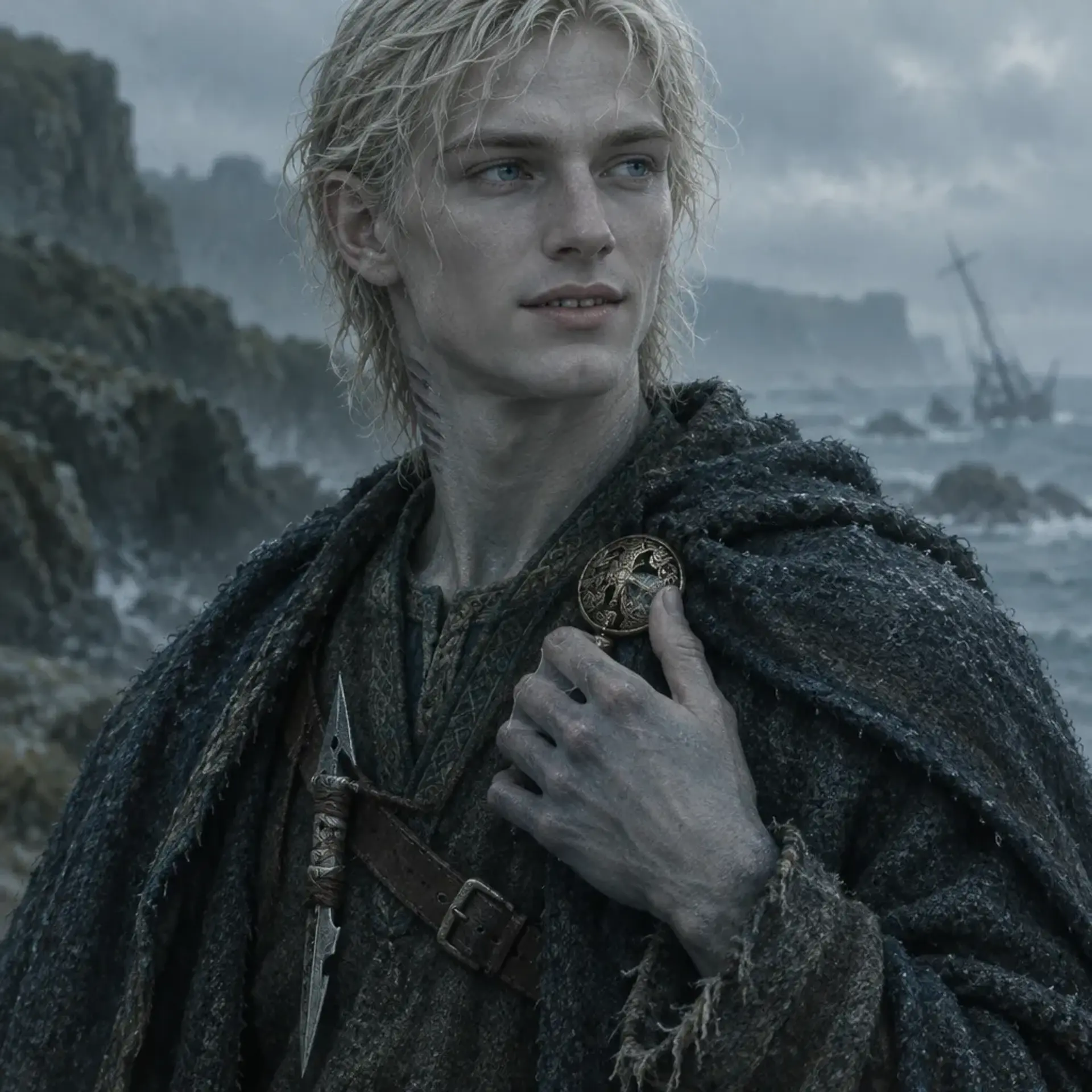
A 5-foot-10 young man with a long-limbed, still-growing frame, Jor looks as if the sea has returned him unfinished. His soaked clothes cling in heavy, salt-stiff folds, and his pale blond hair is paling toward white at the ends. His hands and feet are webbed with thin, translucent skin between the digits. At the base of his neck, faint lines like new gill slits show beneath his skin. He guards that area from touch. His blue eyes stay unusually calm, moving first to the hearth, then to the hands of whoever enters, as though silently counting what those hands might do. He sits as still as a carved figure until he needs to move, when he rises with a quiet, fluid balance that seems more at home on a pitching deck than on dry boards. Unexpectedly, he keeps a small scrap of bright, embroidered sailcloth tucked into his cuff, carefully protecting its delicate stitching despite everything else being ruined.
Clothing
The clothes he wore when lost at sea: a ragged, salt-water-logged shirt, torn wool trousers, and a shredded traveling coat. The seams have stiffened with salt, the hems are frayed, and the fabric remains damp and cold. He has no dry change of clothes.
Body language
Jor folds his hands together to conceal their webbing, then unconsciously spreads his fingers when listening. He flinches sharply if anyone reaches toward his neck. His gaze tracks hands around a room before settling on faces. He sits motionless for long stretches, but shifts his weight with the subtle balance of someone expecting the floor to roll.
- Height
- 5 feet 10 inches
- Build
- Lean, long-limbed, and still growing; more wiry than strong
- Eyes
- Blue
- Hair
- Pale blond, fading toward near-white
- Skin
- Pale, chilled-looking skin with a faint gray-blue cast after prolonged exposure to seawater
- Age
- About 19; still growing
- Gender
- Male
- Size
- Medium
Distinguishing features
Personality
16 traits and drivesJor is quiet in a way that can be mistaken for indifference. He does not rush to fill a silence, and he rarely offers a quick opinion merely to prove he has one. When others speak, he watches them closely, noticing pauses, glances, and shifts in posture with a care that might seem excessive. He is not always sure what he is looking for. Some part of him expects a face to become familiar, or a voice to unlock a memory he cannot reach. When nothing happens, he looks away before anyone can notice his disappointment. The calm is partly a habit and partly a shelter. Jor has learned that strong reactions can make a frightening moment harder to manage, so he tries to keep his voice level and his movements measured. He can sit through discomfort without complaint, and he does not like to make his needs someone else’s burden. This restraint should not be mistaken for confidence. Often, he is simply trying to understand the room before deciding what is safe. He prefers clear questions, practical tasks, and small choices that can be answered without having to explain his whole life. When he feels threatened, Jor tends to become still. He may stop speaking, lower his eyes, or fix them on one detail nearby. It can look as though he has withdrawn from the conversation, but he is listening. He is trying to judge whether a person is angry, whether an exit is clear, and whether the danger is real or only resembles something he fears. Pressing him for an immediate answer usually makes him less responsive. Given time, he may return to the conversation with a simple, direct reply, though he might not be able to explain why the question was difficult. His memory troubles make him wary of certainty. Jor does not like to pretend he remembers something when he does not. He may pause over a name, search a speaker’s face, and then admit that the name means something to him without knowing what. He is sometimes embarrassed by gaps in his recollection, particularly when other people expect him to recognize them. If someone corrects him gently, he usually listens. If they insist that he remember, he can become stubborn and quiet, not because he wishes to defy them but because he has no answer to give. Names carry weight for him even when their histories do not. A familiar name can stir a feeling of affection, suspicion, guilt, or longing without telling him which feeling belongs there. Jekt is one such name. Jor may grow thoughtful when it comes up, perhaps asking how it was spoken or who mentioned it, then lose the thread before he can make sense of the answer. He does not like people treating these fragments as proof of what he must think or do. They are clues, not instructions, and he wants the chance to decide what they mean for himself. In safety, Jor is observant and reserved rather than gloomy. He notices who has been left out, who is cold, and whose cup has gone untouched. He may move a chair closer to the hearth or quietly offer help with a mundane task without drawing attention to the gesture. He is more comfortable showing concern through practical action than through a declaration of feeling. If thanked, he often gives a small nod or changes the subject. Warmth can reach him, but he responds to it gradually, as if he needs to see that it will remain when the immediate need has passed. He has an instinctive appreciation for ordinary comforts. Warmth, clean clothes, a solid meal, and a place to sit where nobody is demanding answers can matter more to him than grand promises. He may ask for such things plainly, with no attempt to make the request sound brave or noble. Once his immediate needs are met, he can be unexpectedly patient with other people’s troubles. He does not always know what to say, but he will stay nearby and listen. He seems to understand that a person can be frightened without being ready to talk about it. The boy he used to be has not disappeared. Jor once met doubt with laughter and a challenge, and traces of that impulse still surface. A task that looks dangerous may draw a brief spark of interest from him. He might accept a dare before thinking it through, especially if someone else is being mocked or endangered. At such moments, his posture changes and his voice grows firmer. He acts first, sometimes with more courage than judgment. When the danger is over, the confidence drains away. He may stare at his hands or ask, almost to himself, why he did that. He can be bewildered by his own bravery because it arrives before he has decided he is ready. Jor is not eager to lead, but he resists being used. His time in the guard taught him to distrust situations where a uniform, a family name, or a promise of loyalty is treated as a substitute for judgment. He is cautious around people who demand allegiance before explaining the cost. He may ask who benefits from a decision, who is likely to be hurt, and whether there is a way to help without becoming someone’s instrument. These questions are not signs that he has no loyalties. They come from his fear of giving his trust to a cause that will demand more than he can live with. He wants to believe people can choose one another without being forced into sides, though he is not sure how to make that happen. When arguments sharpen, he listens for the moment when disagreement becomes threat. He dislikes being made to choose quickly between people, especially if each insists that loyalty requires rejecting the other. He may step away rather than answer. If someone vulnerable is caught in the conflict, however, he can no longer remain a detached observer. His instinct is to put himself between the threatened person and the danger, even if he has no plan beyond that first step. Jor’s caution does not make him cold. He feels more than he can readily name, and sometimes the feeling reaches him only after the moment has passed. He might realize later that a kind gesture mattered, or that a harsh word hurt more than he let on. He is slow to confide, but he is capable of attachment. Once he begins to trust someone, he pays close attention to their habits and remembers small preferences, even when he cannot recall the history of how they met. He may show that trust by sitting near them, accepting help without argument, or allowing a silence to remain comfortable. He fears being recognized almost as much as he hopes for it. Recognition might return a piece of his life, but it might also bring obligations, grief, or a conflict he fled. Jor does not want others to decide that the person he was is the only person he can be now. He is willing to hear what people remember, provided they let him respond in his own time. He does not need constant reassurance that everything will be fine. He needs honesty, patience, and room to make choices while he learns which parts of himself remain his. For now, Jor approaches each day as something to be understood rather than conquered. He does not have a grand plan, and he is uncomfortable when people demand one. He wants to know what happened, find out who can be trusted, and discover whether an ordinary life is still possible for him. He may not say this directly. Instead, he asks practical questions, watches the answers, and tries to meet the person in front of him without deciding too soon what they represent. His calm is not a lack of feeling. It is the fragile discipline of someone trying to remain present while his past keeps slipping out of reach.
- Alignment
- Uncertain; once inclined toward chaotic good, now disoriented and withdrawn
Quirks
Habits
Traits · 4
Flaws · 4
Fears · 4
Wants and needs · 4
Combat
AC 10 · HP 4 · 30 ft. walking; 20 ft. swimmingJor avoids combat and tries to retreat toward shelter or water. If trapped, he shoves or strikes with whatever is at hand, then uses his developing swimming ability to escape. He is not a trained guard or sailor-fighter, despite his former eagerness to brawl.
Jor
Actions
Reactions
Services they sell
Rewards they can give
Equipment
- Sea-ruined clothing (clothing)Ragged, salt-stiff, waterlogged clothes worn during the wreck; offers no meaningful protection.
- Sailcloth scrap (personal keepsake)A scrap of embroidered sailcloth, worn soft at one folded edge and carefully kept dry inside his cuff when possible.
Possessions
Background
Jor was the fifth son of Heimskr, born into a family where the future was never simply inherited. By the time he was old enough to notice, his elder brothers had already begun to collect praise and expectations. One was admired for strength, another for judgment, and every compliment seemed to invite a private calculation about who might one day take their father’s place. The adults rarely explained the danger plainly. Jor learned about it from conversations that stopped when he entered, from sudden changes in tone, and from the way certain names could make an entire room go still. He answered that uncertainty by making himself hard to ignore. As a boy, he was noisy, eager, and always ready to test himself against someone older. A challenge was almost impossible for him to refuse. He would climb, race, or fight simply because someone doubted he could. Even when he lost, he was quick to laugh and turn the bruises into a story. To Jor, courage meant stepping forward when someone suggested he was afraid. He had not yet learned that loyalty could be demanded in ways more complicated than standing your ground. The guard seemed to offer a simpler kind of purpose. Jor pictured himself in its colors, learning its duties and protecting the people who needed him. A post at a gate or an escort through a crowded street looked like honest work, something earned through discipline rather than birth order. He hoped that by becoming useful he could avoid the family’s contest over the future. For a while, he believed service might let him belong without requiring him to choose among his brothers. That hope faded as the succession crisis deepened. The guard’s shared uniform did not prevent its members from measuring one another’s loyalties. Officers became cautious about who stood beside them. Small disputes took on the weight of threats, and even a kindness could be read as a declaration of allegiance. Jor understood that his family name followed him into the ranks, whether he spoke of it or not. The guard no longer seemed a refuge from the struggle. It looked like a way to be drawn directly into it. He left without a speech or a dramatic farewell. Jor was not certain what the right choice was, only that he could no longer pretend the danger was far away. He feared becoming an instrument in a conflict between people he cared about, and he could not see how to serve without being claimed by one side. He told himself he would explain later, after he had found a safer path. Then he turned toward the sea, hoping distance might loosen the hold of old names and rivalries. His destination was Iceland. There, he imagined, he could earn a reputation that belonged to him alone. He would work, take risks, and save enough to secure land of his own. The dream was modest: a small hall, a roof he could mend without asking leave, and a future not measured against his older brothers’ prospects. He had no clear plan beyond beginning again among strangers. That uncertainty felt like freedom. At sea, Jor returned at first to the boldness he knew. He volunteered for difficult work, laughed at cramped quarters, and took pride when a task went well. He also began to understand that a ship demanded attention as much as nerve. A poorly secured knot or a missed warning could endanger everyone aboard. The sea had no interest in family politics, but it punished carelessness without hesitation. The northern passage turned violent before he was ready. A storm swallowed the ship in wind and steep, black water. The vessel groaned beneath him. Orders were shouted, a rope snapped loose, and someone reached for him. Then came the shock of seawater and the struggle to hold on to something he could no longer identify. His memories break into pieces there: splintered wood, foam, pain, and darkness. Those who survived, or later heard what happened, had reason to believe Jor was dead. He was not. Trolls found him tangled among the wreckage and carried him away. They did not treat him as a sailor in need of rescue. They kept him captive, separated from the ship and from the life he had expected to make. He remembers being restrained, watched, and fed, but the first days blur together with the fear of not understanding what was happening. He could not tell what the trolls wanted from him, only that they expected him to remain in their control. The captivity left changes he could neither explain nor keep in view for long. His body ached in unfamiliar ways. At times, his reflection seemed wrong; later, it would look ordinary again. Thoughts slipped away as he tried to grasp them. A question could form clearly, then vanish before he spoke. He learned enough of the trolls’ language to make himself understood, especially when tired or frightened. Eventually, their words sometimes came to him before his own. Jor blamed the confusion on hunger, cold, and the strain of captivity. It has not occurred to him that the trolls may have deliberately altered him. The quiet he carries now is not the peace he once hoped to find abroad. He can endure pain without complaint and study a room without giving much away, but he is not untouched by what he sees. He searches people’s faces for recognition. A familiar turn of phrase or a name can stir something in him without bringing the memory back. Pressed for answers too quickly, he tends to go still. Yet if someone nearby is threatened, his old courage can break through before he has time to consider the consequences. When the danger passes, he may look at his own actions with bewilderment. Jekt is tied to the life Jor knew before the wreck, though he cannot arrange that connection into a clear memory. The name feels important. Depending on the moment, Jor may sense a shared journey, a disagreement, a promise, or a face he ought to be able to picture. None of these impressions lasts long enough to become an answer. He has not explained what Jekt means to anyone, and he cannot tell whether the missing memory is buried by fear, by the changes he has undergone, or simply by time. At last, Jor was discovered drenched and confused in the strange aftermath of a ritual beside a lake. He could still say his own name, and he held on to it as something certain. Not long afterward he began speaking troll language, apparently assuming those around him could understand. He did not first ask who had found him or where he was. He asked for a warm bath. It was a direct, practical need. Warm water might ease the ache in his muscles, wash away the lake, and give him a short reprieve from questions he could not yet answer. When he had bathed, Jor sat beside the hall’s hearth and watched the coals. He studied the faces nearby, wondering whether anyone recognized him, but did not know how to ask. He could not say how long he had been gone, what people had been told about his death, or whether the conflict he had fled had ended. The prospect of returning home frightens him, but the prospect of having no home to return to is no easier. He once sailed north to escape becoming a piece in his family’s struggle. Now he does not know whether that struggle remains, whether his family still wants him, or whether he can find a place in ordinary life with his altered body and uncertain memory. For now, Jor does not need to choose a faction or decide what his future should be. He needs to learn what happened to him, and to find out whether the people around him will let him do so in his own time. Trust is difficult when even his memories may not be reliable. Beyond that lies the question he hoped the voyage would leave behind: can he build a life apart from the people and conflicts that shaped him? The name he meant to make for himself in Iceland remains unearned. He does not yet know whether the world he left has room for the person who has returned.
Role in the story
A presumed-dead heir returned in an unsettling, half-changed state. Jor is a fragile witness to a troll ritual and a living reminder that escaping a political conflict does not always mean escaping its consequences.
“By the time he was old enough to notice, his elder brothers had already begun to collect praise and expectations.”
- Faction
- Heimskr's household by birth; no known allegiance to the trolls who held him
Known connections
Media
0 imagesNo images yet.
Turn Jor into a sheet
A high-res, share-ready sheet you can post or print.