Oswin Hirst
Oswin Hirst
At the table
Voice
A dry, plainspoken Yorkshire voice shaped by years of calling across fields and speaking into wind. His breath usually comes slow through his nose. Under stress, he holds it until his face stills, then lets it out in a harsh, houndlike rasp that makes his next words sound older than his youthful face.
His voice is a work-worn Yorkshire voice, direct and practical, with the clipped rhythm of someone used to speaking over wind and livestock. Old Norse and Anglo-Saxon words surface when he is tired. He does not raise his voice much; when truly shaken, his breath catches and the next words emerge with a rough, animal rasp.
Speech patterns
How to play them
Begin with practical help and plain courtesy. Oswin is more comfortable discussing weather, livestock, and useful work than his past. He warms to anyone who treats William as a person rather than an omen. Questions about the wedding night, the lost children, or his age make him evasive; patient honesty may eventually earn a confession, but threats make him withdraw or transform.
Goal
Keep Mary and William safe, preserve the farm, and find a way to tell the truth about his nature and the wedding night before Thomas tells it for him.
Motivation
Love for his family, shame over the harm he caused, and a longing for the dales and wandering life he left behind pull him in opposite directions.
Appearance
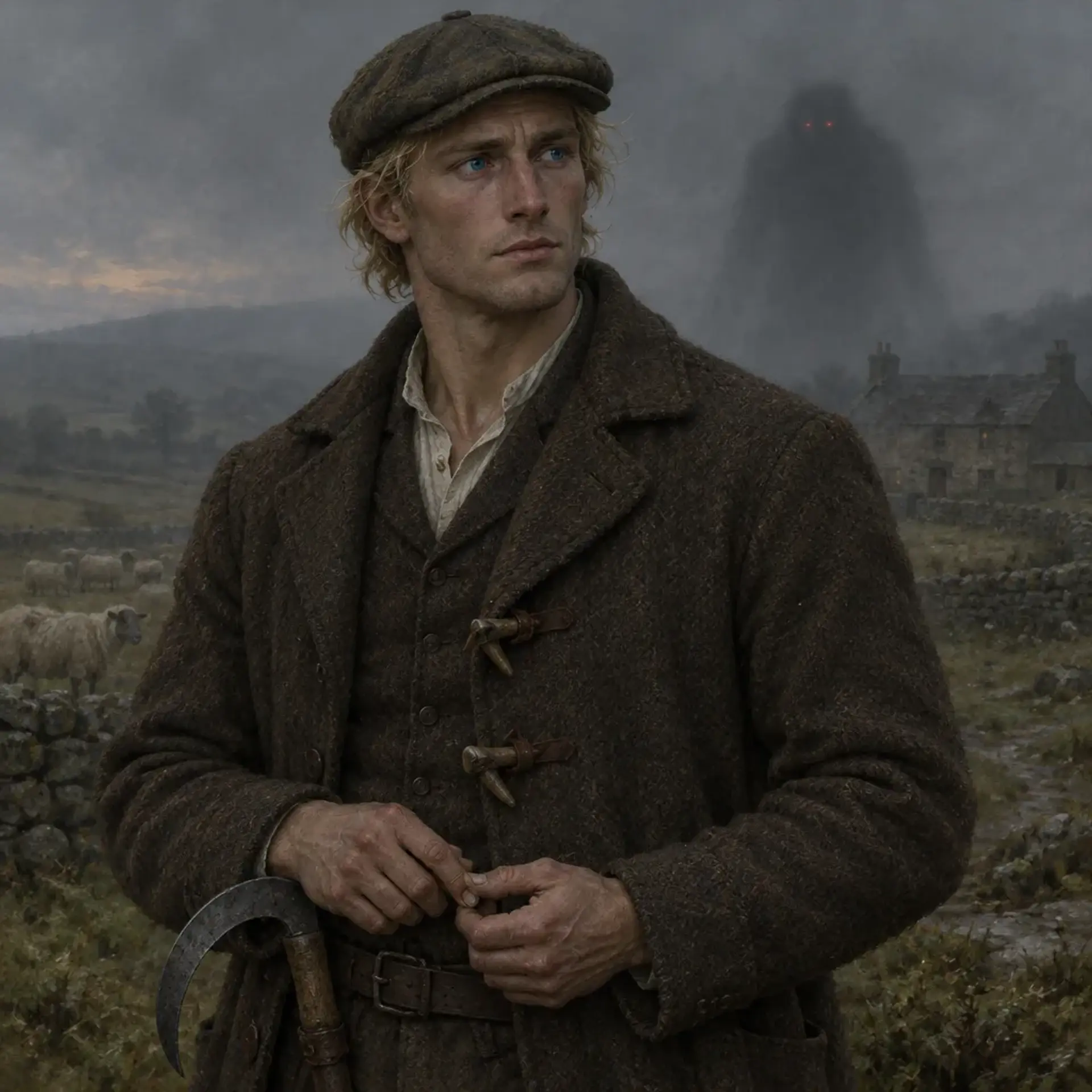
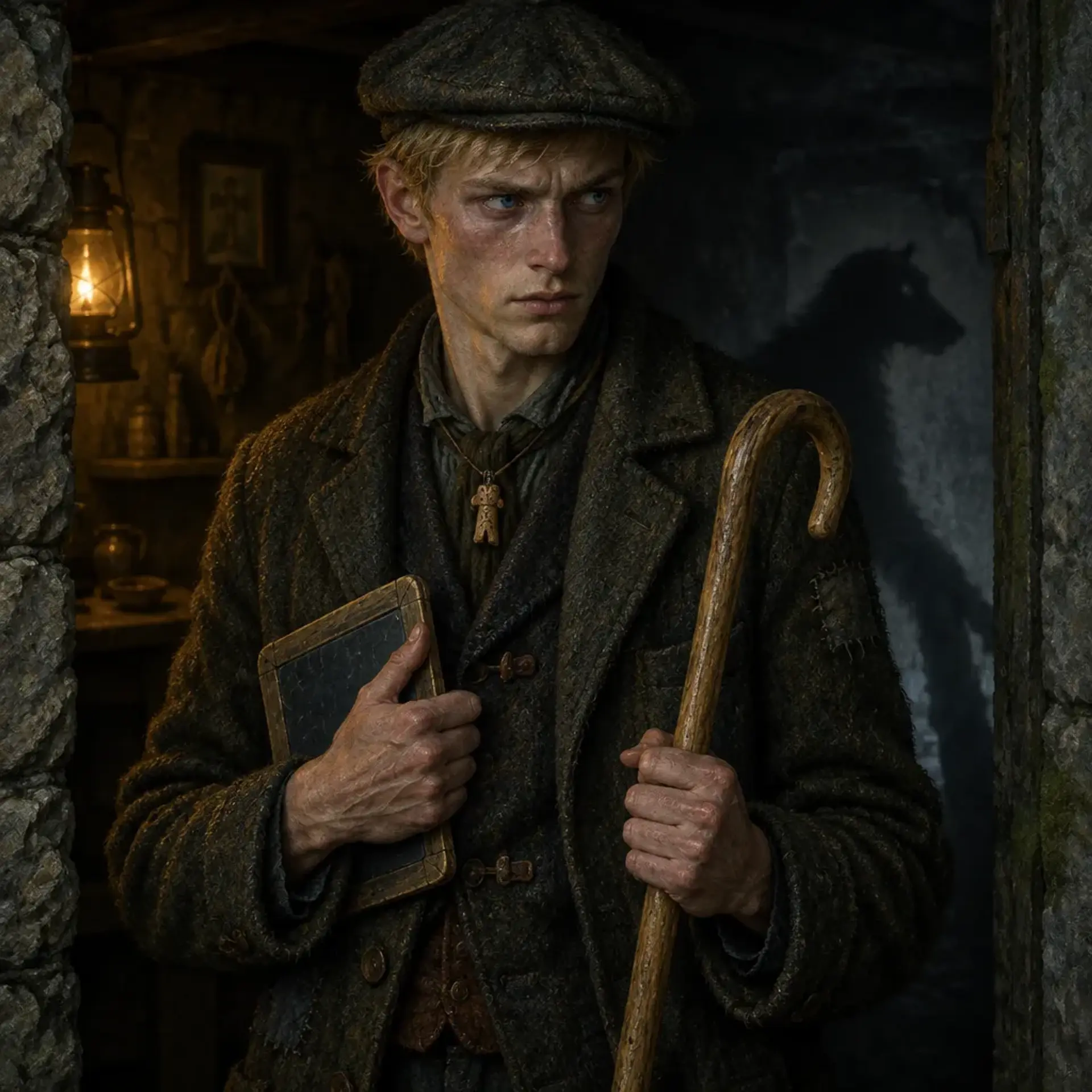
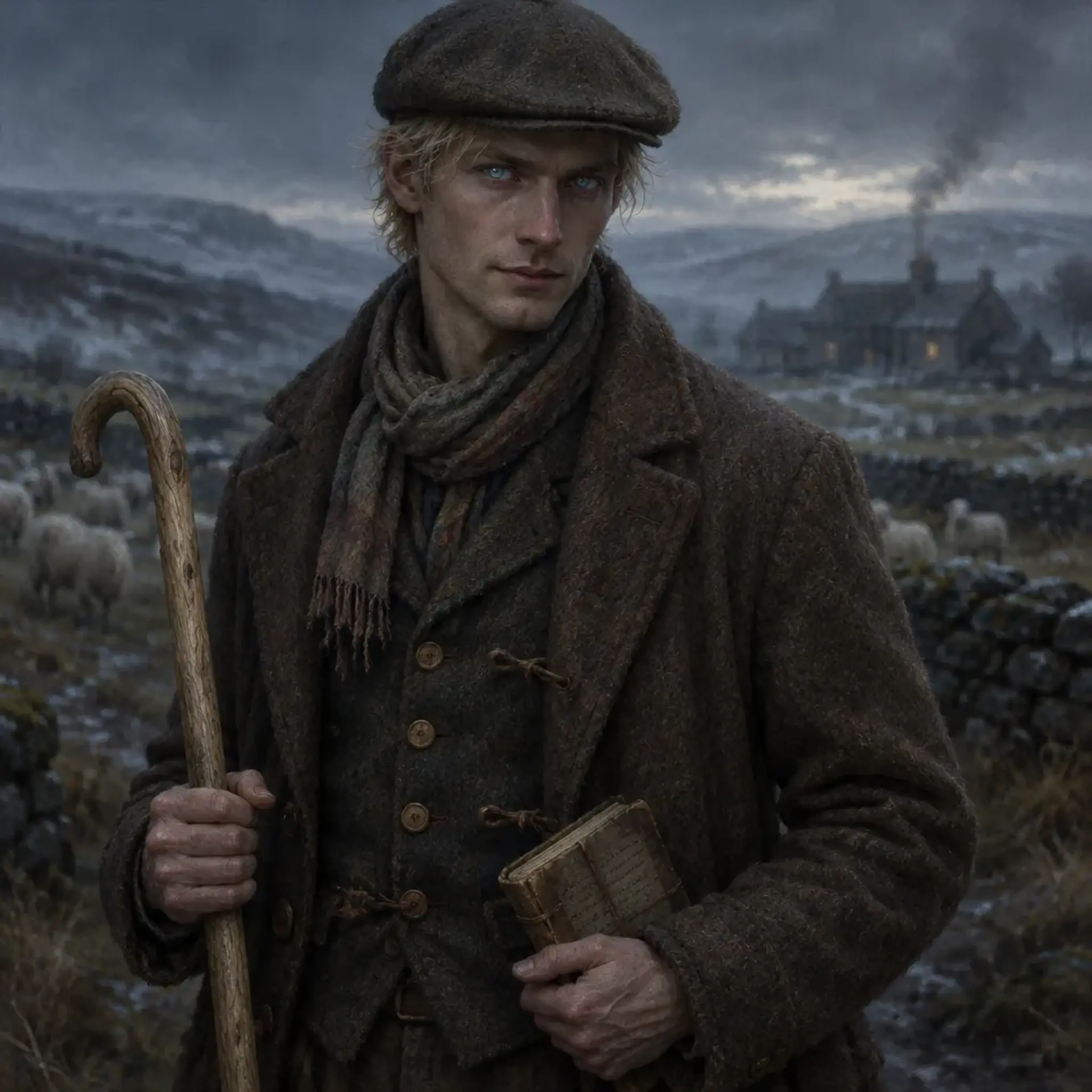
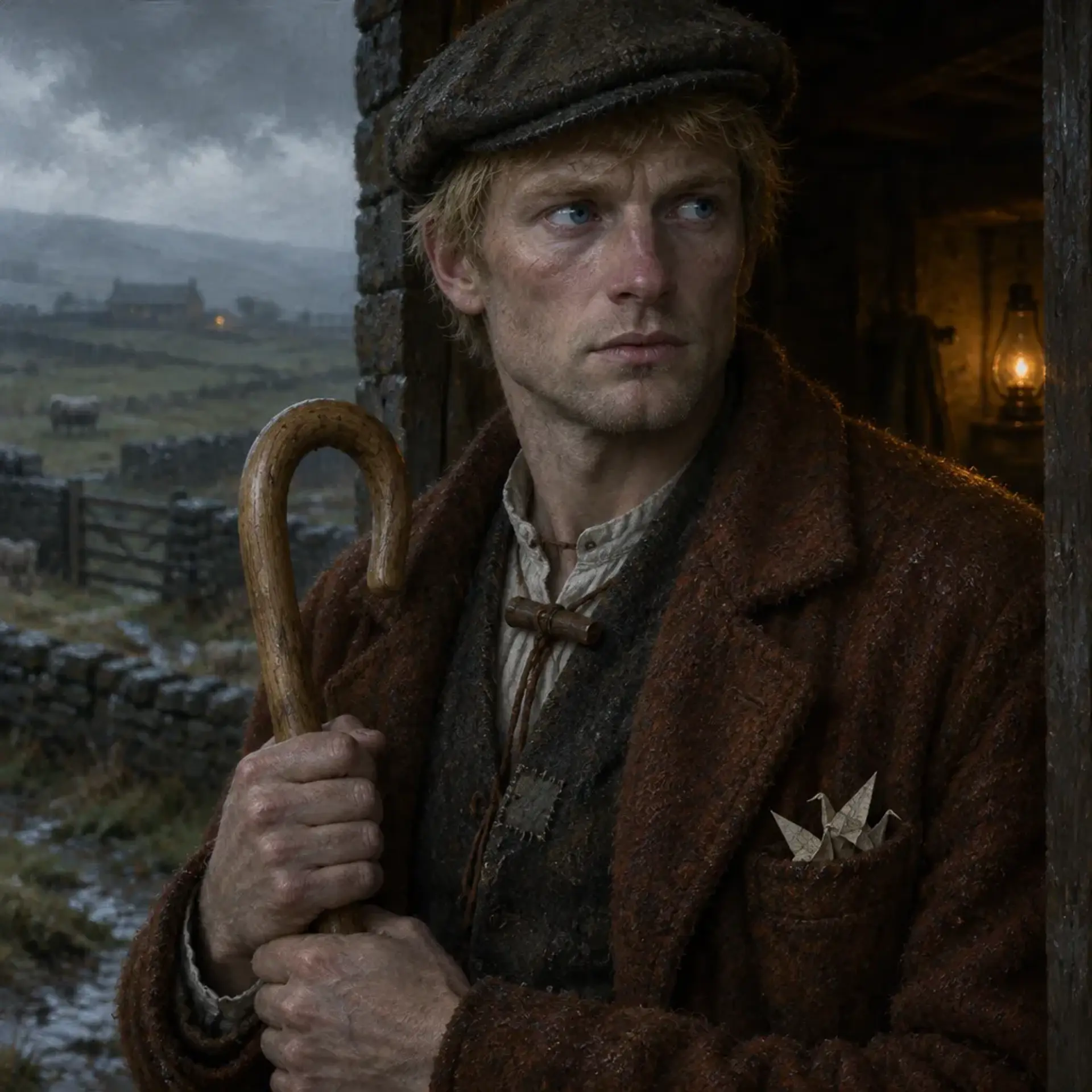
Oswin stands exactly six feet tall, long-limbed and solidly built from years of lifting feed sacks and working wet pasture. His straight pale-blond hair escapes in flat, straw-fine locks beneath his common Yorkshire flat cap. His blue eyes are bright as winter sky, but he rarely looks directly at a face for long: he checks doorways, window glass, and the dark under furniture as if measuring every possible way out. He has a handsome, almost stubbornly youthful face that seems not to have changed since Mary first knew him. His skin has the washed-out pallor of someone who works dawn fields and sleeps badly. He moves with a farmer's careful economy, placing each boot as though the ground might suddenly prove treacherous. In a room, his breathing is the detail people notice: usually slow and nasal, but when rattled it stops altogether for a beat, then resumes with a faint, rough houndlike rasp. Unexpectedly, he keeps tiny folded paper birds in his coat pocket and leaves them on William's windowsill.
Clothing
A weathered flat cap, a russet-brown wool coat, patched waistcoat, plain linen shirt, sturdy breeches, and mud-dark boots. He wears no iron buckle if he can help it, fastening his coat with leather ties and a wooden toggle.
Body language
He stands squarely and still, with his hands folded as if waiting for a difficult question. His eyes map exits and reflective surfaces before settling on a person. When frightened, he goes unnaturally motionless, holds his breath, then exhales through his nose with a coarse rasp. Around William, his posture loosens and he bends to the boy's height rather than calling him over.
- Height
- 6 ft.
- Build
- Tall, rangy, and farm-strong, with broad shoulders under a deceptively lean frame.
- Eyes
- Bright, burning blue.
- Hair
- Pale blond, straight, and often flattened beneath his cap.
- Skin
- Pale, weathered by wind and cold, with a faintly gray cast in winter light.
- Age
- Appears to be in his early thirties; his true age stretches back to the Danelaw, many centuries ago.
- Gender
- Male
- Size
- Medium in human, headless, and hound forms; Large in wild horse form.
Distinguishing features
Personality
18 traits and drivesOswin is gentle in the everyday ways that matter: he mends a torn sleeve, remembers a child's favorite task, and shares the last of his tea. Yet he is practical and shrewd enough to bargain hard over a ewe or spot a lie across a room. With Mary he tries to be steady and affectionate, but shame makes him evasive. With William he is openly tender and playful. In church he is stiff and solemn, as if every movement might draw attention. When frightened or angry, the patient farmer's manner can drop away and something ancient and predatory looks out through his blue eyes.
- Alignment
- Neutral Good, though his fear and shame can make him evasive and dangerously self-serving.
Quirks
Habits
Traits · 4
Flaws · 4
Fears · 5
Wants and needs · 5
Combat
AC 14 · HP 38 · 30 ft.; transformed speeds: hound 40 ft., wild horse 60 ft.Oswin tries to end a fight without killing anyone. He opens with Entangle or Faerie Fire to control the field, uses Eldritch Blast from cover, and changes into the hound to pursue or draw danger away from his family. He uses Hellish Breath only when cornered or when an enemy threatens William. He avoids iron weapons and will retreat rather than let a fight expose his family or force him to reveal his true form.
Oswin Hirst
Spells
Actions
Reactions
Services they sell
Rewards they can give
Equipment
- Shepherd's Crook (weapon)A plain ashwood crook, worn smooth where his palm grips it; useful for sheep and, if necessary, defense.
- Golden Sickle (custom ritual focus)A small golden sickle hidden beneath a loose floorboard. It was given to him by his Durham 'brother' and is used for strange rites at the boundary.
- Work Pouch (adventuring gear)A weathered farmer's pouch with twine, a whetstone, dried yarrow, and scraps of folded paper.
- Mary's Iron Scissors (personal keepsake)A pair of iron scissors Mary used against his headless form on their wedding night. Oswin keeps them wrapped and hidden, unable to throw them away.
Possessions
Background
Oswin was born in the north of England during the age of the Danelaw, the child of a human woman and a thing from the old boundary country. His mother raised him among ordinary folk and taught him scraps of Old Norse and Anglo-Saxon, but she died while he was still young. His childhood was ordinary until it was not: he grew slowly, outlived neighbors, and learned that frightened people can turn a strange child into a monster without ever seeing him change. He roamed for generations under borrowed names, making uneasy friendships with beings who live across the boundary and refusing to speak the forbidden tongues they taught him. Eventually he settled as Oswin Hirst, a sheep farmer with a fine house and a patch of Yorkshire dale he could pretend was home. He married Mary Pickles and, on their wedding night, failed to consummate the marriage in human form. Ashamed and afraid she would reject him, he changed into his headless form and went to her. Mary survived the encounter and struck him with iron scissors. Five days later, he asked to try again as himself; they have never honestly spoken about that first night. Their children have brought joy and grief: Alice, Rose, and Edmund were lost before or shortly after birth. Edmund's eyes had seemed hellish to Oswin. Their surviving son William has black hair, his father's burning blue eyes, developmental delays, and frightening fits of anger and fear. Mary believes the wedding-night visitor was a rogue Barguest and fears William is its child. Oswin takes time with both of them even when the season keeps him awake. He remains stiff but devoted in church. Now Thomas Pickles suspects Oswin's nature and plans to use the truth to force Mary to leave him and claim the farm. Mary has quietly told her father about the wedding night. Oswin does not know.
Role in the story
A loving but compromised husband and father whose concealed identity sits at the center of a folk-horror mystery. Oswin can be an ally, a source of old knowledge, or the focus of a family crisis. Thomas's suspicions, Mary's fear, and William's strange heritage can bring the party into a conflict where the truth matters as much as the danger.
“His mother raised him among ordinary folk and taught him scraps of Old Norse and Anglo-Saxon, but she died while he was still young.”
- Faction
- No formal faction. He maintains cautious friendships with beings of the boundary country and is loyal to the Hirst household.
Known connections
Media
0 imagesNo images yet.
Turn Oswin Hirst into a sheet
A high-res, share-ready sheet you can post or print.