
Gods of Bretes
Gods of Bretes
Invoke a god

Avarion
The First Measure
Symbol A bronze compass laid over a square
Holy day The First Measure
- Keep sworn agreements.
- Build institutions that outlast their founders.
- Do not mistake authority for personal virtue.
The gods
10Avarion
The First Measure
Greater · Lawful Neutral
Order and sovereignty, balanced against Kettaros's ambition
Patient and exacting, Avarion treats kingdoms as temporary instruments of cosmic balance and rarely answers individual prayers.
Faith
- Keep sworn agreements.
- Build institutions that outlast their founders.
- Do not mistake authority for personal virtue.
Holy dayThe First Measure, observed at the spring equinox.
Holy textThe Tablets of the First Measure
RitesMark a new undertaking with a measured square. · Recite public oaths before a bronze compass.
Valuesmeasure · continuity · law
Look
SymbolA bronze compass laid over a square
- ivory
- bronze
Animalseagle · white ox
AppearanceA tall, ageless figure in a pleated ivory mantle, bearing a bronze compass whose needle points to the nearest broken oath.
Followers
WhoJudges, magistrates, civic architects, and rulers seeking legitimacy.
BeliefsFollowers believe that just laws echo a cosmic pattern, though they know Avarion may never notice their obedience.
The faith
How it began
In the oldest surviving account, the gods emerged from the Assembly of the First Measure after the world had already taken shape.
Avarion set boundaries among them, while Tovek gave the silent heavens motion. The account ends before explaining who made the world, and the gods neither confirm nor deny its missing verses.
The heavens
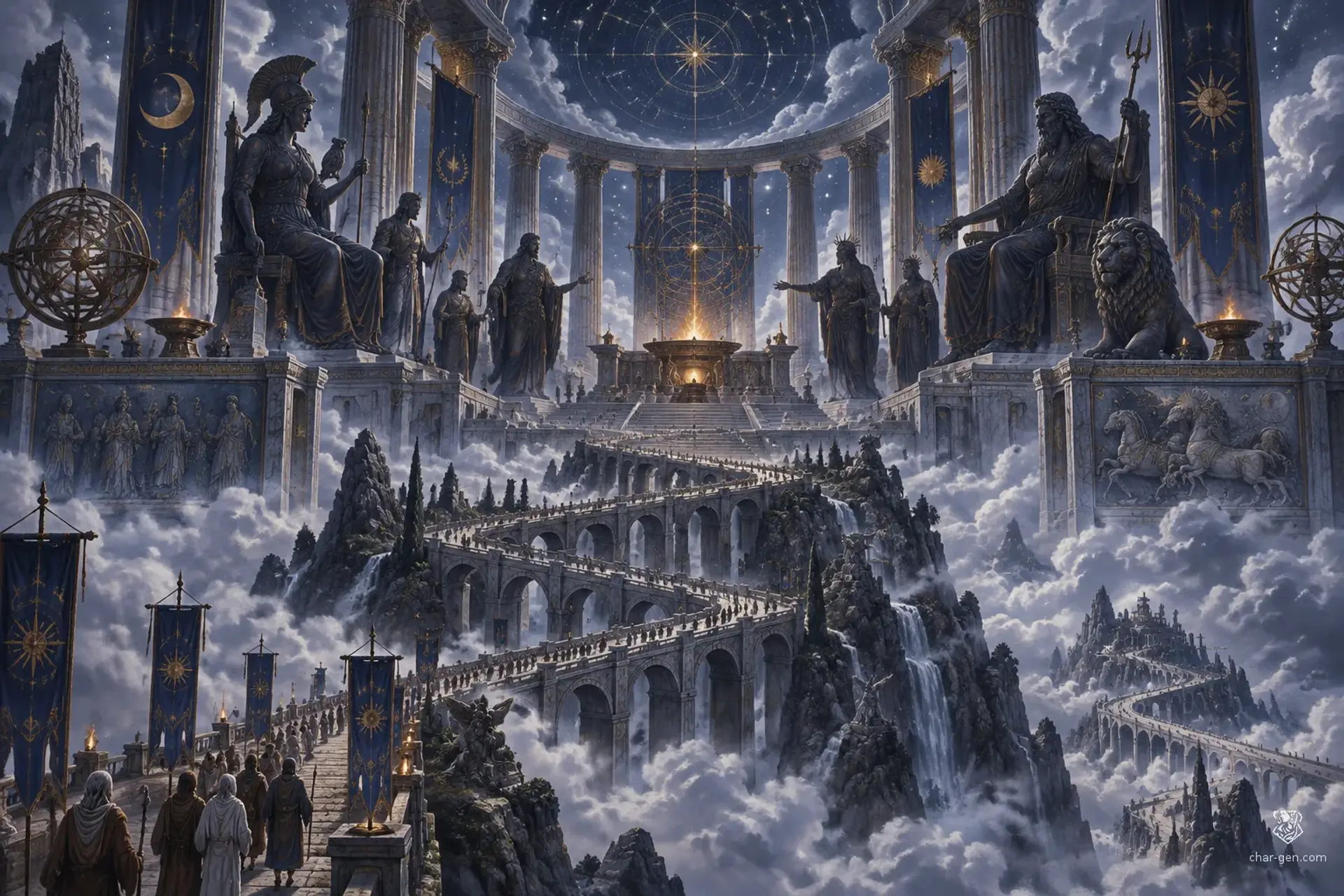
Bretes rests beneath a high, remote firmament, its mortal world one ordered province among many.
Avarion raised the celestial vault; Tovek set the winds and waters moving; Ghaltek forged the sun's road through the sky. The gods meet in a marble assembly hall beyond the stars, but their decrees reach mortals as omens, seasons, and rare interventions rather than familiar visitations.
Gods and mortals
Most people honor several gods according to circumstance rather than choosing one exclusive patron.
Cities maintain public altars to Avarion, Oruessa, and Belsa; soldiers appeal to Kettaros and Ghaltek; travelers leave offerings to Phaedon; and private shrines to Seshara or Zureth are treated with suspicion. The gods seldom appear in person, so priests interpret omens and rites without certainty that any deity has answered.
After death
The dead cross the dim River of Bretes under the gaze of Oruessa, who weighs their names against the deeds witnessed by Seshara and Kettaros.
Most dwell in quiet, ash-colored halls; the honored receive remembrance, while the unquiet are bound to the riverbank until their wrongs are answered. A few souls vanish into the far dark, beyond even Oruessa's jurisdiction.
What people say, what is true
Players may hear
For the GM
Plot hooks
Conflicts
The wars
Avarion's measured order is repeatedly unsettled by Zureth's appetite for upheaval.
Kettaros and Phaedon dispute who may claim the achievements of mortal rulers, while Seshara conceals prophecies that Ghaltek would rather destroy. Belsa urges the gods toward mortal compassion, but Iskene insists that affection distorts judgment. Oruessa keeps the dead apart from these disputes, though Tovek's storms sometimes breach her quiet borders.
| Avarion | Kettaros | Seshara | Tovek | Oruessa | Ghaltek | Iskene | Zureth | Belsa | Phaedon | |
|---|---|---|---|---|---|---|---|---|---|---|
| A | A | E | ||||||||
| A | A | E | E | |||||||
| E | A | A | ||||||||
| E | A | |||||||||
| A | A | E | ||||||||
| A | E | A | ||||||||
| A | E | A | ||||||||
| E | A | A | E | |||||||
| A | A | |||||||||
| E | A | A |
Order of heaven
Structure
The religion has no universal high priest or central scripture.
Each city maintains temples, household shrines, and civic calendars overseen by local priesthoods. The Assembly of the Gods is a theological image rather than a governing institution; disputes between cults are settled by custom, civic law, and occasional oracles. Pilgrims may honor many deities, while mystery rites devoted to Seshara, Zureth, or Oruessa remain private.
Theme
A distant divine assembly of order, conflict, revelation, and fragile mortal renewal, framed through Greco-Roman civic religion and classical myth.
Tone
Distant and solemn: the gods are real but seldom intimate, their temples enduring longer than their attention.
Mortals must interpret ambiguous signs, make choices without assurance, and live with consequences the heavens rarely soften.
Alignments
The assembly ranges from lawful to chaotic and from benevolent to malevolent.
Its distant gods rarely agree on what mortals deserve, and no single moral doctrine governs the pantheon.
Media
0 imagesNo images yet.
Turn Gods of Bretes into a sheet
A high-res, share-ready sheet you can post or print.