
The Primordial Elementals
The Primordial Elementals
Invoke a god
Yurak
The Evergreen
Symbol A spiral tree ring encircled by three small leaves.
Holy day The First Bud
- Make room for what must grow after you.
- Take only what can return in another form.
- Protect a place long enough to learn what depends on it.
The gods
6Yurak
The Evergreen
Greater · Neutral Good
Forests, renewal, and patient growth; Yurak regards Iruñ as the keeper of roots and Suyana as the giver of rain, though neither can command the green to flourish.
Patient beyond comfort, generous without affection, and difficult to hurry. Yurak considers individual lives brief but not insignificant, like leaves that shelter one another before falling.
Faith
- Make room for what must grow after you.
- Take only what can return in another form.
- Protect a place long enough to learn what depends on it.
Holy dayThe First Bud, observed when the year's first local plant unfurls.
Holy textThe Rings Beneath
RitesPlant a native tree for each major change in a household. · Leave a portion of a harvest untouched for animals and soil. · Keep a quiet vigil beside a living tree during a funeral.
ValuesRenewal · interdependence · patience
Look
SymbolA spiral tree ring encircled by three small leaves.
- deep green
- old gold
- bark brown
Animalsstag · moss-backed tortoise · woodpecker
AppearanceA towering, many-branched figure whose bark resembles layered dark stone. New leaves appear and fall from its crown even in the same moment, while small animals nest unnoticed in its shoulders.
Followers
WhoForest wardens, herbalists, orchard keepers, and communities that depend on shared woodland.
BeliefsYurak's followers believe that living things are bound by debts of shelter and nourishment, though the god does not guarantee that any debt will be repaid.
The faith
How it began
The oldest accounts describe a world without direction or measure.
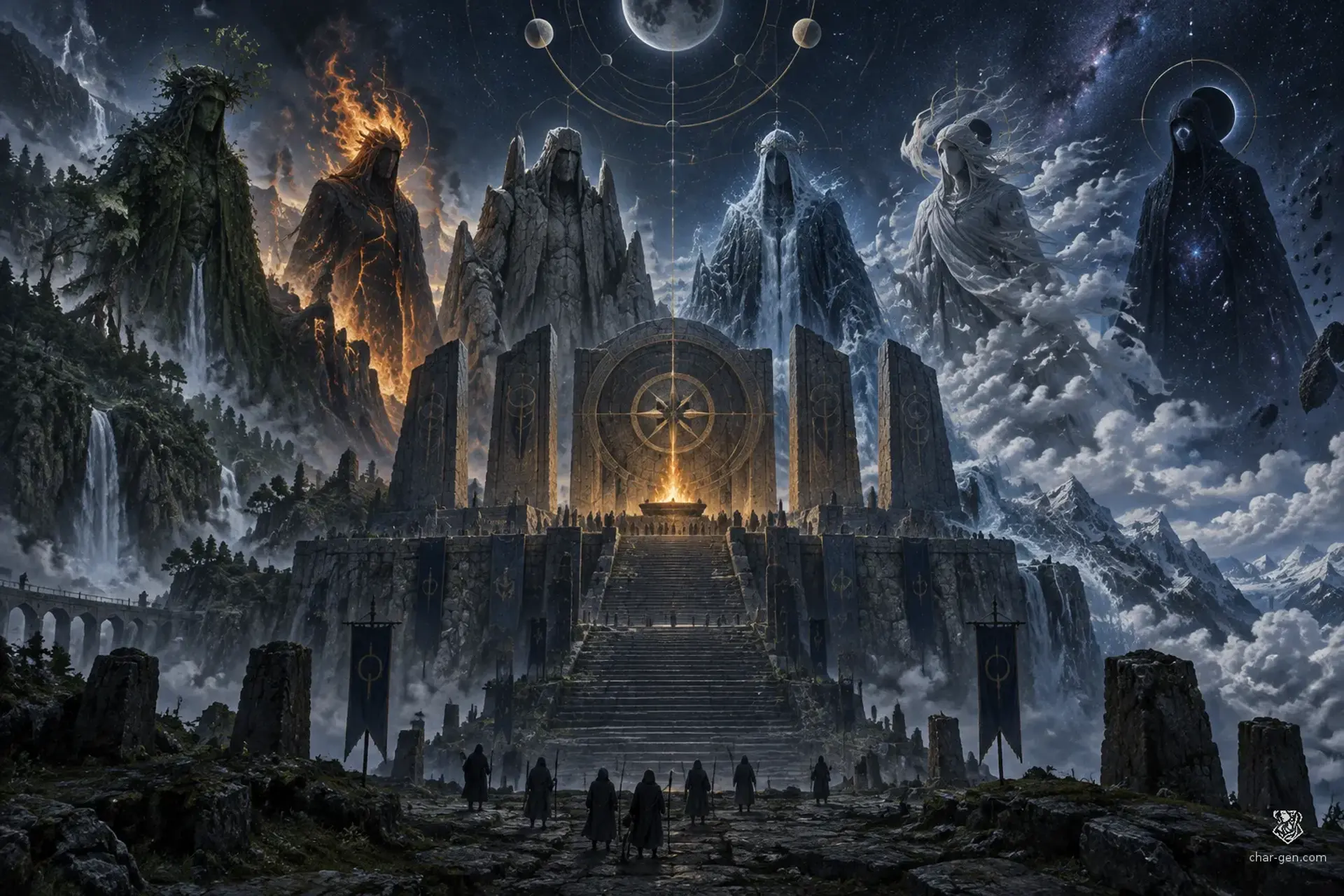
Amai's unbounded possibility gave rise to the five elemental powers, whose collisions and conjunctions made a place where life could persist. The gods themselves do not confirm this account; every version is a mortal attempt to describe beginnings beyond memory.
The heavens
Before the world had shape, Amai the Aether was the possibility of all things, without intention or boundary.
From that unbounded expanse arose Yurak's green persistence, Kori's fire, Iruñ's stone, Suyana's tide, and Vayu's wind. Their interaction formed the world, but no single deity designed it. Amai remains the distance between every star and every thought; the other five continue to alter the world through cycles too vast for mortals to observe whole.
Gods and mortals
The gods rarely manifest or answer prayers plainly.
Most worship takes place in household rites, local shrines, and practical acts of stewardship. Priests interpret weather, growth, flame, stone, and unusual silences, but rival traditions often read the same sign differently. The assembly has no universal church: settlements commonly honor several deities according to need, season, or inherited custom.
After death
The dead drift first into the Quiet Between, where the six Primordial Elementals neither judge nor welcome them.
At the last turning, each soul is drawn toward the element it most resembled in life: growth, fervor, endurance, change, motion, or possibility. The destinations are not heavens or punishments but vast, impersonal continuations. Some traditions say the soul eventually dissolves into the element; others claim it returns to the world as an unremembered impulse.
What people say, what is true
Players may hear
For the GM
Plot hooks
Conflicts
The wars
Yurak and Suyana dispute whether persistence or change better sustains the world; their followers argue over dams, migrations, and the preservation of old lands.
Iruñ and Vayu clash whenever wind erodes the stone that holds a settlement together. Amai watches these quarrels from the Aether and sometimes alters their consequences without revealing why. Yurak and Kori are wary allies: forests need rain, but the Tide never promises to leave a forest standing.
| Yurak | Kori | Iruñ | Suyana | Vayu | Amai | |
|---|---|---|---|---|---|---|
| A | A | E | ||||
| E | A | A | ||||
| A | E | A | ||||
| A | E | A | ||||
| E | A | E | A | |||
| A | A |
Order of heaven
Structure
The religion has no central authority.
Local circles of keepers maintain shrines and rites for one or more elementals, while itinerant interpreters compare omens across regions. Some communities arrange worship around the six in seasonal order; others treat Amai as the encompassing mystery and the five elemental powers as its visible expressions. Disagreement is considered natural, though disputes over land, fire, and water can turn doctrine into conflict.
Theme
The Evergreen.
The Eternal Flame. The Unrelenting Stone. The Evershifting Tide. The Relentless Wind. The Enigmatic Aether.
Tone
Distant, immense, and quietly indifferent: divine forces shape mortal lives, but seldom notice individual prayers or explain their workings.
Alignments
The assembly spans lawful, neutral, and chaotic creeds, with both benevolent and harsh interpretations.
Its gods are forces rather than moral exemplars, and worshippers disagree about whether nature's indifference is wisdom or cruelty.
Media
0 imagesNo images yet.
Turn The Primordial Elementals into a sheet
A high-res, share-ready sheet you can post or print.