
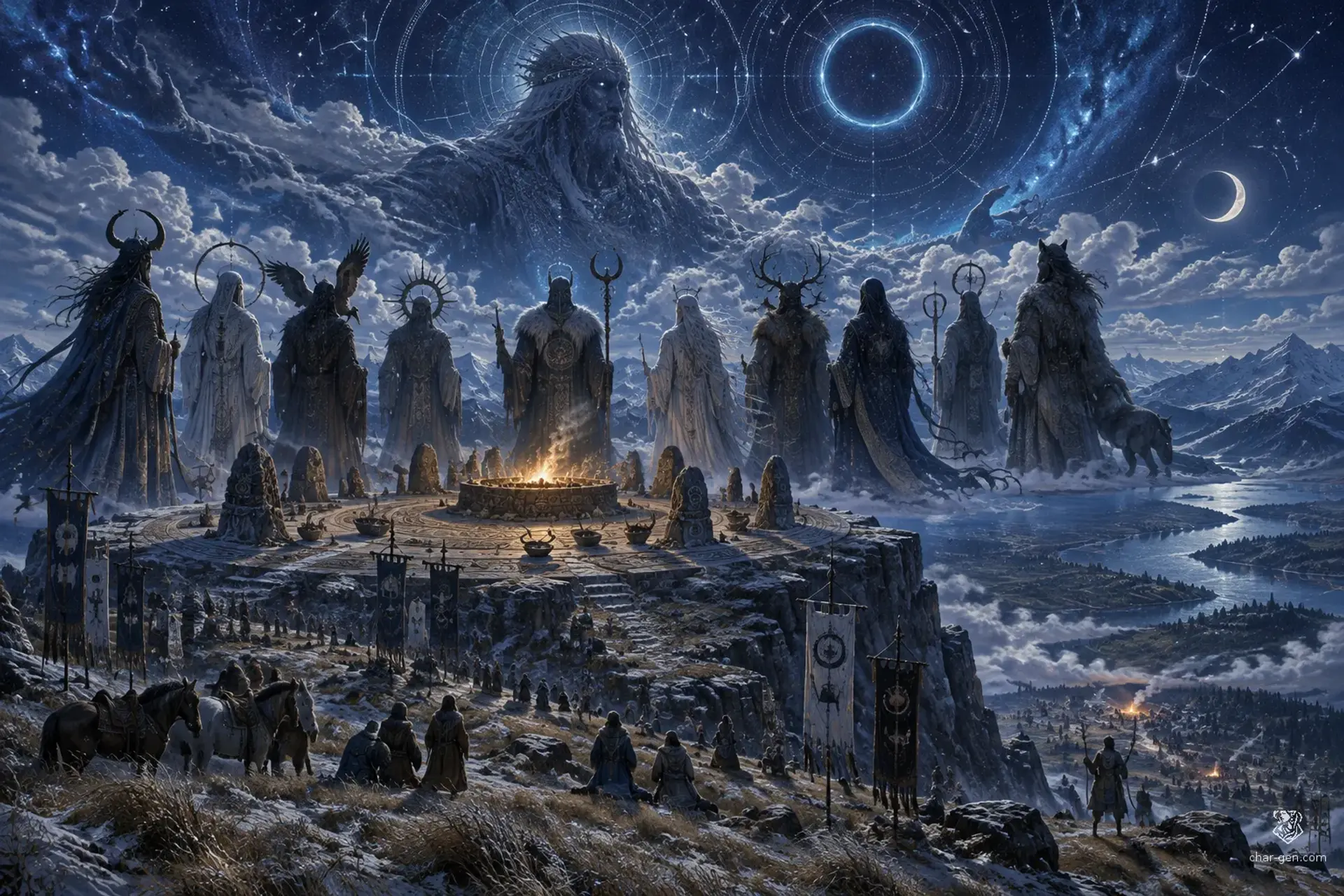
Servants of the Great Blue Sky
Servants of the Great Blue Sky
Invoke a god
Great Blue Sky
The Unroofed One
Symbol A blue circle open at its lower edge, with a single white line beneath it.
Holy day The First Clear Morning
- Keep the sky unobstructed where you can.
- Honor promises made beneath open heavens.
- Do not mistake distance for indifference.
The gods
10Great Blue Sky
The Unroofed One
Greater · Neutral Good
Sky, freedom, fate, and the open heavens; Hearth-Mother Ula says every household lives beneath Great Blue Sky's shelter.
Patient, immense, and difficult to read. Great Blue Sky rarely answers petitions directly; Reed-Speaker Mosi teaches that this silence leaves mortals room to act.
Faith
- Keep the sky unobstructed where you can.
- Honor promises made beneath open heavens.
- Do not mistake distance for indifference.
Holy dayThe First Clear Morning, celebrated after the thaw with open-air offerings and no roof between worshippers and the sky.
Holy textThe Unroofed Verses, a collection of brief hymns carried orally and never gathered into a single authoritative book.
RitesOffer milk or kumis by pouring a little onto bare earth beneath open sky. · Speak important vows outdoors, naming witnesses among the living. · Leave a doorway or tent flap open at dawn.
Valuesfreedom · truthful oaths · patience · the dignity of all living things
Look
SymbolA blue circle open at its lower edge, with a single white line beneath it.
- deep blue
- white
Animalseagle · white horse
AppearanceA boundless blue presence, sometimes glimpsed as a tall figure whose robe is the horizon and whose eyes resemble pale daylight. Great Blue Sky is never shown standing on the earth.
Followers
WhoTravelers, herders, oath-keepers, chiefs seeking legitimacy, and people who need room to choose their own path.
BeliefsFollowers believe Great Blue Sky grants the space in which life and choice can exist, but does not micromanage mortal affairs. Tazuun's eagles are seen as messengers of possibility, not commands.
The faith
How it began
In the oldest telling, before there were roads or names, Great Blue Sky opened above the dark and made room for the world.
Wind crossed that space, rain fell, mountains rose, and life began to move. The other gods emerged as relationships within this living expanse: shelter, law, passage, memory, storm, endurance, claim, and voice. The stories differ from camp to camp, and no single account is declared final.
The heavens
All things unfold beneath the Eternal Blue: the upper world of Great Blue Sky, the middle world of wind, grass, beasts, and mortals, and the deep world of ancestors and buried powers.
These are not sealed realms but layers of one vast existence. The sun and moon cross the upper world as signs, not rulers; rivers carry its gifts downward, and mountains raise prayers back toward it. Great Blue Sky gives space for life, while the other gods tend its particular bonds and dangers.
Gods and mortals
Worship is communal and practical: families, clans, and traveling groups make offerings at hearths, cairns, rivers, and open-air shrines.
There is no universal priesthood. Local elders, oath witnesses, singers, and spirit-speakers interpret custom, while itinerant worshippers carry hymns and news between camps. The gods are honored as powers woven through the world, not as reliably accessible patrons; signs are debated rather than treated as unquestionable orders.
After death
The dead travel along the Blue Road, a wind-borne path watched by Great Blue Sky.
Those who kept faith with their oaths may join their ancestors at the hearthlands beneath the horizon; the restless linger as wandering winds until remembered or released. No judgment is final: Hearth-Mother Ula and Bone-Keeper Qorun guide souls, while Great Blue Sky remains distant.
What people say, what is true
Players may hear
For the GM
Plot hooks
Conflicts
The wars
Great Blue Sky's stillness frustrates those who want divine intervention.
Iron-Voice Kharvek claims order can be imposed by force, while Reed-Speaker Mosi insists living peoples must choose their own paths. Qorun's claim over the dead is challenged by Ula's insistence that memory and kinship can call souls home. The storm-lord Salkh and the river-mother Namiya contest where rain belongs, though both know their struggle serves the sky.
| Great Blue Sky | Iron-Voice Kharvek | Hearth-Mother Ula | Namiya of the Many Fords | Eagle-Eye Tazuun | Bone-Keeper Qorun | Salkh of the Far Thunder | Temur of the Unbroken Rein | Arkhun of the Rooted Peaks | Reed-Speaker Mosi | |
|---|---|---|---|---|---|---|---|---|---|---|
| E | A | A | ||||||||
| AE | A | E | ||||||||
| A | A | |||||||||
| A | A | E | ||||||||
| A | E | A | ||||||||
| AE | A | |||||||||
| AE | A | |||||||||
| A | A | E | ||||||||
| A | A | E | ||||||||
| A | E | A | AE | E |
Order of heaven
Structure
A loose covenant of local traditions rather than a centralized church.
Shrines are commonly open to the sky, with small household altars for Ula and roadside or riverside offerings to other gods. Elders and ritual specialists gain authority through trust, memory, and service; none can claim exclusive command of the pantheon. Seasonal gatherings settle disputes, share news, renew oaths, and honor whichever gods are most relevant to the community's needs.
Theme
A Tengrism-inspired faith centered on the personification of the sky: immense, sacred, and distant, yet present in the open space shared by all life.
The pantheon explores the duties that arise beneath that sky—hospitality, law, freedom, endurance, memory, and respect for forces no mortal can command.
Tone
Distant, spacious, and contemplative.
Divine power is real but rarely intimate; signs are subtle, the horizon is vast, and mortals must make consequential choices without expecting the gods to resolve them.
Alignments
Varied: one lawful good, two neutral good, two lawful neutral, two true neutral, one chaotic good, one chaotic neutral, and one lawful evil deity.
Media
0 imagesNo images yet.
Turn Servants of the Great Blue Sky into a sheet
A high-res, share-ready sheet you can post or print.