
Auran-Rukh
Auran-Rukh
Invoke a god

Auran-Rukh
The Turning Wing
Symbol A single feather curved around an unhatched egg.
Holy day The Long Turning
- Accept that every life has a season and a turning.
- Leave the sky-road open to those who must travel.
- Do not mistake silence for absence.
The gods
3Auran-Rukh
The Turning Wing
Greater Deity · True Neutral
Skies and the long flight watched by Veyshka · Birdfolk and the living voices carried by Serevash · Weather-crossings and cyclical renewal
Distant, patient, and difficult to interpret. It rarely intervenes directly, and its few signs may be a migrating flock, a sudden lull in wind, or the cry of a bird heard far overhead.
Faith
- Accept that every life has a season and a turning.
- Leave the sky-road open to those who must travel.
- Do not mistake silence for absence.
Holy dayThe Long Turning, observed at the first clear dawn after the season’s final great storm.
Holy textThe Unclosed Sky, a body of oral verses whose lines change with each generation of Auran-Rukh.
RitesRelease a feather from a high place at the beginning of a journey. · Keep a vigil through the first storm of the season, listening for a changed birdcall. · At a death, leave a small empty nest facing the open sky.
ValuesRenewal · Patience · Freedom of passage
Look
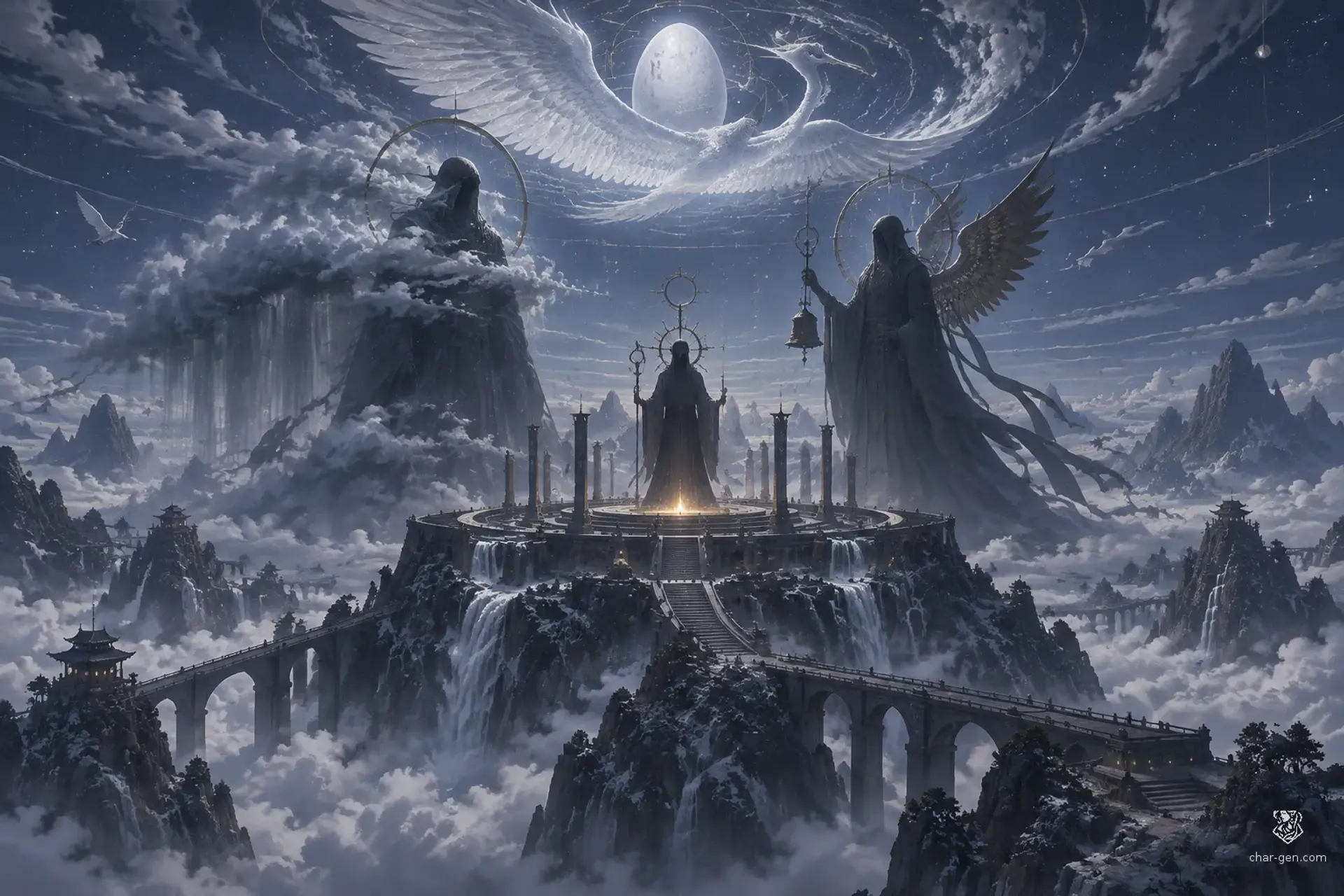
SymbolA single feather curved around an unhatched egg.
- Cloud white
- Blue-grey
- Dawn gold
AnimalsAlbatrosses · Kites · Migrating cranes
AppearanceA vast bird whose plumage shifts from dark, sharp-feathered masculinity in youth to a broad, luminous, feminine presence in age. At the end of its life it lays a single cloud-pale egg, then falls from the sky; the new Auran-Rukh hatches when its first storm breaks.
Followers
WhoBirdfolk, navigators, weather-watchers, messengers, and those passing through a profound change of life.
BeliefsAuran-Rukh’s death is not an ending but the costly beginning of its next life. Veyshka’s weather tests the flight, and Serevash’s sounds reveal fragments of the route.
The faith
How it began
The oldest Apotos songs say the sky was once without a voice.
Auran-Rukh appeared as the first great bird, and its passage made the air navigable. Veyshka arose from the turbulence of that first flight; Serevash came into being when the first wind carried the bird’s cry beyond sight.
The heavens
The sky is not a ceiling but a vast road between the mortal world and the High Quiet.
Auran-Rukh flies that road through a life cycle of masculine-presenting bird, growing increasingly feminine with age, then laying the egg of its future self and dying. Veyshka shapes the winds and weather through which the cycle passes. Serevash gives those winds audible meaning, so that thunder, birdsong, and silence can carry warnings across the region.
Gods and mortals
The faith has no central priesthood or universal temple.
Birdfolk communities keep open-air shrines on ridges and tower roofs, while human and other settlements maintain bell posts, weather stones, or small nesting platforms. Clerics and druids commonly serve Auran-Rukh or Veyshka; bards and rangers often honor Serevash. The deities are regarded as remote presences, and worshippers usually seek guidance through observation rather than expecting direct miracles.
After death
The dead are carried as faint tones into the High Quiet, a remote region of cloud and echo.
There, Serevash weighs each soul’s last honest note; those who have become part of the weather may be heard again in Auran-Rukh’s distant calls.
What people say, what is true
Players may hear
For the GM
Plot hooks
Conflicts
The wars
Auran-Rukh’s cyclic rebirth depends on the sky remaining open, while Veyshka’s storms sometimes close it and Serevash’s bells can call the fledgling toward the wrong horizon.
Veyshka resents Serevash’s attempts to make sound predictable; Serevash insists that warning tones save lives. None can overrule the others without disturbing the balance of Apotos.
| Auran-Rukh | Veyshka | Serevash | |
|---|---|---|---|
| A | A | ||
| A | E | ||
| A | E |
Order of heaven
Structure
A loose constellation of local practices rather than a single organized church.
Ridge shrines tend Auran-Rukh’s cycle, weather-watchers leave offerings to Veyshka, and bell-keepers preserve Serevash’s calls. Seasonal councils may gather to compare signs, but no council claims authority over the deities or over another community’s rites.
Theme
The Auran-Rukh faith treats change as a distant, repeating mystery: life ends, weather alters every plan, and sound offers connection without guaranteeing understanding.
Tone
Distant and contemplative.
Divine signs are rare, indirect, and open to interpretation; the sky’s scale makes mortal certainty feel small, while local rites offer modest ways to listen and endure.
Alignments
The three deities span lawful good, true neutral, and chaotic neutral, reflecting the order of flight, the indifference of weather, and the freedom of sound.
Media
0 imagesNo images yet.
Turn Auran-Rukh into a sheet
A high-res, share-ready sheet you can post or print.