
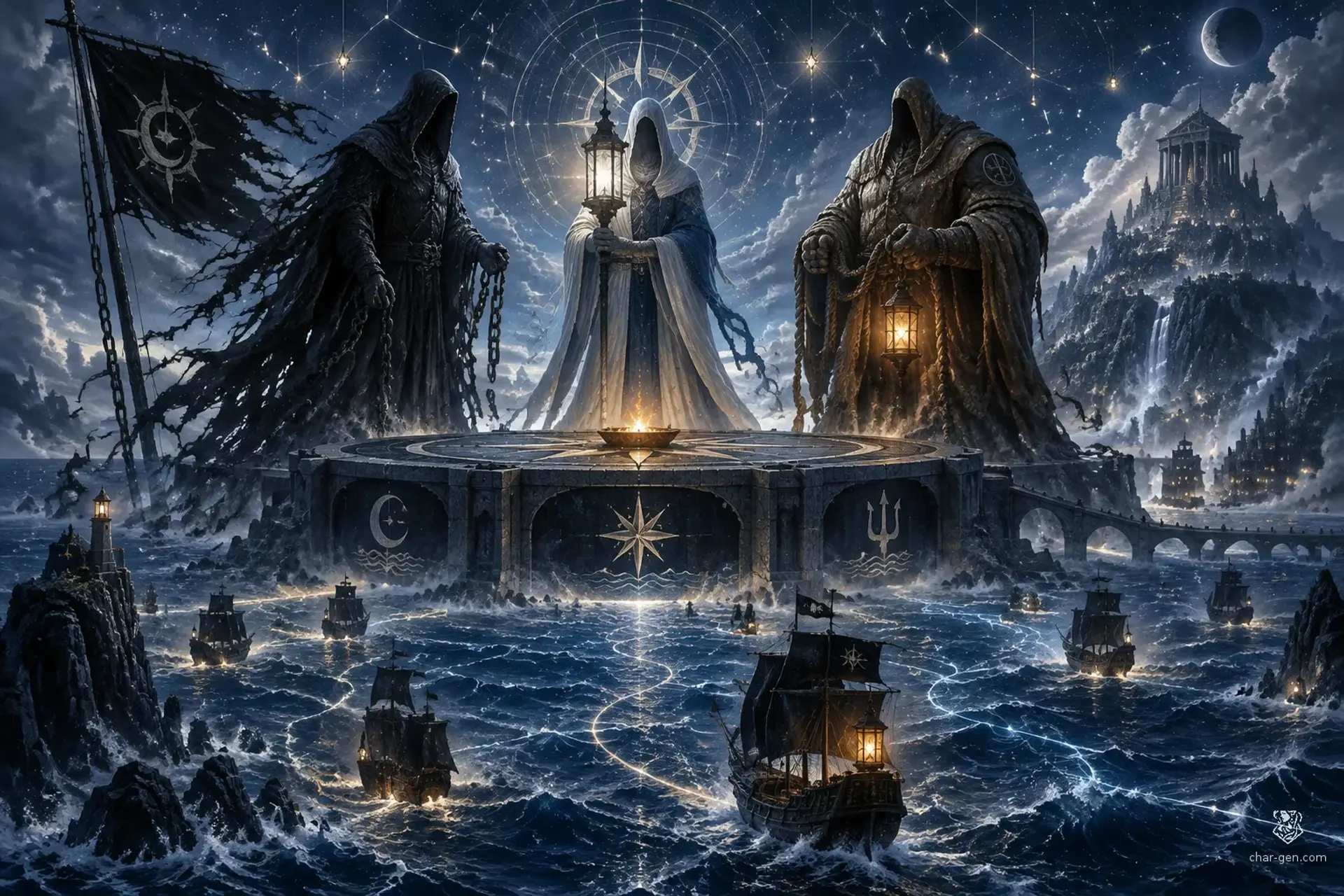
The Sea Farers
The Sea Farers
Invoke a god

Skrev
The Unmoored Captain
Symbol A snapped anchor chain looped around a black pennant.
Holy day The Night of Unmoored Lanterns
- No ruler owns the open sea.
- Share the danger and the gain with your crew.
- Break unjust chains, but do not pretend that betrayal is freedom.
The gods
3Skrev
The Unmoored Captain
Lesser Deity · Chaotic Neutral
Piracy and rebellion; Skrev challenges Yori’s claim that law can rule every tide. · Risk, plunder, and escape; Pell reminds Skrev that freedom is worth little if a crew is left to drown.
Clever, irreverent, and generous to the desperate, but quick to punish a lie told under his flag. Skrev despises ownership without consent and has little patience for those who mistake freedom for kindness.
Faith
- No ruler owns the open sea.
- Share the danger and the gain with your crew.
- Break unjust chains, but do not pretend that betrayal is freedom.
Holy dayThe Night of Unmoored Lanterns, when crews set adrift a lantern for every chain they have escaped.
Holy textThe Unclaimed Wake, a shifting collection of shipboard oaths, escape tales, and warnings against captains who become tyrants.
RitesBefore a voyage, crew members cast a coin into the wake and promise one thing they will never surrender. · A captain accused of abusing their crew must answer charges before the ship’s company. · At a successful escape, sailors cut a knot from a rope and leave it on a shore shrine.
ValuesFreedom · Cunning · Loyalty among chosen companions
Look
SymbolA snapped anchor chain looped around a black pennant.
- Tar black
- Tarnished gold
- Sea green
AnimalsGulls · Octopuses
AppearanceA lean figure in a patched coat of sailcloth, with a grin like a cut rope and a crown of mismatched coins. Skrev’s shadow always seems to lean toward an open sea.
Followers
WhoPirates, smugglers, mutineers, escaped prisoners, and coastal rebels who oppose cruel monopolies.
BeliefsFollowers believe the sea grants no one a throne and that every crew must choose its own rules. Many respect Pell’s rescue ethic, even when they fear Yori’s courts.
The faith
How it began
In the oldest harbor story, a single storm scattered the first fleet across an uncharted sea.
Skrev led the desperate survivors through a forbidden channel, Yori held the harbor against raiders until the fleet could return, and Pell kept the crews alive on the long passage between them. Each claimed the voyage had taught the world its most necessary lesson, and so the three became an assembly rather than a single ruler.
The heavens
The world is a vessel afloat on the Endless Deep, whose currents are shaped by the three divine callings.
Skrev opens untamed routes through hidden waters, Yori lays safe channels and keeps the harbors accountable, and Pell carries ordinary ships between them. The stars are said to be lanterns hung by the first sailors; storms are the sea’s reminders that no route belongs to mortals forever.
Gods and mortals
The Sea Farers are directly involved in mortal life.
Their priests bless departures, settle disputes, maintain rescue stores, and advise captains; their agents may appear in storms, courts, or shipboard crises. The gods’ influence is real but not absolute: weather remains dangerous, and mortals must still make hard choices.
After death
The drowned and the dead sail to the Far Shoals, where each soul must choose a captain.
Those who follow Skrev slip into the hidden coves of the afterlife; those who trust Yori pass through her bright harbor courts; those who heed Pell board his quiet vessel and voyage beyond the horizon. The three routes meet at the Last Beacon, where the dead may reconcile old debts before setting out.
What people say, what is true
Players may hear
For the GM
Plot hooks
Conflicts
The wars
Skrev teaches that no crown owns the sea, bringing him into constant conflict with Yori, who claims that laws and rescue duties must reach every coast.
Pell mediates between them, but his insistence that no vessel be abandoned frustrates Skrev’s hard bargains and Yori’s strict judgments. Their fiercest dispute concerns wrecks: Skrev sees salvage as freedom, Yori demands evidence and restitution, and Pell insists the living must be rescued before anything is claimed.
| Skrev | Yori | Pell | |
|---|---|---|---|
| E | A | ||
| E | A | ||
| A | A |
Order of heaven
Structure
The religion has no single high priest.
Coastal communities maintain three linked institutions: Skrev’s loose shipboard fellowships, Yori’s organized marine chapels and harbor courts, and Pell’s practical guilds of navigators, pilots, and rescue crews. A rotating Harbor Moot brings their representatives together to coordinate rescues, settle jurisdictional disputes, and negotiate shared rules for dangerous waters.
Theme
The freedom to choose one’s course, the duty to protect the waters, and the solidarity that carries a crew home.
Tone
Mortal-engaged: divine influence is visible in maritime life, but sailors, marines, and pirates still shape their own fates through courage, skill, and choice.
Alignments
The assembly spans a range of convictions: Skrev is Chaotic Neutral, Yori is Lawful Good, and Pell is Neutral Good.
Their faithful disagree over whether freedom, duty, or mutual aid should govern life at sea.
Media
0 imagesNo images yet.
Turn The Sea Farers into a sheet
A high-res, share-ready sheet you can post or print.