
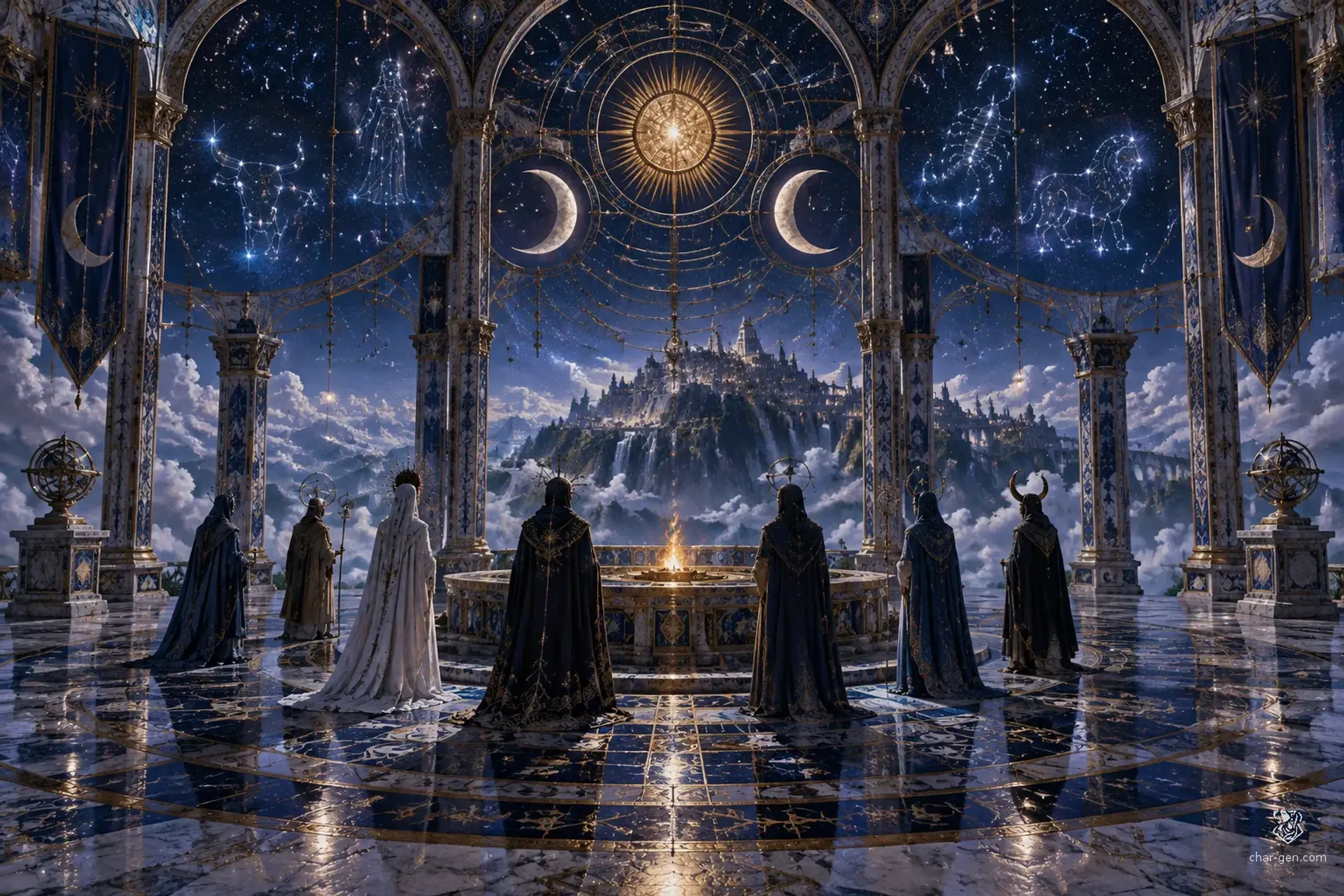
Unnamed pantheon
Unnamed pantheon
Invoke a god

Aurelho
The Noon Sovereign
Symbol A golden disk divided by a straight vertical line.
Holy day The Long Measure
- Keep promises in daylight and in darkness.
- Let no judgment outrun its evidence.
- Accept that a measured order can still be distant from justice.
The gods
7Aurelho
The Noon Sovereign
Greater deity · Lawful Neutral
Light · Order · Sun · judgment measured against Vespera's secrets
Patient, exacting, and almost impossible to surprise. Aurelho regards Bruma as a necessary counterweight and Vespera as a danger that must be watched, not destroyed.
Faith
- Keep promises in daylight and in darkness.
- Let no judgment outrun its evidence.
- Accept that a measured order can still be distant from justice.
Holy dayThe Long Measure, observed at the summer solstice with a silent vigil from dawn to dusk.
Holy textThe Tables of Noon, a collection of brief maxims copied onto sun-bleached ceramic.
RitesMark a threshold with a disk of gold paint before taking public office. · At noon, read one line from the Tables of Noon in silence. · When a dispute is settled, leave a small unlit lamp for Vespera.
ValuesOrder · clarity · patience
Look
SymbolA golden disk divided by a straight vertical line.
- gold
- white
- deep blue
Animalslion · falcon
AppearanceAurelho appears as a crowned figure of burnished copper, face hidden behind a radiant disk. He casts no shadow in the sky, though his light reveals the shadows cast by Bruma and Vespera.
Followers
WhoJudges, astronomers, rulers, architects, and those who keep public records.
BeliefsFollowers believe that truth is not always kind, but that it is safer than convenient falsehood. They acknowledge that Vespera guards necessary secrets even as they seek Aurelho's clarity.
The faith
How it began
In the oldest account, the world was an unlit observatory.
Aurelho kindled the first lamp, Bruma and Vespera divided its reflection, and four patterns appeared in the dark: Ildar's road, Arzabal's burden, Soreia's hearth, and Otxan's escape. No version explains who built the observatory or why its ceiling has no edge.
The heavens
The heavens are a vast, silent observatory whose celestial bodies keep watch over one another but rarely intervene.
Aurelho crosses the upper vault by day; Bruma and Vespera circle the unseen underside of night, alternately waxing and waning. The four great constellations— Ildar, Arzabal, Soreia, and Otxan—mark the cardinal stations of the sky. Mortals read their shifting relationships as omens, though the gods themselves do not explain them.
Gods and mortals
The gods are distant: they rarely grant unmistakable visions, and direct manifestations are the stuff of disputed chronicles.
Their worshippers interpret celestial alignments, weather, dreams, and coincidence as signs, often disagreeing. Clerics may receive magic without receiving clear answers; the assembly's silence is considered part of its nature, not proof of abandonment.
After death
The dead travel as dim lights along the road between the moons.
Those who kept their vows are welcomed into the House of the Unsetting Sun; others drift among the stars until their names are spoken by the living or fade beyond the heavens. No priest can promise a place there.
What people say, what is true
Players may hear
For the GM
Plot hooks
Conflicts
The wars
The Sun-King Aurelho insists that the heavens require a single, measured order, while Vespera, the waning moon, conceals truths that his light would expose.
Bruma, the waxing moon, tries to keep their struggle from consuming the mortal calendar. The four constellations quarrel over what human lives mean: the navigator Ildar favors chosen journeys, the bull Arzabal demands endurance, the handmaid Soreia protects fragile bonds, and the wolf Otxan would rather break the pattern entirely.
| Aurelho | Bruma | Vespera | Ildar | Arzabal | Soreia | Otxan | |
|---|---|---|---|---|---|---|---|
| A | E | A | E | ||||
| A | A | E | |||||
| E | E | A | A | ||||
| A | E | A | |||||
| A | A | E | |||||
| A | A | E | |||||
| E | A | A | E |
Order of heaven
Structure
The religion has no universal hierarchy.
Local temples are observatories, tiled courtyards, mountain shrines, and household altars. A sky-reader or keeper may lead a community, but authority is negotiated among specialists: solar judges, lunar dream-interpreters, road-guides, contract-keepers, hearth-tenders, and wilderness devotees. Most communities honor all seven while keeping one deity as a patron. Shared festivals follow celestial events, yet calendars differ by region, and disputes over interpretation are common.
Theme
The heavens offer patterns, not explanations.
People seek direction in distant celestial powers, then must decide what those signs mean and who bears the cost of acting upon them.
Tone
Distant, contemplative, and quietly uncanny.
The gods are visible in the sky but seldom near at hand; their beauty can comfort or unsettle, and their silence leaves mortals responsible for their own choices.
Alignments
Varied: the assembly includes lawful, neutral, and chaotic powers, with good, neutral, and evil dispositions.
Its distance from mortal affairs prevents any single moral faction from ruling it.
Media
0 imagesNo images yet.
Turn Unnamed pantheon into a sheet
A high-res, share-ready sheet you can post or print.