
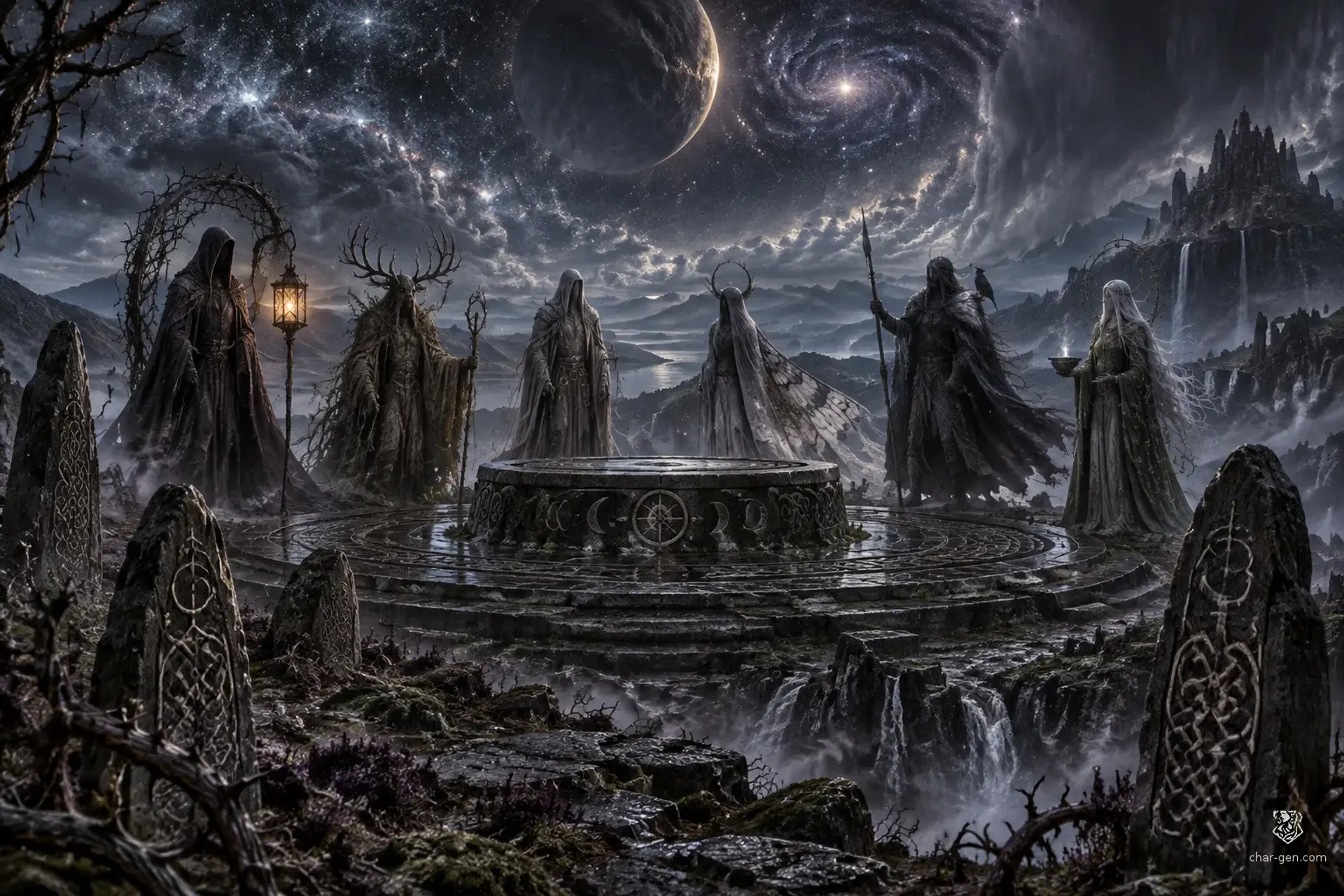
Gods of the Thistle
Gods of the Thistle
Invoke a god
Ailith
Keeper of the Kindly Threshold
Symbol A lantern hanging within a thorn-ringed doorway.
Holy day The First Hearth
- Offer shelter before judgment.
- A threshold is a promise, not a wall.
- Never invite a guest across a boundary by deceit.
The gods
6Ailith
Keeper of the Kindly Threshold
Greater · Neutral Good
Twilight and sanctuary; Ailith keeps the thresholds Eòghan roots into the land and guides travelers toward Dùghall's safe passage.
Quietly compassionate, watchful, and difficult to hurry. She gives refuge without asking whether it is deserved, but remembers those who abuse it.
Faith
- Offer shelter before judgment.
- A threshold is a promise, not a wall.
- Never invite a guest across a boundary by deceit.
Holy dayThe First Hearth, observed on the longest night with a place set for a stranger.
Holy textThe Book of the Open Door, a collection of short invocations and accounts of shelter given.
RitesLeave a lamp burning for late travelers. · Tie a sprig of heather above a doorway. · Ask permission before crossing a marked threshold.
ValuesHospitality · Mercy · Guarded boundaries
Look
SymbolA lantern hanging within a thorn-ringed doorway.
- Moss green
- Lantern gold
AnimalsHare · Barn owl
AppearanceA veiled figure in a grey-green mantle, holding a lantern whose flame burns without heat. Her face is usually turned toward whoever stands outside in the rain.
Followers
WhoInnkeepers, healers, travelers, twilight clerics, and those who hide the pursued.
BeliefsHer followers believe that a well-kept threshold can hold back both mortal violence and Fae mischief, though no door can bar every power forever.
The faith
How it began
In the oldest account, the world was a pathless moor beneath a sky without stars.
The first thorn caught the moon's reflection; from its six branches came Ailith, Eòghan, Dùghall, Sgàthach, Taran, and Mòrna. They set boundaries, seasons, endings, roads, storms, and healing in motion, but left the making of daily life to mortals and the Fae.
The heavens
The world is a braided knot of three realms: the Mortal Land, the Fae's Near Country, and the distant Halls Beyond.
They touch at wells, standing stones, thorn brakes, and shorelines at low tide. Ailith tends the thresholds, Eòghan binds the living land, and Dùghall tends the passage of souls; none rules the whole. The Fae are ancient neighbors rather than subjects of the gods, and their bargains can bend the paths between realms.
Gods and mortals
The gods are distant and rarely answer prayer with unmistakable signs.
Their worship is organized through scattered shrines, family rites, seasonal gatherings, and a few keepers who tend standing stones. Clerics interpret omens rather than receive clear commands. Mortals treat the Fae with wary courtesy: a deity may guard a threshold or record a loss, but no god routinely cancels the consequences of a mortal bargain.
After death
The dead travel west along the Grey Road, visible only at dusk as a thread of light across the moors.
Ailith keeps its first gate; those who lived with courage may pass into the quiet halls beyond. Others linger in the Fae's Near Country, where Dùghall weighs their promises and Sgàthach may bargain for their release. No priest can promise that the dead will be welcomed home unchanged.
What people say, what is true
Players may hear
For the GM
Plot hooks
Conflicts
The wars
Ailith's insistence on sanctuary clashes with Taran's demand that every oath be answered, while Mòrna quietly tests the boundary between justice and vengeance.
Dùghall and Sgàthach dispute who may claim those lost in the Fae's Near Country. Eòghan's patient keeping of the land frustrates Sgàthach's appetite for change, and Taran's storms can undo the careful balance Ailith and Eòghan try to preserve.
| Ailith | Eòghan | Dùghall | Sgàthach | Taran | Mòrna | |
|---|---|---|---|---|---|---|
| A | A | E | ||||
| A | E | A | ||||
| A | E | A | ||||
| E | E | A | ||||
| E | A | E | ||||
| A | A | E |
Order of heaven
Structure
There is no central church.
Local shrines honor whichever gods matter most to a community, while stone-circle keepers maintain shared seasonal rites. A village may have an Ailith-tended hearth shrine and an Eòghan grove, with Dùghall's name invoked at funerals. Priests do not claim to speak for the whole pantheon. The six are honored together at midsummer and midwinter, when people leave six small offerings at a crossroads and depart without looking back.
Theme
A remote, morally varied divine assembly shaped by hospitality, land, memory, bargains, vengeance, and healing.
The pantheon is less a family of protectors than a set of powers whose uneasy balance leaves mortals responsible for their choices.
Tone
Distant, mist-laden, and solemn.
The gods rarely intervene openly; their presence is felt through weather, old customs, uncanny coincidences, and the consequences of vows. The Fae are near enough to bargain with, but never safe enough to trust.
Alignments
The six span lawful good, neutral good, lawful neutral, true neutral, chaotic neutral, and chaotic evil.
Their differences are understood as necessary tensions in a world where mortal law, wild nature, and Fae whim rarely agree.
Media
0 imagesNo images yet.
Turn Gods of the Thistle into a sheet
A high-res, share-ready sheet you can post or print.