
The Far Meridian
The Far Meridian
Invoke a god
Ilyet
Keeper of the Long Chart
Symbol A seven-point star crossed by a single fine line.
Holy day The Night of Recalibration
- Keep records without pretending they are certainty.
- Do not mistake a forecast for an order.
- Let each generation read the chart anew.
The gods
12Ilyet
Keeper of the Long Chart
Greater · Lawful Neutral
Fate and celestial charts, which Surn interprets as prophecy · Stars and measured time, guarded at the edge of Oruun's dark
Patient, remote, and exacting. Ilyet records outcomes without claiming to understand them, and regards Edran's interventions as beautiful but difficult to chart.
Faith
- Keep records without pretending they are certainty.
- Do not mistake a forecast for an order.
- Let each generation read the chart anew.
Holy dayThe Night of Recalibration, held on the year's longest night.
Holy textThe Long Chart, a collection of star tables annotated across centuries.
RitesCopy a night's stars before dawn. · Leave an empty place in every chart for what cannot be known. · Keep a vigil in silence when a prediction fails.
ValuesPatience · Precision · Continuity
Look
SymbolA seven-point star crossed by a single fine line.
- indigo
- silver
Animalsmoth · white owl
AppearanceA tall, veiled figure whose face is a chart of cold stars; Tamas's lantern is always a distant point behind the veil.
Followers
WhoAstronomers, archivists, navigators, and rulers seeking counsel without guarantees.
BeliefsFollowers believe every life leaves a mark in the heavens, but only the rarest devotee may hear Ilyet speak directly. Such contact is treated as an unsettling exception, not a reward.
The faith
How it began
In the first darkness, twelve lights appeared at the edge of the world and began to move in a pattern no one could read.
The gods arose as keepers of that pattern, not its makers. Ilyet named the moving course the Long Chart, while Keth rejected the claim that naming a road meant it had to be followed. Mortals came later, and their choices became the smallest, brightest marks upon the heavens.
The heavens
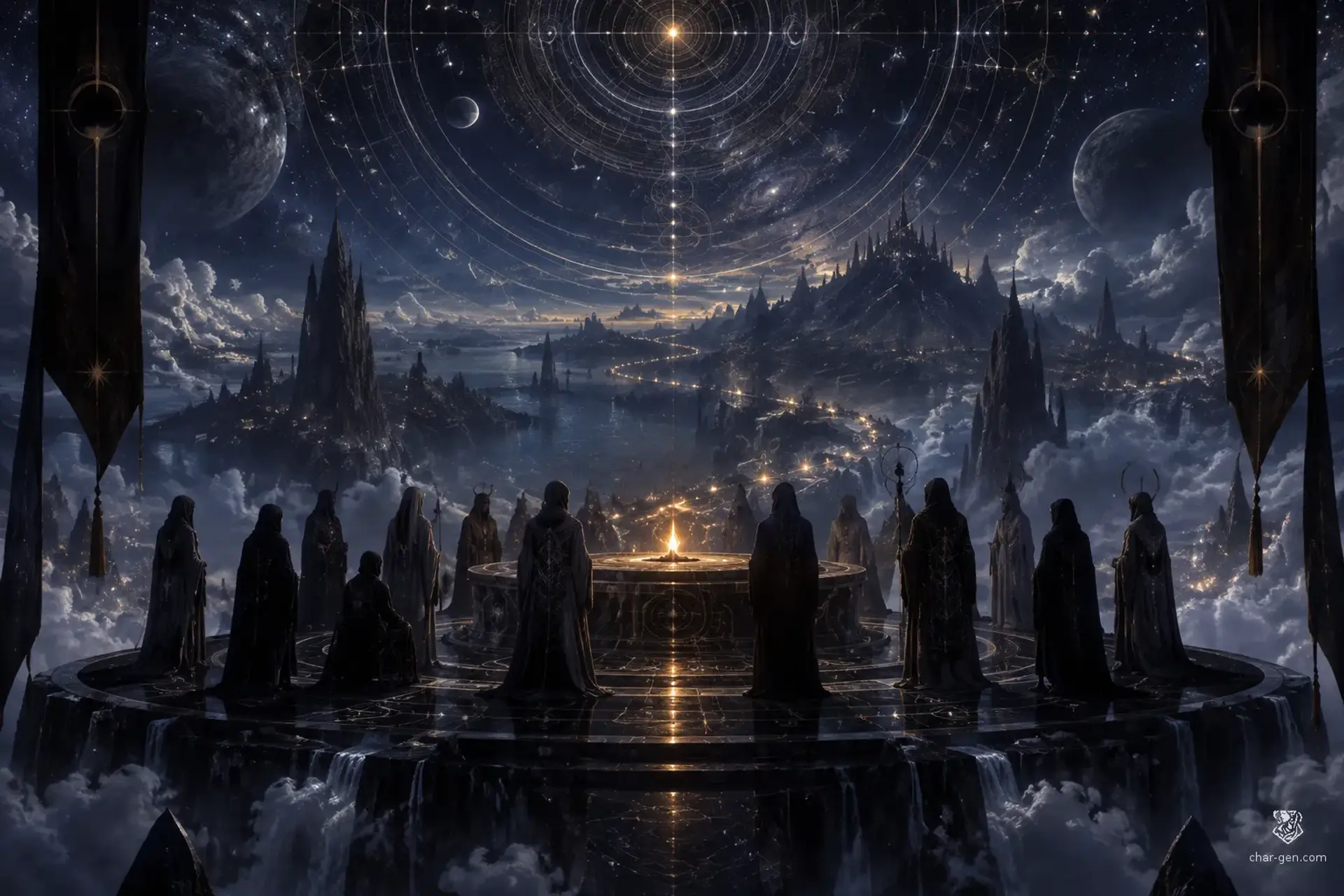
The cosmos is a dark ocean crossed by the Star-Road, a vast and changing pattern of lights.
The gods dwell at its remote stations, each keeping one measure of mortal existence: birth, choice, loss, memory, or ending. Ilyet charts the Road, but no deity commands it alone. Mortals' choices appear as brief sparks upon the chart; enough sparks can alter a constellation, though the change may take generations to reach divine notice.
Gods and mortals
Most people honor several gods according to circumstance rather than choosing a single patron.
A birth may be marked for Ygri, a contract sworn before Hadrik, and a funeral entrusted to Nereth. Temples are commonly small observatories, roadside lantern houses, public record rooms, or quiet shrines beside water. Priests offer counsel and ritual, but discourage claims that the gods have plainly dictated a mortal decision. The rare person who speaks directly with a deity is regarded with awe, suspicion, and concern; such encounters do not establish authority over others.
After death
At death, a soul becomes a faint star on the Long Chart, a celestial map tended by Ilyet.
The dead do not receive a guaranteed judgment or reunion: their lights drift toward the constellation most like the life they led. Vask keeps the uncharted dead until their names are remembered, while Oruun's priests teach that even the brightest star may eventually go dark.
What people say, what is true
Players may hear
For the GM
Plot hooks
Conflicts
The wars
Ilyet's effort to keep the Long Chart legible is opposed by Vask, who protects the unrecorded, and by Keth, who believes fate should be severed.
Surn and Tamas contest whether prophecy should guide rulers or ordinary people; Edran's mercy frustrates both. Oruun seeks the final silence of all stars, while Ygri insists that endings must make room for beginnings. Even allies such as Hadrik and Pelya quarrel over whether a promised future is worth the suffering required to reach it.
| Ilyet | Tamas | Surn | Keth | Ygri | Edran | Hadrik | Vask | Nereth | Oruun | Garran | Pelya | |
|---|---|---|---|---|---|---|---|---|---|---|---|---|
| A | E | A | E | |||||||||
| E | E | A | ||||||||||
| A | E | E | A | |||||||||
| E | E | A | A | |||||||||
| E | A | A | E | |||||||||
| A | E | A | E | |||||||||
| A | A | E | E | |||||||||
| E | A | A | E | |||||||||
| A | E | A | E | |||||||||
| E | A | E | A | |||||||||
| A | E | A | E | |||||||||
| A | E | A | E |
Order of heaven
Structure
The religion has no universal hierarchy.
Local observatories and shrines are maintained by keepers, readers, and vow-witnesses, while regional councils gather when multiple temples must coordinate. Ilyet's chart-keepers preserve astronomical records; Hadrik's witnesses mediate disputes; Nereth's passage-keepers tend funerals. Rival sects may disagree sharply without denying one another's gods. Direct divine contact confers no automatic office or right to command, and the rarity of such speech makes any claim a matter for careful, communal discernment.
Theme
Fate as a distant pattern that can be glimpsed but not safely obeyed; mortal choice as a small light capable of changing what the heavens will one day record.
Tone
Distant, contemplative, and quietly uncanny.
The gods are real but seldom intimate; signs are ambiguous, revelations rarer still, and ordinary acts of care or defiance matter more than certainty.
Alignments
The Twelve range from lawful good to chaotic evil, with no single moral doctrine binding them.
Their faithful agree that fate is real, but disagree over whether it is a road, a debt, a pattern, or merely a name mortals give to chance.
Media
0 imagesNo images yet.
Turn The Far Meridian into a sheet
A high-res, share-ready sheet you can post or print.