
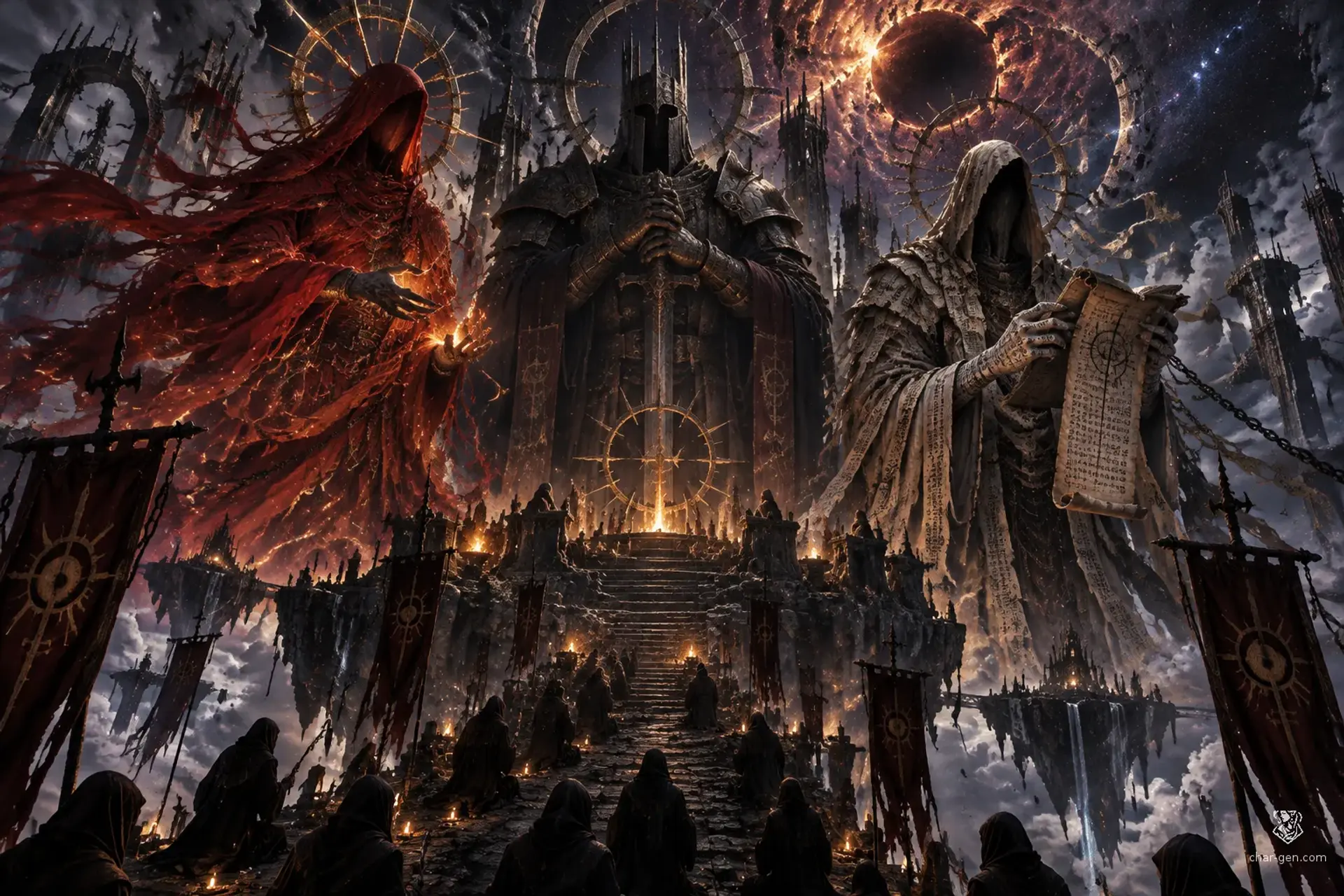
The Ashen Triad
The Ashen Triad
Invoke a god

Sheshara
The Unruly Flame
Symbol A cracked bell with a flame rising from its hollow clapper.
Holy day The Unfastening
- Break what claims it cannot be broken.
- Make the mighty laugh, then make them afraid.
- Never let a settled peace go untested.
The gods
3Sheshara
The Unruly Flame
Greater · Neutral Evil
Chaos and upheaval, which she unleashes against Kzhor's attempts to impose order · Mischief and destructive revelry, celebrated in the broken streets where Othíren's agents leave false clues
Playful, impulsive, and cruelly curious. She treats suffering as a punchline and becomes furious when events unfold predictably.
Faith
- Break what claims it cannot be broken.
- Make the mighty laugh, then make them afraid.
- Never let a settled peace go untested.
Holy dayThe Unfastening, observed on the year's longest night with bonfires, overturned tables, and the public destruction of one unjust rule.
Holy textThe Laughing Ruin, a collection of contradictory parables whose margins are said to change overnight.
RitesStage a midnight prank against a powerful institution, leaving a cracked-bell mark behind. · Speak one deliberate falsehood during a feast, then reveal it before dawn. · At the Unfastening, destroy a personal possession that represents obedience.
ValuesDisruption · Daring · Surprise
Look
SymbolA cracked bell with a flame rising from its hollow clapper.
- Scarlet
- Soot-black
AnimalsMagpie · Hyena
AppearanceA laughing figure veiled in strips of scarlet silk, with a face that changes whenever a witness blinks. Sparks spill from the gaps in her ribs, and her shadow dances a heartbeat ahead of her.
Followers
WhoRioters, pranksters turned arsonists, anarchic mercenaries, and those who resent every authority but seek no gentler replacement.
BeliefsHer worshippers believe that order is a brittle lie and that every upheaval reveals who truly holds power. They claim Sheshara favors audacity, not justice, and that a clever catastrophe is a kind of prayer.
The faith
How it began
At the world's beginning, a wound opened in the void.
Kzhor forged its edges into walls and laws; Sheshara slipped through and made the new creation unpredictable; Othíren collected the first casualties' names and bound their resentments to the world. The Three have competed ever since, each claiming that mortal suffering proves their vision correct.
The heavens
The world was hammered from the First Wound, a rupture in nothingness.
Kzhor forged its boundaries from the wound's burning edges; Sheshara leapt through the gap and taught creation to break its own rules; Othíren gathered what the other two discarded—grudges, secrets, and the names of the dead—and made them endure. The heavens are a storm above the world, the underworld a tribunal below it, and mortal life is the contested ground between.
Gods and mortals
The Three rarely grant aid without demanding an act that spreads fear, disorder, or dependence.
Clerics and warlocks may serve one deity openly, while secret societies invoke all three to set a crisis in motion, seize control, and profit from the revenge that follows. Their faith is outlawed in many realms, but rulers sometimes tolerate Kzhor's temples when they need compliant enforcers.
After death
The dead descend to the Ashen Tribunal, where their lives are weighed beneath a storm of falling embers.
Those who served the Three are assigned to the realm matching their final allegiance: the riven revels of Sheshara, the iron bastions of Kzhor, or the silent galleries of Othíren. The condemned are not judged for cruelty itself, but for having suffered it without making it useful to the gods.
What people say, what is true
Players may hear
For the GM
Plot hooks
Conflicts
The wars
Sheshara delights in disorder that undermines Kzhor's hard-won dominions, while Kzhor insists that chaos must eventually be harnessed into rule.
Othíren feeds both rivalries, arranging betrayals and reprisals so that neither can claim a lasting victory. Their followers turn these divine tensions into street uprisings, punitive campaigns, and cycles of revenge.
| Sheshara | Kzhor | Othíren | |
|---|---|---|---|
| E | A | ||
| E | A | ||
| A | A |
Order of heaven
Structure
The faith has no universal hierarchy.
Sheshara's loose circles gather around charismatic instigators; Kzhor's temples resemble military garrisons led by ordained commanders; Othíren's discreet custodians preserve archives and recruit through personal debts. Regional conclaves convene only when a crisis threatens all three traditions, and such meetings are notorious for ending in accusations or violence.
Theme
An evil divine assembly whose gods turn chaos, domination, and vengeance into mutually reinforcing engines of suffering.
Sheshara causes upheaval for delight and teaches her followers to make it contagious.
Tone
Wrathful, volatile, and morally bleak.
Divine favor does not bring comfort: it sharpens anger, rewards cruelty, and makes every apparent victory the beginning of another reckoning.
Alignments
All three deities are Neutral Evil.
Their methods differ—riot, conquest, and calculated vengeance—but none values freedom or kindness except as instruments.
Media
0 imagesNo images yet.
Turn The Ashen Triad into a sheet
A high-res, share-ready sheet you can post or print.