
The long watchers
The long watchers
Invoke a god
Vraas
Keeper of the Open Hearth
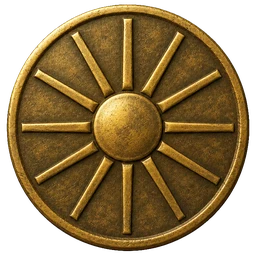
Symbol A sun above a bowl of grain, with one ray shaped like a hearth flame.
Holy day First Hearth
- Share the harvest before storing a surplus.
- Keep an oath made beneath a roof.
- Offer warmth without demanding obedience.
The gods
9Vraas
Keeper of the Open Hearth
Greater · Lawful Good
Sun and harvest, whose seasons Nym's night completes · Hearth and honor, upheld by Mordun's craft
Patient and warm in counsel, but convinced that withholding aid when it is possible is a moral failure.
Faith
- Share the harvest before storing a surplus.
- Keep an oath made beneath a roof.
- Offer warmth without demanding obedience.
Holy dayFirst Hearth, the first evening after the harvest, when families share bread with strangers.
Holy textThe Measure of the Bowl, a collection of harvest oaths and household teachings.
RitesLeave the first loaf of harvest at a communal hearth. · Renew household promises at sunrise.
ValuesGenerosity · Honor · Stewardship
Look
SymbolA sun above a bowl of grain, with one ray shaped like a hearth flame.
- Gold
- Wheat
AnimalsOx · Swallow
AppearanceA vast, sun-faced figure in a plain mantle, carrying a sheaf of grain and a coal that never cools.
Followers
WhoFarmers, cooks, oath-keepers, and village elders who believe divine care should be tangible.
BeliefsFollowers believe Vraas gives the world its seasons but is forbidden to rescue every failing crop; they regard that restraint as a wound in the divine order.
The faith
How it began
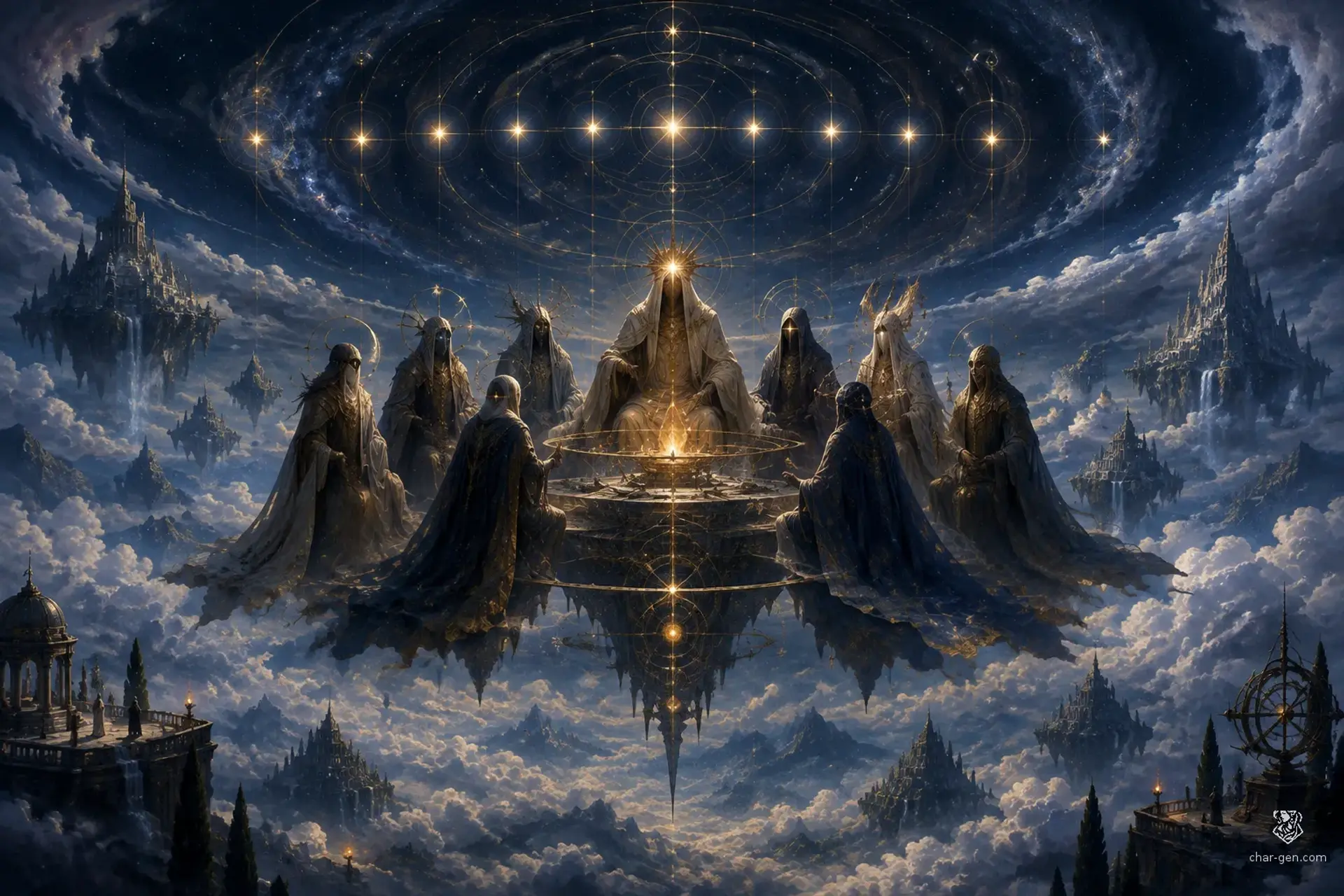
Before the first dawn, nine powers gathered in the Quiet Vast.
Mythra shaped a world from possibility, Mordun gave it form, and The Arbor filled it with life. Vraas set its seasons, Nym its dark, and Iera its memory. Rao taught conflict, Zashaar taught endings, and The one who waits gave every life a boundary. When the gods' interventions threatened to turn the young world into their private contest, they swore the Long Watch: observe, advise, and let mortals decide.
The heavens
The world hangs beneath nine fixed stars, each a window through which one god watches.
Their light falls on the mortal world but cannot touch it directly without consequence. Between the stars lies the Quiet Vast, a place beyond time where the gods meet, argue, and wait. The sun is Vraas's bright eye; Nym governs the dark intervals in which that eye is shut.
Gods and mortals
The gods rarely answer directly.
They act through dreams, omens, coincidences, and the choices of their clergy, each of whom interprets the Watch differently. Their temples are usually modest observatories, archives, workshops, or shared hearths rather than grand palaces. A miracle is treated as both a gift and a troubling precedent.
After death
The dead pass into the Hall of Still Questions, where the One who waits weighs each life without haste.
Iera preserves their memories, while Nym veils what they cannot bear to carry onward. The judged return to the world only as stories, dreams, or warnings; none of the gods can simply restore the dead.
What people say, what is true
Players may hear
For the GM
Plot hooks
Conflicts
The wars
Vraas argues that a god who can prevent famine must do so; The Arbor insists that mortal choices and the balance of wild things matter more than comfort.
Rao wants the gods to arm worthy mortals against existential threats, while The one who waits forbids them to decide whose life is worth saving. Mordun and Mythra dispute whether invention is careful making or beautiful upheaval. Iera records every breach of the Watch, and Nym hides the records that might provoke another. Zashaar warns that unchecked preservation only makes eventual ruin crueler.
| Vraas | Nym | The one who waits | Mordun | Iera | Mythra | Rao | The Arbor | Zashaar | |
|---|---|---|---|---|---|---|---|---|---|
| A | E | A | E | ||||||
| E | A | A | E | ||||||
| A | A | ||||||||
| A | A | E | E | ||||||
| A | A | E | E | ||||||
| E | A | E | A | ||||||
| E | A | E | A | ||||||
| A | A | E | E | ||||||
| E | A | E | A |
Order of heaven
Structure
The religion has no universal priesthood or central authority.
Its nine traditions are called Watches, each tending a different kind of threshold: hearth, sleep, death, workshop, archive, wonder, battlefield, wild boundary, or ruin. Councils of local keepers meet rarely and disagree openly. The observatories that house their records are deliberately built with empty seats, reminders that the gods watch but do not govern.
Theme
Nine gods watch the world they made, divided over whether distance is a sacred restraint or a failure of care.
Their faithful inherit that argument: when does help become control, and when does restraint become abandonment?
Tone
Distant and contemplative.
Divine presence is undeniable but seldom intimate: a season turns, a dream recurs, or a ruin flowers, while the gods remain silent in the high dark.
Alignments
The nine span lawful, neutral, and chaotic convictions, with good, neutral, and evil tendencies represented.
Their disagreements are genuine, but no alignment is a reliable guide to whether a god will intervene: all are bound by the Long Watch.
Media
0 imagesNo images yet.
Turn The long watchers into a sheet
A high-res, share-ready sheet you can post or print.