
The Council
The Council
Invoke a god
Astra
The Kindly Flame
Symbol A lit lantern held in two open hands
Holy day The Open Hand
- Relieve suffering before debating its cause.
- Mercy must not erase the testimony of the harmed.
- Give aid without demanding worship.
The gods
12Astra
The Kindly Flame
Greater · NG
healing offered in tension with Dhoran's judgment · sunlight shared with Sura's changing seasons
Patient and brave, Astra will shelter the guilty from immediate harm but asks Veyra to preserve the truth of what they did.
Faith
- Relieve suffering before debating its cause.
- Mercy must not erase the testimony of the harmed.
- Give aid without demanding worship.
Holy dayThe Open Hand, observed at the first spring thaw with communal meals and free care for the sick.
Holy textThe Book of Unclosed Hands
RitesLight a lamp for each person treated or sheltered. · Share a meal with someone outside one's household. · Speak the name of a harmed person before asking forgiveness.
Valuescompassion · care · courage
Look
SymbolA lit lantern held in two open hands
- gold
- clay red
Animalsdove · sheep
AppearanceA broad-shouldered figure in a plain clay-colored mantle, carrying a lantern whose flame bends toward the injured. Dhoran's iron scales hang from the lantern's handle as a reminder that compassion must see clearly.
Followers
WhoHealers, midwives, disaster responders, and people who have received unexpected help.
BeliefsFollowers believe that every life is a claim upon the living, though Dhoran reminds them that care cannot make every choice harmless.
The faith
How it began
In the first age there was only the First Silence, containing every possibility but choosing none.
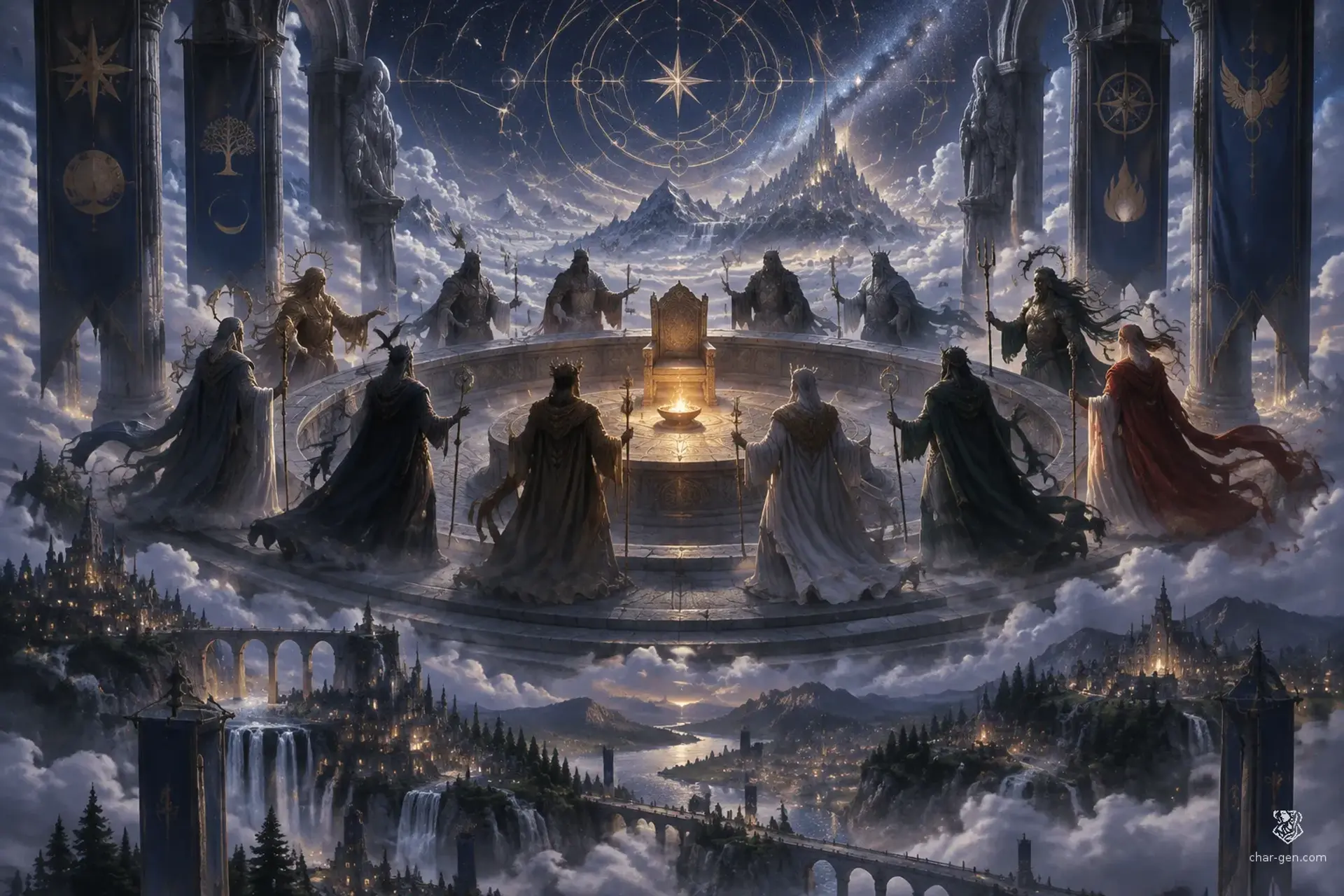
Twelve claims rose from it: care, judgment, change, season, dominion, revolt, craft, memory, passage, dream, revelation, and protection. Their disagreement shaped the world. They tried to resolve their claims through a final assembly, but left the center chair empty when they realized that no divine voice could speak for mortal lives. The Council has endured ever since, not despite its divisions but because each power requires its opposite to remain meaningful.
The heavens
Creation began when the First Silence split into twelve claims about what existence should become.
Their arguments made time, matter, life, and consequence. The Council meets around an unoccupied chair representing the world itself: no god may sit there, and no divine decree can settle every dispute. Their realms overlap at thresholds—bridges, courts, hearths, battlefields, and places where one season becomes another—because each divine power depends on the others to have meaning.
Gods and mortals
The Council's temples are local institutions rather than a unified hierarchy.
A city may maintain shrines to all twelve, with different clergy negotiating shared festivals, relief work, judgments, and funerals. Clerics commonly honor one deity most closely while acknowledging the others as necessary; a priest of Astra may testify before Dhoran, record the case with Veyra, and ask Edris to protect the witnesses. Rival congregations can become political factions, but open conflict between the faithful is considered proof that the gods' argument has been misunderstood. Mortals matter to the Council because their choices turn divine tensions into lived consequences.
After death
The dead arrive at the Turning Court, where the deeds of a life are weighed not against a single law but against the needs they served and the harms they caused.
Veyra keeps the record, Orun opens the road onward, and Namar grants the dead a final audience with one deity they served or opposed. Most souls pass into a fitting realm; some choose reincarnation, while those who deny every bond become quiet stars beyond the Court.
What people say, what is true
Players may hear
For the GM
Plot hooks
Conflicts
The wars
Astra and Dhoran contend over whether justice should repair a wrong or punish it; neither can prevail without the other, since Astra's mercy needs Dhoran's limits and his judgment needs her measure.
Keth and Sura dispute whether change should be planned or unleashed. Ilyat and Brakka contest who owns the fruits of labor, while Veyra insists that every bargain be remembered. The Council's most dangerous disagreement is between Namar and Orun: one would preserve the dead as counsel, the other insists they must be allowed to leave.
| Astra | Dhoran | Keth | Sura | Varkesh | Brakka | Ilyat | Veyra | Orun | Syth | Namar | Edris | |
|---|---|---|---|---|---|---|---|---|---|---|---|---|
| A | E | E | A | |||||||||
| A | E | E | A | |||||||||
| E | A | A | E | |||||||||
| A | E | E | A | |||||||||
| E | A | E | A | |||||||||
| A | E | A | E | |||||||||
| E | E | A | A | |||||||||
| A | E | E | A | |||||||||
| A | E | E | A | |||||||||
| E | A | E | A | |||||||||
| A | E | E | A | |||||||||
| A | E | E | A |
Order of heaven
Structure
The Council has no high priest and no binding scripture shared by every shrine.
Its worship is organized through twelve Orders, each led locally by elders, clergy, and lay stewards. Conclaves meet at seasonal turns to settle practical matters, with seats reserved for each deity and the central chair left empty. Disputes are conducted as formal counter-claims: one Order states a need, another names its cost, and a third proposes a rite or civic remedy. Councils of worshippers may temporarily favor one god's teaching, but no resolution is considered complete until its consequences for the other domains are acknowledged.
Theme
The Council's gods are opposing forces whose conflict sustains them and the world.
Mercy needs judgment to distinguish care from denial; change needs memory to know what it breaks; death needs life to give passage meaning. Their rivalry is real, sometimes painful, and never finally resolved. The religion teaches mortals to live inside that tension, making choices that the gods themselves cannot settle.
Tone
Mortal-engaged and grounded in civic life.
The gods answer prayers, grant spells, appear in dreams, and sometimes intervene directly, but their influence is most visible in courts, workshops, kitchens, roads, hospitals, and public squares. Divine power creates responsibility rather than removing it: mortals must choose how opposing truths apply in particular lives.
Alignments
The Council spans lawful good, neutral good, chaotic good, lawful neutral, true neutral, chaotic neutral, lawful evil, neutral evil, and chaotic evil.
Its members are not a moral consensus: their opposing claims are understood as necessary forces, while individual worshippers choose which obligations to uphold.
Media
0 imagesNo images yet.
Turn The Council into a sheet
A high-res, share-ready sheet you can post or print.