
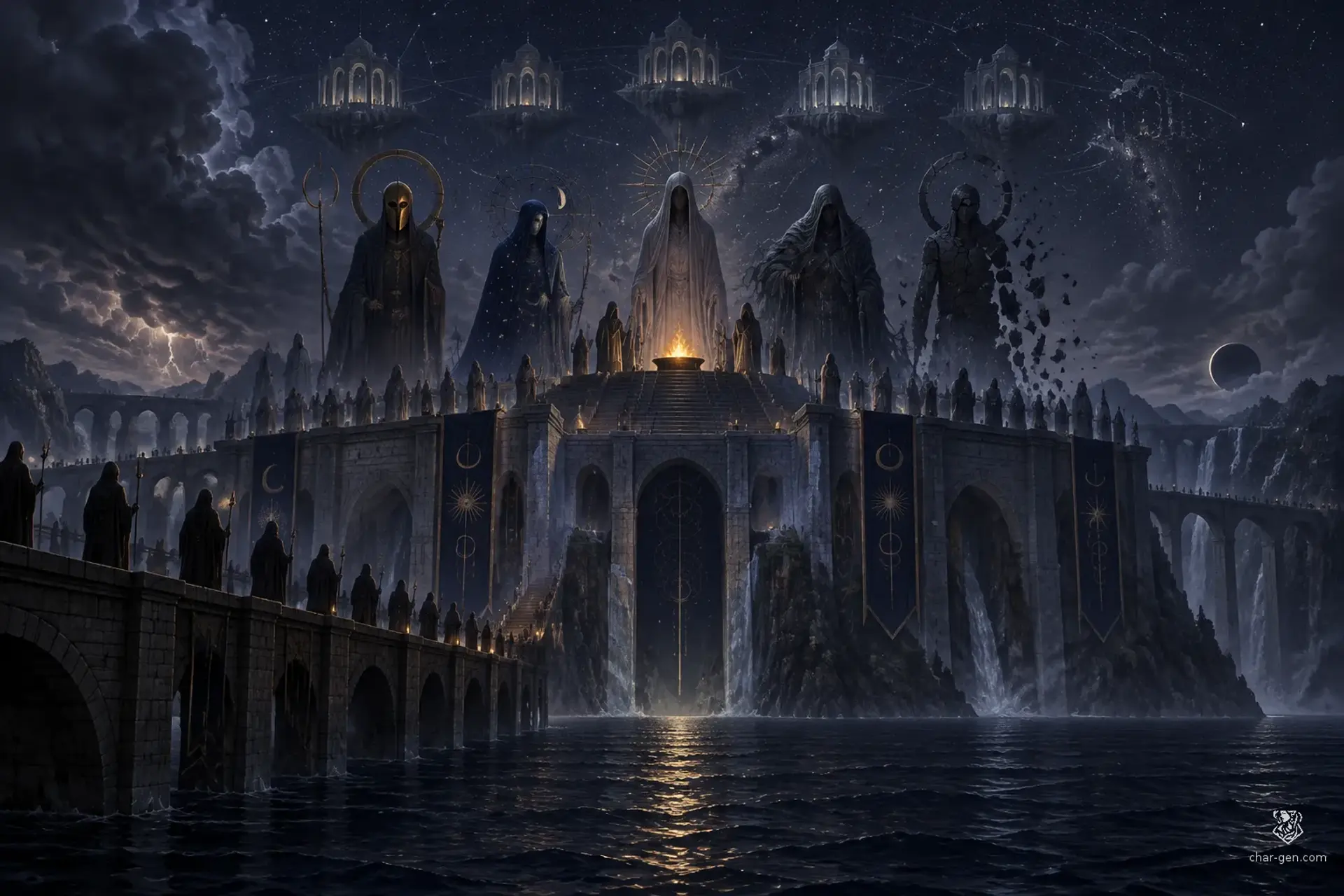
Unnamed pantheon
Unnamed pantheon
Invoke a god

Suth
Keeper of the Last Gate
Symbol A key laid across a closed arch
Holy day The Day of Sealed Doors
- Keep promises that guard others.
- Respect the boundary between the living and the dead.
- Do not mistake a locked door for an invitation to break it.
The gods
12Suth
Keeper of the Last Gate
Greater · Lawful Neutral
Thresholds and lawful boundaries, which Qadir marks in the heavens
Patient, exacting, and remote; Suth rarely intervenes unless a boundary has been violated.
Faith
- Keep promises that guard others.
- Respect the boundary between the living and the dead.
- Do not mistake a locked door for an invitation to break it.
Holy dayThe Day of Sealed Doors, observed at the year's turning.
Holy textThe Measure of Gates
RitesTouch a lintel before crossing a threshold. · Seal important agreements with a shared key-token. · Leave a gate open for the dead on the Day of Sealed Doors.
ValuesDuty · Restraint · Continuity
Look
SymbolA key laid across a closed arch
- Bronze
- Dull blue
AnimalsTortoise · Heron
AppearanceA tall figure in a bronze mask, holding a closed gate on one shoulder and a key on the other.
Followers
WhoJudges, sentries, oath-keepers, and those who guard dangerous places.
BeliefsFollowers believe Suth keeps the world from sliding into the formless dark, though they do not expect the god to notice any one mortal.
The faith
How it began
In the oldest account, Suth shut a gate in the empty dark, and the sound of its closing became the first dawn.
Brask broke a fragment from the gate to make the first land. Edda named the first dead, Qadir set their passing beneath the stars, and the other powers took shape around the needs and dangers of the new world. The priests insist this tale is metaphor, but disagree about what it means.
The heavens
The world rests on a stone plinth raised from a dark, depthless sea.
Above it turn the seven halls of heaven, each separated by a gulf crossed only by divine messengers, dreams, or the dead. The gods convene in the far-off Court of the Meridian, where Suth keeps the threshold and Qadir measures the turning stars. Mortals see only signs of these proceedings: a season out of place, a distant thunderhead, or a familiar constellation gone dark.
Gods and mortals
The gods are distant, and their worshippers cannot count on timely answers.
Most divine influence arrives as omens, strange weather, remembered dreams, or small coincidences. Clerics and other devoted figures interpret these signs imperfectly; temples offer rites and counsel, not guaranteed miracles. Communities commonly honor several deities according to need, while priests argue over which divine customs must never be mixed.
After death
The dead travel down the Quiet Road, where Edda weighs their deeds against the lives they touched.
Those she releases cross into the dim country of the ancestors; those who cling to the world may be detained by Nesh until they surrender their last grievance. The faithful disagree on whether this is a literal journey or a distant dream shared by all mortals.
What people say, what is true
Players may hear
For the GM
Plot hooks
Conflicts
The wars
Suth claims that the world survives through boundaries, while Brask insists that every boundary must eventually break.
Qadir and Volda dispute whether fate is a law to uphold or a burden to loosen. Edda and Nesh contest the care of the dead, and Hroth's storms repeatedly undo the works of Tarek and Gell.
| Suth | Brask | Edda | Qadir | Hroth | Tarek | Gell | Volda | Nesh | Gwyn | Celyn | Orm | |
|---|---|---|---|---|---|---|---|---|---|---|---|---|
| E | A | A | E | |||||||||
| E | A | E | A | |||||||||
| A | E | A | ||||||||||
| A | A | E | ||||||||||
| A | E | A | ||||||||||
| E | A | E | A | |||||||||
| A | A | E | ||||||||||
| A | E | A | ||||||||||
| AE | E | A | ||||||||||
| E | A | A | ||||||||||
| A | A | E | ||||||||||
| E | A | E | A |
Order of heaven
Structure
The religion has no central authority.
City temples maintain local calendars and public rites, while roadside shrines serve travelers and household altars honor whichever gods a family needs. Priests may specialize in one deity but are expected to know the customs of the whole assembly. Disputes are settled by councils of local keepers, though distant sanctuaries sometimes refuse to recognize one another's rulings. The most respected religious duty is tending a shrine that no one else remembers.
Theme
A distant divine order gives meaning to mortal customs but offers no guarantee of rescue.
People make their own lives amid old laws, uncertain omens, and forces too vast to care about them individually.
Tone
Distant and classically mythic: gods are vast presences glimpsed in signs, seasons, and old stone, rarely intimate and never reliably available.
Their worshippers inherit ancient rites but must face the dangers of the world with mortal judgment.
Alignments
The assembly spans lawful, neutral, and chaotic convictions, with good, indifferent, and cruel powers represented.
No single moral faction rules it: Suth and Qadir favor order, while Brask and Nesh delight in its disruption.
Media
0 imagesNo images yet.
Turn Unnamed pantheon into a sheet
A high-res, share-ready sheet you can post or print.