
Masters of the Jade Mountain
Masters of the Jade Mountain
Invoke a god

Lianru
Keeper of the Celestial Register
Symbol A jade tablet bound with a red cord
Holy day The First Register
- Keep the record faithfully.
- Preserve knowledge through war and change.
- Let mercy amend a rule, but never erase the truth.
The gods
12Lianru
Keeper of the Celestial Register
Greater · Lawful Neutral
Knowledge · Order; Lianru's records preserve the precedents that Xunwei's laws depend upon.
Patient, exacting, and quietly compassionate, Lianru believes that a well-kept record is the first protection against injustice.
Faith
- Keep the record faithfully.
- Preserve knowledge through war and change.
- Let mercy amend a rule, but never erase the truth.
Holy dayThe First Register, at the opening of the new year.
Holy textThe Jade Register
RitesCopy a family name into a public register. · Offer ink and tea before beginning a difficult judgment. · Read the names of the dead at dawn.
Valuesmemory · measured judgment · mercy
Look
SymbolA jade tablet bound with a red cord
- jade green
- ivory
Animalscrane · white hare
AppearanceA serene elf in pale robes, seated behind a screen of green jade; Xunwei's seal rests beside her, though she seldom looks toward it.
Followers
WhoArchivists, magistrates, tutors, and elven families charged with preserving ancestral records.
BeliefsFollowers believe that every act leaves a trace in the heavens, and that honest remembrance allows a soul and a society to mend.
The faith
How it began
In the first age, the elves found twelve jade tablets scattered across an empty mountain.
Each tablet bore a celestial office but no name. The first spirits to claim them became the divine assembly; later generations shaped their court according to the models of earthly dynasties. The gods' origin remains distant and disputed, and no account explains who made the tablets.
The heavens
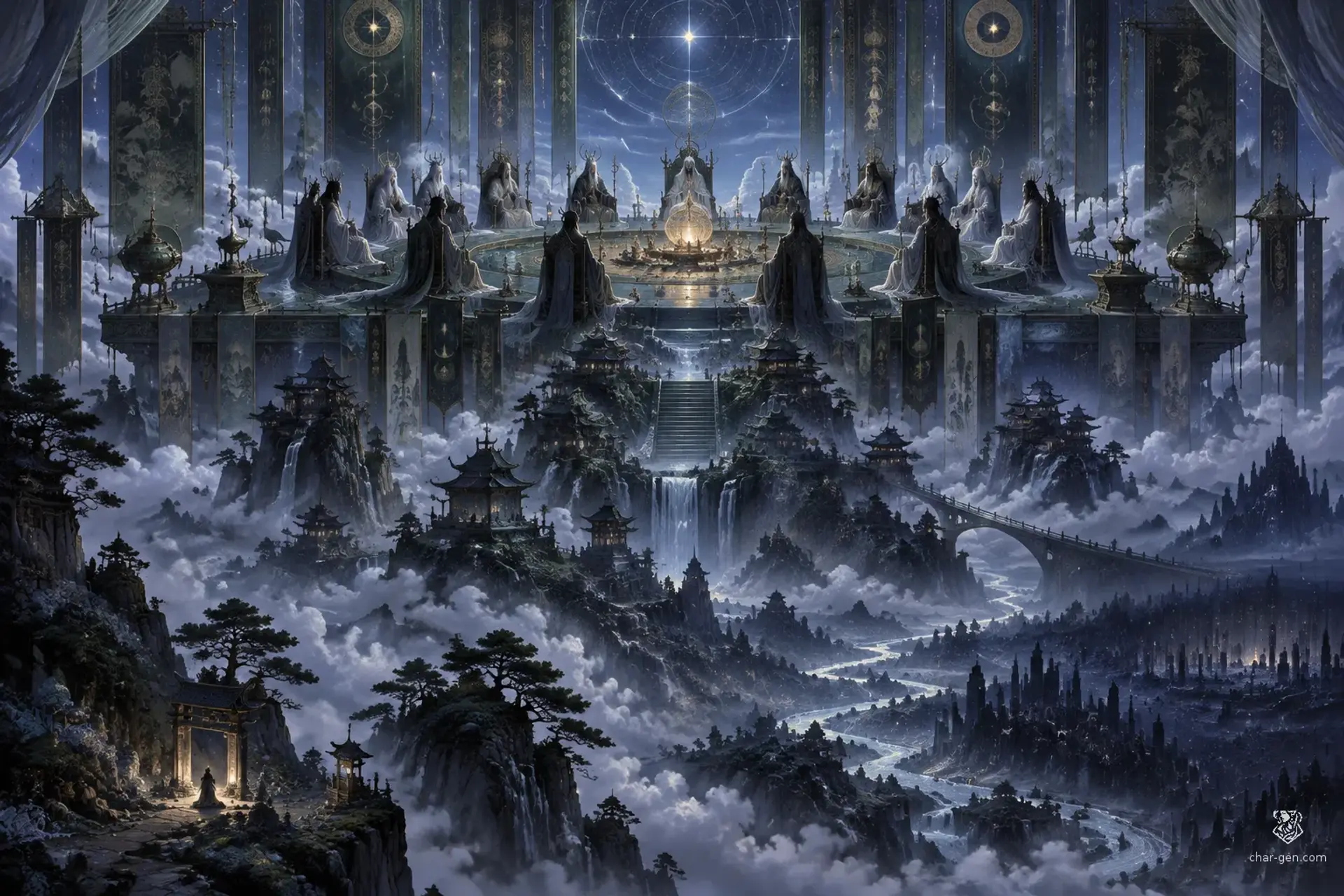
The world rests beneath the Jade Mountain, whose twelve ridges are the seats of the divine assembly.
Above it turns the Celestial Bureaucracy, below it flows the Jade River, and between them lies the mortal realm, a temporary province in a vast and largely indifferent order. The mountain's summit is said to touch the Pole Star, while its roots descend into the halls of the dead.
Gods and mortals
The gods rarely speak plainly to mortals.
Their influence arrives through dreams, shifting weather, ancestral rites, uncanny coincidences, and the decisions of temples. Elven communities treat worship as a long relationship with powers that may take generations to answer; mortal rulers still seek Xunwei's mandate, while common folk more often turn to Mingzhu, Deyu, or Yaozhen for immediate aid.
After death
Elven souls travel westward along the Jade River to the Quiet Court, where the dead are received by Heshun, weighed by Yulan, and assigned to ancestral halls, dream-gardens, or cycles of return.
The court is distant: prayers may take years to receive an omen, and none can compel a verdict.
What people say, what is true
Players may hear
For the GM
Plot hooks
Conflicts
The wars
The court's oldest dispute pits Xunwei's strict celestial statutes against Lianru's insistence that compassion must sometimes bend them.
Shuyin quietly aids those seeking escape from Yulan's judgments, while Qirong argues that such interference imperils the boundary between life and death. Feiyan and Deyu contend over whether the heavens should answer mortal appeals at all.
| Lianru | Xunwei | Deyu | Feiyan | Yulan | Shuyin | Qirong | Mingzhu | Yaozhen | Zhenyu | Baishen | Huoji | |
|---|---|---|---|---|---|---|---|---|---|---|---|---|
| E | A | |||||||||||
| A | E | A | E | |||||||||
| E | A | A | ||||||||||
| A | E | A | ||||||||||
| A | E | A | ||||||||||
| E | A | E | E | A | ||||||||
| A | A | E | ||||||||||
| A | A | |||||||||||
| E | A | A | ||||||||||
| A | A | |||||||||||
| A | E | E | ||||||||||
| A | E | E |
Order of heaven
Structure
The faith has no single earthly hierarchy.
Major temples keep courtly rites and ancestral records; local shrines serve practical needs, and wandering ritualists carry prayers between distant settlements. Communities often maintain a shared mountain altar with twelve tablets, while individual devotees favor one or more gods. Priests act as archivists, mediators, guides, and keepers of seasonal observances rather than claiming direct command over the divine assembly.
Theme
An elven faith shaped by Han-era court ceremony, ancestral memory, celestial bureaucracy, and the tension between just order and personal freedom.
Tone
Distant and contemplative.
The gods are powerful but rarely intimate; their signs are ambiguous, their courts slow, and mortal lives unfold beneath an immense order that may not notice every plea.
Alignments
The assembly spans lawful, neutral, and chaotic convictions, with good, neutral, and evil deities represented.
Its balance is political rather than harmonious: no single doctrine governs every realm.
Media
0 imagesNo images yet.
Turn Masters of the Jade Mountain into a sheet
A high-res, share-ready sheet you can post or print.