
The astral Court
The astral Court
Invoke a god

Varkesh
The Unblinking Judge
Symbol A balanced scale beneath a single star
Holy day The Reckoning of Ash
- Keep sworn testimony intact.
- Punishment must fit the harm.
- Do not mistake mercy for forgetfulness.
The gods
12Varkesh
The Unblinking Judge
Greater · Lawful Neutral
Judgment, measured by Soryn's witness-stars · Oaths, enforced alongside Tzagan
Implacable and patient, Varkesh believes a sentence must be exact, though Soryn's hidden prophecies can unsettle even his certainty.
Faith
- Keep sworn testimony intact.
- Punishment must fit the harm.
- Do not mistake mercy for forgetfulness.
Holy dayThe Reckoning of Ash, held at the year's end.
Holy textThe Twelve Measures
RitesSpeak disputed testimony before a bronze scale. · Mark the names of the dead on ash tablets.
Valuesjustice · proportion · accountability
Look
SymbolA balanced scale beneath a single star
- bronze
- ivory
Animalswhite stag · raven
AppearanceA broad-shouldered judge in a bronze mask, with scales suspended from the antlers of a white stag.
Followers
WhoMagistrates, oathkeepers, arbiters, and rulers who fear divine reprisal.
BeliefsFollowers believe every deed leaves a mark visible to Varkesh, and that no authority is exempt from judgment.
The faith
How it began
According to temple tradition, Orveth's primordial sea held no shore until Soryn kindled a star above it.
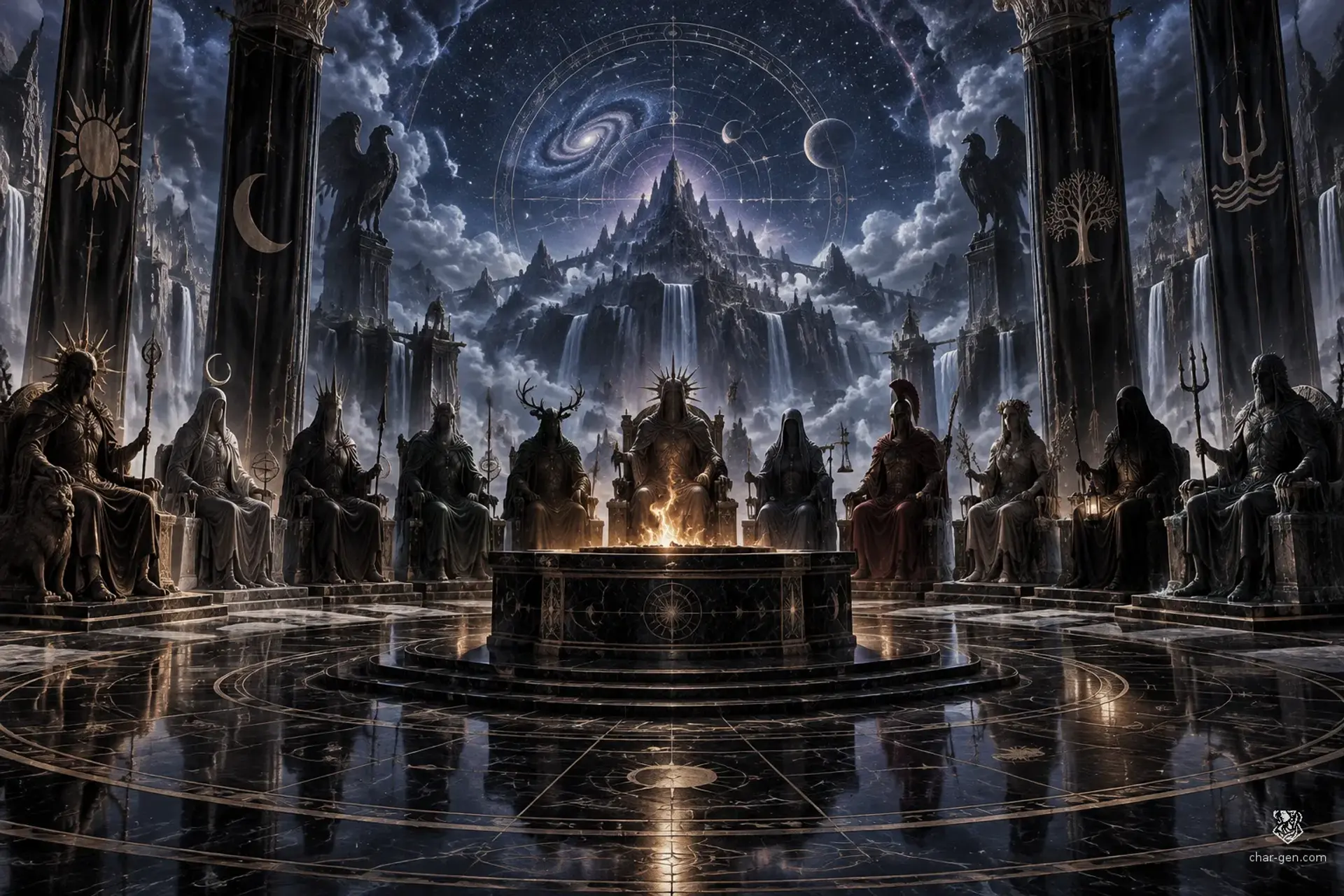
Its reflection broke into twelve celestial fragments, each becoming a throne and a god. The Court later claimed the fragments as its inheritance, though Mirkut's oldest rites suggest they were stolen from a power that still waits below.
The heavens
Creation began when Orveth's dark sea reflected Soryn's first star.
The reflection cracked, and its fragments became the heavens, the mortal world, and the twelve thrones of the Astral Court. The sun is Drazha's war-chariot; the moon is Ilyat's shield, eternally scarred by Bragor's arrows. Beyond the visible sky lies the Unlit Deep, which even the gods fear to name.
Gods and mortals
The Court answers prayers unevenly and often through omens, bargains, or sudden disasters.
Temples compete for political influence, but most communities honor several gods according to need: Varkesh at court, Ilyat at the hospice, Orveth at the harbor, and Pelk at the workshop. Clergy of rival deities may cooperate in public while their divine patrons pursue incompatible aims.
After death
The dead climb the Stair of Constellations, where Varkesh weighs their deeds against the witness-stars kept by Soryn.
The worthy join their patron's celestial retinue; the unrepentant are cast into the grinding dark below, unless Keldra claims them for a final trial. Even blessed souls may be summoned back when the Court's feuds spill into mortal lands.
What people say, what is true
Players may hear
For the GM
Plot hooks
Conflicts
The wars
Varkesh and Tzagan dispute who may judge oathbreakers; Soryn conceals prophecies that Keldra insists must be fulfilled; Orveth's sea-tempests repeatedly challenge Drazha's command of the winds.
Ilyat shelters fugitives from Bragor's punitive hunts, while Mirkut and Zorvanna compete to decide whether the dead should be remembered or released.
| Varkesh | Soryn | Tzagan | Drazha | Ilyat | Keldra | Orveth | Urzga | Bragor | Zorvanna | Mirkut | Pelk | |
|---|---|---|---|---|---|---|---|---|---|---|---|---|
| A | A | E | E | |||||||||
| E | A | A | E | |||||||||
| A | E | E | A | |||||||||
| E | E | A | A | |||||||||
| A | E | E | ||||||||||
| E | A | A | E | |||||||||
| E | A | E | A | |||||||||
| A | E | E | A | |||||||||
| A | E | E | A | |||||||||
| A | E | E | A | |||||||||
| E | A | E | A | |||||||||
| A | A | E | E |
Order of heaven
Structure
The Astral Court is a divine assembly of twelve rival powers, not a unified church.
Two Greater deities, Varkesh and Soryn, dominate formal rites and celestial interpretation; the remaining gods hold lesser, demigod, or outsider status. Temples are local and practical, while high synods meet under open skies to negotiate festivals, doctrines, and divine disputes. No priest may claim that the Court speaks with one voice.
Theme
Classical fantasy of celestial authority, divine rivalries, mortal choice, and the dangerous cost of appeasing powers that demand justice, glory, memory, or obedience.
Tone
Wrathful and grand: divine favor can save a city, but divine attention can ruin one.
Omens are rarely comforting, and even benevolent gods expect courage from those they protect.
Alignments
Varied: lawful, neutral, and chaotic powers each include benevolent, balanced, and cruel impulses.
The Court is not a moral consensus; its gods disagree fiercely about what mortals deserve.
Media
0 imagesNo images yet.
Turn The astral Court into a sheet
A high-res, share-ready sheet you can post or print.