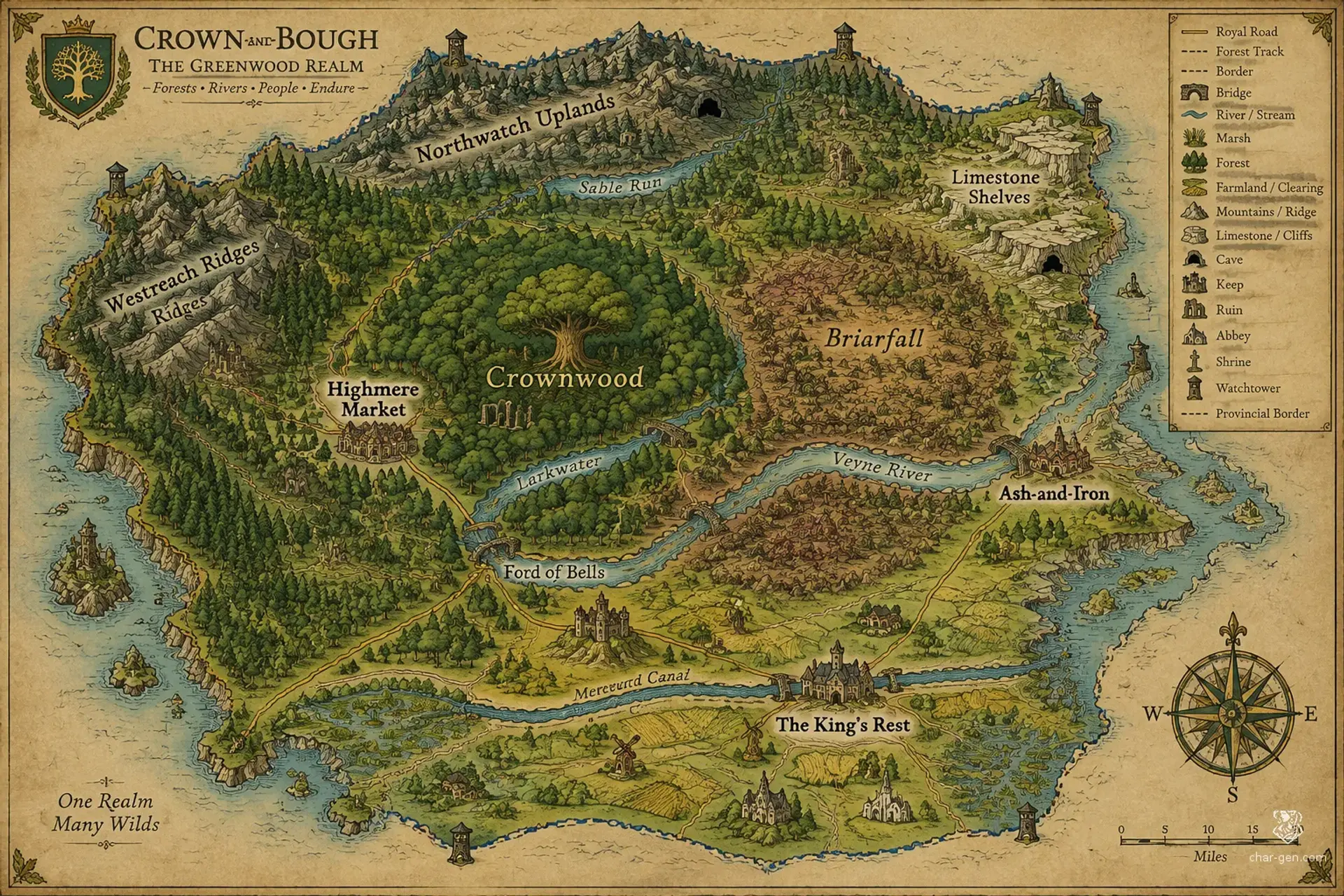
Where royal roads end, the forest begins to remember.
KCKingdom of Cormantia
Overview
The Kingdom of Cormantia spans hundreds of miles of woodland, river valleys, and cultivated clearings, broad enough to contain many provinces and settlements. Its Capetian-inspired court prizes dynastic legitimacy, ceremony, and alliances among powerful nobles, while guilds and temples shape daily life beyond the palace halls. High magic enriches crafts and scholarship, yet the forests remain only partly mastered. Travelers find busy roads, scattered keeps, old shrines, and stretches of wild country where familiar maps fail.
Cultures
Courtly Cormantine tradition blends Capetian-style dynastic ceremony with forest stewardship.
River communities preserve market customs shaped by seasonal floods and barge traffic.
Border marches mix royal law with local woodland practices.
Places
5 settlements
Large · Walled townCrown-and-BoughAdministrative and timber market centerA fortified market town where royal timber rights meet ancient woodland customs.
Medium · Riverside townThe Ford of BellsRiver crossing and ferry exchangeIts bridge bells warn boatmen of floods and announce the opening of weekly markets.
Medium · Market townHighmere MarketAgricultural and craft marketA busy inland market grows around a boastful old fairground now half reclaimed by forest.
Small · Mining townAsh-and-IronMetalworking and upland supply centerThe name recalls rival charcoal burners and smiths whose merger created a durable mining community.
Small · VillageThe King's RestForest-edge farming and lodgingOnce promised as a grand royal retreat, it is now a modest village beside a neglected hunting lodge.
How they spread
PatternSettlements cluster along rivers, cleared valleys, and maintained roads, becoming sparse within the Crownwood and northern uplands. Most communities rely on nearby estates, guild markets, or religious houses for protection and trade.
Common kinds
Market towns at river crossings.
Walled noble seats beside major roads.
Timber villages on forest edges.
Abbeys, colleges, and shrine communities.
Mining hamlets in the northern uplands.
Trade routes
The Veyne barge road links central markets to eastern neighbors.
The King's Forest Road connects noble seats and timber towns.
The Mereward Canal carries southern grain toward royal storehouses.
Dangers and hooks
4 threats
Most dangerous · HighBriarfall StraysMagical wildernessMagically altered beasts and thorn growths spread from the scar into nearby clearings.
The Hollow CourtHighFey intrigue
Unseen fey agents bargain with villagers and lure the unwary into old groves.
Marcher ReaversModerateBanditry
Small armed bands raid isolated farms and travelers near the western uplands.
Toll-Road MilitiasModeratePolitical violence
Competing noble patrols seize wagons and claim disputed bridge dues.
Floods overwhelm lowland roads during wet springs.
Predatory beasts follow logging camps and isolated farms.
Old ruins conceal unstable wards and collapsing cellars.
Plot hooks
1
The Unfinished BoundaryExploration and mysteryA royal survey crew vanishes while tracing a new boundary through the Briarfall scar.Starts: A magistrate offers the party a sealed map and a meeting with the crew's surviving guide.Reward: A royal writ, recovered survey records, and a parcel of land rights.
2
Cargo on the LarkwaterInvestigation and river adventureA guild barge carrying licensed spell components has disappeared between two busy river towns.Starts: The party is hired at a riverside counting house to follow the route and question witnesses.Reward: Coin, trade favors, and a cache of useful magical materials.
3
Axes at the BoundarySocial conflictTwo noble houses accuse each other of sending armed loggers into a protected grove.Starts: A village reeve asks the party to find proof before the rival patrols clash.Reward: A negotiated pardon, local allies, or a rare forest charm.
4
The Tower's AnswerDungeon and magical threatAn abandoned watch tower has begun broadcasting a spell that awakens dormant forest wards.Starts: A warden recruits the party at a roadside shrine after the first ward attacks a nearby farm.Reward: A warding token and access to a secluded magical archive.
The land
Climate and ground
ClimateVariable, with wet springs, mild summers, foggy autumns, and cold winters that grow harsher in the north.
TerrainA broad forested kingdom of rolling ridges, deep woods, fertile clearings, and navigable river valleys.
Biomes
Mixed deciduous forest, Pine uplands, River meadows, Heath and managed pasture
Waters and borders
Waterways
The Veyne River carries grain barges toward the eastern border.
The Larkwater winds through central forests and market towns.
The Sable Run drains the northern uplands.
The Mereward Canal links southern farms with royal storehouses.
Borders
Western marches meet rugged uplands and rival lordships.
Northern forests thin into colder, sparsely settled country.
Eastern waterways connect to neighboring principalities.
Southern roads descend toward warmer grainlands.
On the road
Royal roads are reliable near towns but often become muddy tracks beyond them.
Forest paths shift under magical growth and may mislead travelers after dusk.
River travel is swift downstream but difficult during spring floods.
Landmarks
The Crownwood is a vast managed forest with ancient, unmapped interior groves.
The Briarfall scar is a tangled belt of magically altered woodland.
Old royal roads meet at stone causeways above the river marshes.
Abandoned watch towers overlook several border passes.
Landforms
Long ridges cloaked in mixed forest.
Fertile river plains and broad flood meadows.
Northern pine uplands cut by ravines.
Scattered limestone shelves and hidden caverns.
Resources
Mature hardwood and resinous pine.
Iron, copper, and building stone.
Medicinal plants, enchanted fungi, and wild honey.
Power
Rule
GovernmentHereditary monarchy advised by a council of high nobles, clerics, guild delegates, and appointed magistrates.
SeatThe royal court travels between established palaces, with its principal residence in the central riverlands.
StabilityThe kingdom is broadly stable, though noble rivalries, disputed tolls, and magical hazards strain royal authority.
Laws
Royal writs govern major roads, bridges, and river tolls.
Nobles must provide armed service or an agreed levy to the crown.
Unlicensed enchantments that endanger a settlement are forbidden.
Forest commons require customary dues and seasonal access limits.
Factions
The Crown-and-Bough CompactRoyal court and noble coalition
Influence: High near the royal seat and major highways.The royal court seeks to strengthen central authority while preserving noble alliances.
The Ledger of Three RoadsMerchant league
Influence: Strong in market towns and river ports.The guilds seek reliable access to timber, river tolls, and magical licenses.
Green Mantle WardensForest order
Influence: Strong in remote forests and respected by rural communities.The wardens protect old groves and contain dangerous magical growth.
Faiths
The Radiant Crown
Influence: Widely practiced in courts, towns, and royal ceremonies.The Radiant Crown teaches that lawful rule carries sacred duties of protection and judgment.
The Green Communion
Influence: Strong in villages, among wardens, and within forest enclaves.The Green Communion honors seasonal cycles, local spirits, and the mutual obligations of people and woodland.
The Lantern Testament
Influence: Influential among scholars, healers, and licensed practitioners.The Lantern Testament values learning, restraint, and the responsible use of magic.
People and trade
Who lives here
How manyModerate overall, with dense settlement along rivers, roads, and cleared forest margins.
Main peoples
Cormantine humans form the largest population group.
Dwarven craft families maintain mines and fortified workshops.
Halfling riverfolk operate farms, ferries, and market boats.
Other peoples
Elven enclaves guard ancient groves.
Gnomish artisans settle near royal colleges.
Languages
Cormantine, the court and common tongue.
Old Marcher, spoken in western borderlands.
Sylvan cant, used by forest guides and several woodland communities.
Trade
WealthModerately wealthy, with royal and temple centers rich beside poorer forest villages.
Work
Timber, charcoal, and shipbuilding.
Grain, orchard fruit, and livestock farming.
Enchanted crafts, scholarly magic, and alchemy.
Exports
Hardwood and carved furniture.
Dyes, honey, and medicinal herbs.
Wool cloth and worked copper.
Imports
Salt and southern wines.
Fine steel and specialist spell components.
Markets
Crown-and-Bough, The Ford of Bells, Highmere Market
History and secrets
Cormantia grew from a union of river lords and forest nobles whose competing claims once threatened to divide the region. Successive monarchs built authority through road charters, marriage alliances, and cooperation with powerful guilds and temples. High magic has enriched its colleges and crafts, but the recent Briarfall left strange growths across the woods and revived old disputes over land, inheritance, and who may command the forest.
Key events
Founding era
The Joining of Bough and FordA royal marriage joined rival river and woodland claims, establishing a shared dynasty.
Middle reigns
The Road CharterThe crown standardized tolls and patrol duties along the principal roads.
Recent generation
The BriarfallA surge of wild magic altered forests and left several old estates abandoned.
Secret 1 · GM only
The founding marriage treaty secretly placed the central forest under shared stewardship rather than royal ownership.Found by: Compare old boundary stones with the roots exposed in the Briarfall scar.If found: The revelation could invalidate noble land claims and provoke a succession crisis.
Secret 2 · GM only
The Briarfall is not a natural magical surge but the weakening of a kingdom-wide ward.Found by: A sealed chapter in the Lantern Testament archive describes the first royal warding rite.If found: If renewed, the spell could quiet the wild magic but bind the crown to an ancient forest power.
Secret 3 · GM only
A forgotten canal branch remains open beneath the southern storehouses and is used by an unknown network.Found by: Question ferrymen who travel the Mereward Canal after midnight.If found: The hidden route can move people or contraband past royal checkpoints and alter the balance of power.
Media
0 images
No images yet.
Visual sheet
Turn Kingdom of Cormantia into a sheet
A high-res, share-ready sheet you can post or print.