Salt remembers every footprint, and the wells remember every debt.
TFThe Drained Flats
Overview
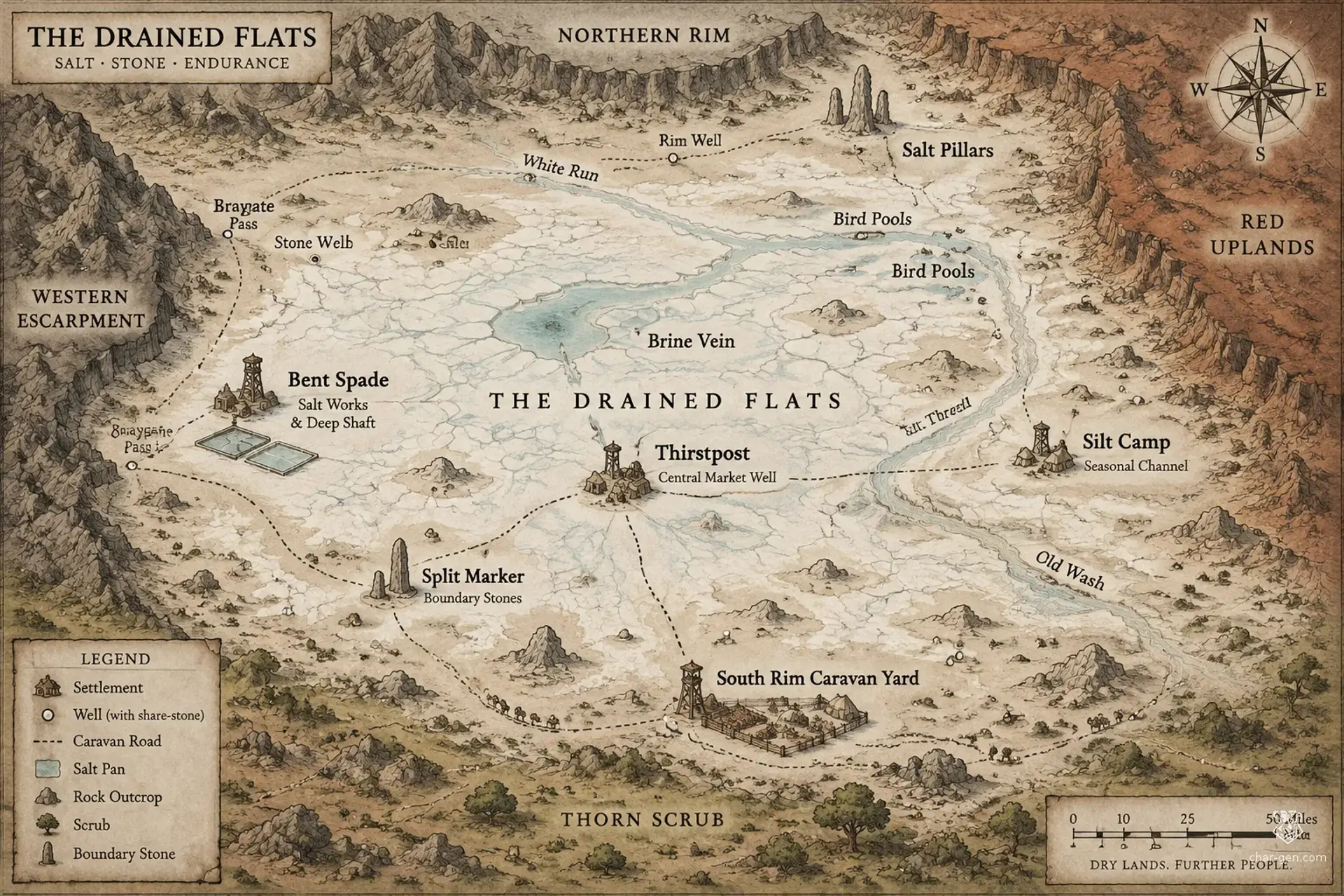
The Drained Flats are a broad, enclosed basin where salt crusts, dry channels, and scattered wells shape every journey. Salt brings caravans from distant regions, but reliable water is scarce enough to govern work, law, and hospitality. Small settlements cluster around wells and evaporation beds, separated by long stretches of blinding open ground. The discovery of a sealed storehouse beneath a deepening salt shaft has unsettled agreements that once kept trade moving.
Cultures
Salt-pan families organize work by shared evaporation beds and inherited water shares.
Well-road caravaneers value written measures, dependable animals, and mutual aid.
Basin-edge herders follow seasonal grazing paths and maintain old guest-right customs.
Places
4 settlements
Large village · Salt-work townBent SpadeContested salt works and excavation siteIts deepening salt shaft uncovered the disputed storehouse, and work has slowed under faction guard.
Small town · Market settlementThirstpostCentral caravan marketA busy market offers measured water, repairs, and news, though prices rise in dry weeks.
Village · Well hamletSplit MarkerWellside stop and local meeting placeIts residents maintain old boundary stones whose placement is disputed after every major storm.
Small camp · Seasonal campSilt CampSeasonal grazing and exchange pointA shifting cluster of herders and traders gathers near the seasonal channel when grazing permits.
How they spread
PatternSettlements form loose chains around dependable wells and salt beds, with broad empty stretches between them. Temporary camps appear along seasonal washes and caravan tracks when trade or grazing shifts.
The White Run road links northern wells with the central salt works.
The Old Wash track leads west toward the escarpment passes.
The South Rim trail connects herding villages to the caravan yard.
Dangers and hooks
3 threats
Most dangerous · HighThe Long ThirstDrought and water scarcityMost severe during failed rains or when wells are blocked by dispute.
Crustfall HollowsModerateEnvironmental hazard
Hidden beneath thin salt crusts, especially near old brine pans.
Wash-RunnersModerateCaravan raiders
Small bands watch the Old Wash and target isolated loads after storms.
Hazards of the land
Salt glare causes disorientation and painful eye strain.
Unmarked crust can collapse into brine mud.
Water caches may be fouled or emptied during long dry spells.
Plot hooks
1
Below the Salt LineExploration and faction conflictA new collapse reveals a second sealed chamber, and both claimants want the party to reach it first.Starts: The guard line at the deep shaftReward: A share of recovered trade goods and a lasting water-right favor
2
The Measure That LiedInvestigationA caravan arrives with forged water-share records that could redirect an entire route.Starts: The Thirstpost market ledger houseReward: Coin, caravan contacts, and a signed travel warrant
3
Bitter DrawMystery and survivalA string of wells has turned brackish, and each faction blames the other for sabotage.Starts: The first fouled well on the Old WashReward: Fresh water allotment and practical supplies
4
Stones Under SiltTravel and negotiationA storm has buried a marker field, leaving several settlements unsure where their shared grazing rights begin.Starts: The boundary camp at the southern scrubReward: Livestock, local goodwill, or a negotiated claim
The land
Climate and ground
ClimateHot, arid days and sharp night cooling define most of the year, with brief, erratic storms.
TerrainA broad enclosed basin of salt crust, shallow brine pans, gravel fans, and scattered wells.
Biomes
Open salt flats, Dry scrub basin, Stony desert foothills, Seasonal wash margins
Waters and borders
Waterways
The White Run, a seasonal wash crossing the northern flats
The Silt Thread, an intermittent channel from the eastern uplands
The Brine Vein, a chain of shallow seep pools
The Old Wash, a dry channel used as a caravan track
Borders
The stony northern rim
The red uplands to the east
The thorn scrub to the south
The broken western escarpment
On the road
Travel between wells requires permission or a reliable water cache.
Salt glare hides shallow hollows and makes distance difficult to judge.
Seasonal washes can become impassable after rare storms.
Landmarks
The deep shaft opening into the contested storehouse
White marker stones that record old water shares
A field of salt pillars left by wind erosion
A chain of brackish pools used by migrating birds
Landforms
Broad salt crusts broken by shallow pans
Low gravel fans at the basin edges
Wind-carved ridges of packed silt
Dry channels winding between wells
Resources
Rock salt and surface brine
Clay suitable for water jars
Hardy scrub for fuel
Small deposits of copper-bearing stone
Power
Rule
GovernmentA compact of well-holders, salt-work delegates, and caravan representatives governs through negotiated water and trade rules.
SeatA rotating council meets at whichever market well can host its delegates; no settlement holds permanent precedence.
StabilityTense but functional, with water-right disputes and the newly uncovered storehouse testing old agreements.
Laws
Well shares must be recorded before water is drawn.
Caravans may not block a public well or conceal its condition.
Salt claims require witnessed boundary markers.
Violence at a working well brings collective restitution.
Factions
The Bent Spade ClaimantsSalt-workers' league
Influence: Strong among salt workers and the older evaporation beds.Secure control of the buried storehouse and the deeper well beneath the salt works.
The Dry Measure CompactWater-rights coalition
Influence: Strong at the wells and along the principal caravan roads.Assert that the storehouse and its contents belong to the water-right holders who financed the well.
The Cracked Cart FellowshipCaravan association
Influence: Moderate at markets and caravan stops.Keep trade moving and prevent either claimant from imposing exclusive tolls.
Faiths
The Open Cup
Influence: Widespread at wells and caravan stops, especially among road communities.Hospitality, measured generosity, and the duty to offer water to travelers.
The White Measure
Influence: Common among salt workers and families who maintain evaporation beds.Endurance, honest labor, and respect for the earth's hidden reserves.
The Rainward Vigil
Influence: Modest, strongest among herders and basin-edge settlements.Seasonal renewal and the return of rain, without promises that it will come.
People and trade
Who lives here
How manySparse overall, with crowded clusters around dependable wells, salt works, and caravan stops.
Main peoples
Salt workers and their households
Caravan traders and water haulers
Basin-edge herders
Other peoples
Itinerant repairers, Pilgrims and surveyors
Languages
Basin Common, Salt Cant, Rim Trade Speech
Trade
WealthUneven; salt merchants can prosper, while most households live close to their water allotments.
Work
Salt extraction and refining
Well maintenance and water hauling
Caravan trade and animal husbandry
Exports
White salt blocks
Brine and curing salts
Pack animals and leather goods
Imports
Grain and dried fruit, Timber and iron tools
Markets
The Bent Spade works, Thirstpost market, South Rim caravan yard
History and secrets
The Drained Flats grew around shallow brine pans and scattered wells that made salt extraction possible but never easy. Caravans brought tools, grain, and competing claims, while local agreements turned water access into the foundation of governance. Droughts repeatedly altered routes and settlement fortunes. The latest dispute began when a deeper shaft at the salt works uncovered a sealed storehouse, claimed by both the salt workers and the water-right holders.
Key events
Old Road Era
The Stake That Split the WhiteA caravan captain drove a marker stake through a salt crust, and later retellings wrongly claim the flats opened like a gate.
Compact Era
The First Water SharesSeveral wells were linked by shared maintenance obligations after a drought forced neighboring camps to cooperate.
Present Year
The Deep Well BreachA deeper shaft at the salt works broke into a sealed underground storehouse, renewing disputes over ownership.
Secret 1 · GM only
The storehouse was built as an emergency reserve for the whole basin, not as private property.Found by: Compare the storehouse's sealed jars with the oldest water-share ledgers.If found: The chamber contains records showing that its original contents were entrusted jointly to the ancestors of both claimants.
Secret 2 · GM only
A buried water-bearing layer lies beneath the bird pools and connects to wells across the basin.Found by: Look for pale mineral seams beneath the brackish pools after a hot, windless day.If found: The seam could supply a new well, but careless digging might drain several established wells.
Media
0 images
No images yet.
Visual sheet
Turn The Drained Flats into a sheet
A high-res, share-ready sheet you can post or print.