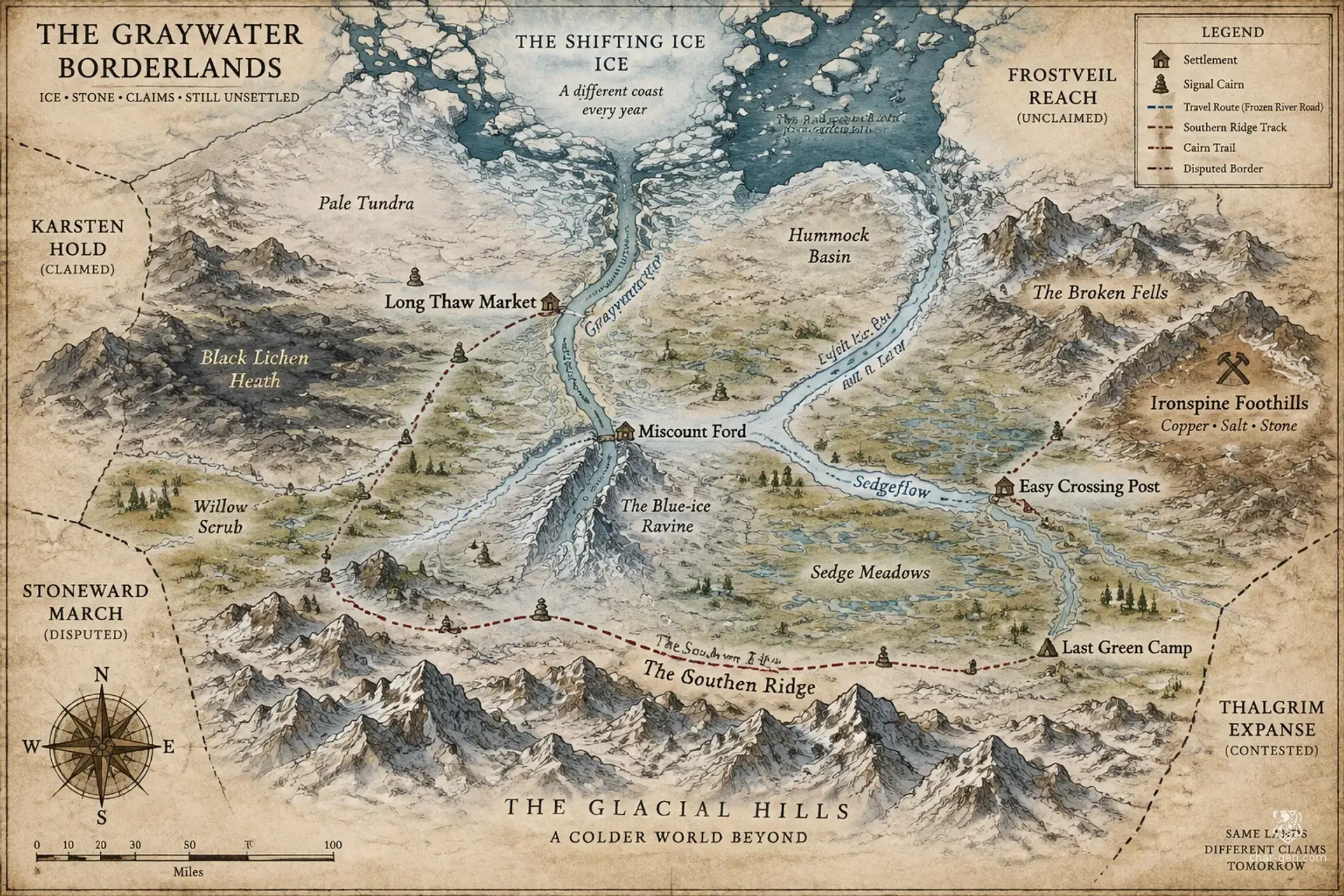
The Long Thaw is a broad polar borderland where open tundra, frozen rivers, and low glacial ridges stretch across a region of roughly a hundred miles. Its name is an old boast: spring rarely lasts long enough to soften the ground before cold returns. Scattered villages, seasonal camps, and frontier posts depend on narrow travel windows. Local herders, traders, and border officers share uneasy routines, while disputed claims and unreliable maps keep the region unsettled.
Cultures
Seasonal herding communities prize shared stores and reciprocal rescue.
Border outposts blend local trail customs with distant military regulations.
River traders mark time by ice breakup, even when inland roads remain frozen.
Places
4 settlements
Small · Market villageLong Thaw MarketSeasonal trade hub and meeting placeA broad gravel shelf hosts trading tents, storehouses, and council gatherings when conditions allow.
Small · Crossing hamletMiscount FordRiver crossing and guide stationIts name recalls an old patrol that miscounted the river channels and camped on the wrong bank.
Small · Fortified postEasy Crossing PostBorder patrol and supply depotNamed after the expedition that called the route easy, it now struggles to stay supplied each winter.
Variable · Herding campLast Green CampSeasonal livestock gathering placeThe boastful name persists although its grazing ground is mostly stony and sparse.
How they spread
PatternSettlements are sparse and follow reliable water, sheltered ground, and established winter routes. Camps shift seasonally, while permanent posts cluster near crossings and resource sites.
The Ford That MovedRescue and explorationA routine crossing has vanished beneath new ice, along with a caravan carrying medicine and sealed survey papers.Starts: The travelers' last camp stands beside the Miscount ford.Reward: A winter guide's services and a share of the recovered cargo.
2
Lines on Frozen GroundNegotiationA mining survey stakes claims across a migration route, and both the company and herders demand outside support.Starts: A boundary meeting is called at the Long Thaw market.Reward: A legal claim, valuable ore samples, or a lasting local alliance.
3
The Unmanned SignalMysteryA signal cairn flashes at night despite having no keeper, and nearby patrols report hearing bells under the snow.Starts: A border officer offers payment to investigate the old cairn line.Reward: A hidden cache of supplies and access to a forgotten route.
4
Brands from NowhereInvestigationA herd has returned from the eastern hills marked with fresh brands that resemble the seal of a vanished settlement.Starts: A herding camp asks for help tracing the animals' route.Reward: Rare hides, safe passage, and the elders' favor.
The land
Climate and ground
ClimatePolar, with long dark winters, brief summers, sudden ground blizzards, and persistent winds.
TerrainBroad, mostly level tundra broken by low ridges, thawing marshes, gravel fans, and scattered rocky heights.
Biomes
Open Arctic tundra, Lichen-covered rocky heath, Stunted willow scrub, Cold marsh and sedge meadow
Waters and borders
Waterways
The Graywater River, The Split Ice Run, The Sedgeflow, The northern coastal inlet
Borders
A glaciated ridge marks the southern boundary.
The eastern edge meets disputed upland territory.
Northern sea ice defines a shifting coastal frontier.
On the road
Winter travel is fastest on frozen rivers but dangerous when hidden currents thin the ice.
Summer melt turns low ground into bogs that can swallow carts and pack animals.
Whiteouts erase landmarks, so guides rely on cairns and remembered wind patterns.
Landmarks
A line of old signal cairns vanishes beneath seasonal snow.
The Miscount ford shifts its crossing point after every major thaw.
A field of blue ice persists in a shaded ravine through summer.
The Long Thaw market occupies a raised gravel shelf above marshland.
Landforms
Low, wind-scoured ridges
Permafrost hummocks and shallow basins
Broad gravel fans below the southern ridge
A broken chain of glacial hills
Resources
Iron-bearing stone
Pale semi-precious gems
Fish, hides, and animal oil
Peat and hardy medicinal lichens
Power
Rule
GovernmentA loose frontier compact of village councils, herding elders, and appointed border officers.
SeatThe regional council meets wherever river ice and roads permit, usually at the Long Thaw market.
StabilityUneasy but functional, with local councils cooperating when weather or border pressure demands it.
Laws
No traveler may be denied emergency shelter during a whiteout.
Herding routes remain open unless a council marks them unsafe.
All extracted ore must be declared at a recognized trade post.
Factions
The Unbroken TrackHerders' council
Influence: Strong among herding families and river settlements.Keep ancestral grazing routes open and prevent outsiders from fencing winter pasture.
The Forward CompanyFrontier charter
Influence: Moderate near patrol roads and supply depots.Secure the border, tax trade, and turn temporary forts into permanent claims.
The White LedgerMining syndicate
Influence: Growing around the eastern foothills.Control mineral claims while denying that their surveys cross local lands.
Faiths
The Hearth Beneath Snow
Influence: Strong in herding camps and small villages.Honoring ancestors, land spirits, and the obligations of hospitality.
The Witness Flame
Influence: Common among traders, clerks, and frontier officers.Keeping promises through ritual witness and careful record.
The Long Night Way
Influence: Quiet but widespread among isolated settlements.Finding meaning in endurance, silence, and the returning light.
People and trade
Who lives here
How manyVery sparse, with small communities clustered near rivers, sheltered valleys, and dependable winter trails.
Main peoples
Indigenous tundra herders
Frontier settlers from southern provinces
Seasonal fishers and traders
Other peoples
Displaced families from the eastern marches
Itinerant metalworkers
Languages
Tundra trade speech, Northern court language, Old river dialect
Trade
WealthPoor overall, though a few trading posts prosper during brief shipping and caravan seasons.
Work
Reindeer and hardy livestock herding
Fishing and seal hunting along northern waters
Small-scale mining and fur trading
Exports
Dried fish and blubber oil, Furs, hides, and carved bone, Iron ore and pale gemstones
Imports
Grain and preserved vegetables
Iron tools and lamp oil
Markets
The Long Thaw market, The Miscount ford
History and secrets
The region was long used as seasonal ground by herders and fishers before southern authorities tried to fix its borders on paper. A short-lived trade boom brought forts, mines, and rival claims, but harsh winters repeatedly broke supply lines. Local communities learned to bargain with distant officials while preserving older routes. Most disputes remain unresolved, and every new survey risks turning a quiet boundary into an active frontier.
Key events
Early settlement
The Easy CrossingA southern expedition crossed the ridge during an unusually mild season, then claimed the route had always been open.
Lean years
The Empty GranariesSeveral communities survived a famine by pooling stores, creating customs of shared rescue and public accounting.
Recent decades
The Wandering StoneA boundary marker was moved after a thaw, and both sides have since treated the resulting line as official.
Secret 1 · GM only
The original boundary was set along a river channel that no longer exists, and early officials knew the marker would drift.Found by: Compare the oldest cairn marks with the current route recorded in trading ledgers.If found: The established border follows a deliberate misreading that could invalidate several land claims.
Secret 2 · GM only
A survey party entombed its findings in a crevasse after discovering that the richest ore lies beneath disputed pasture.Found by: Inspect the blue ice ravine during the briefest days of summer.If found: A sealed cache could provide evidence of an abandoned expedition and alter control of the eastern mineral fields.
Secret 3 · GM only
A hidden stone shelter was built after the famine, but its entrance is deliberately omitted from every public map.Found by: Ask elders why the old rescue songs leave one verse unfinished.If found: The missing verse points to a concealed refuge that can shelter many people during a severe winter.
Media
0 images
No images yet.
Visual sheet
Turn The Long Thaw into a sheet
A high-res, share-ready sheet you can post or print.