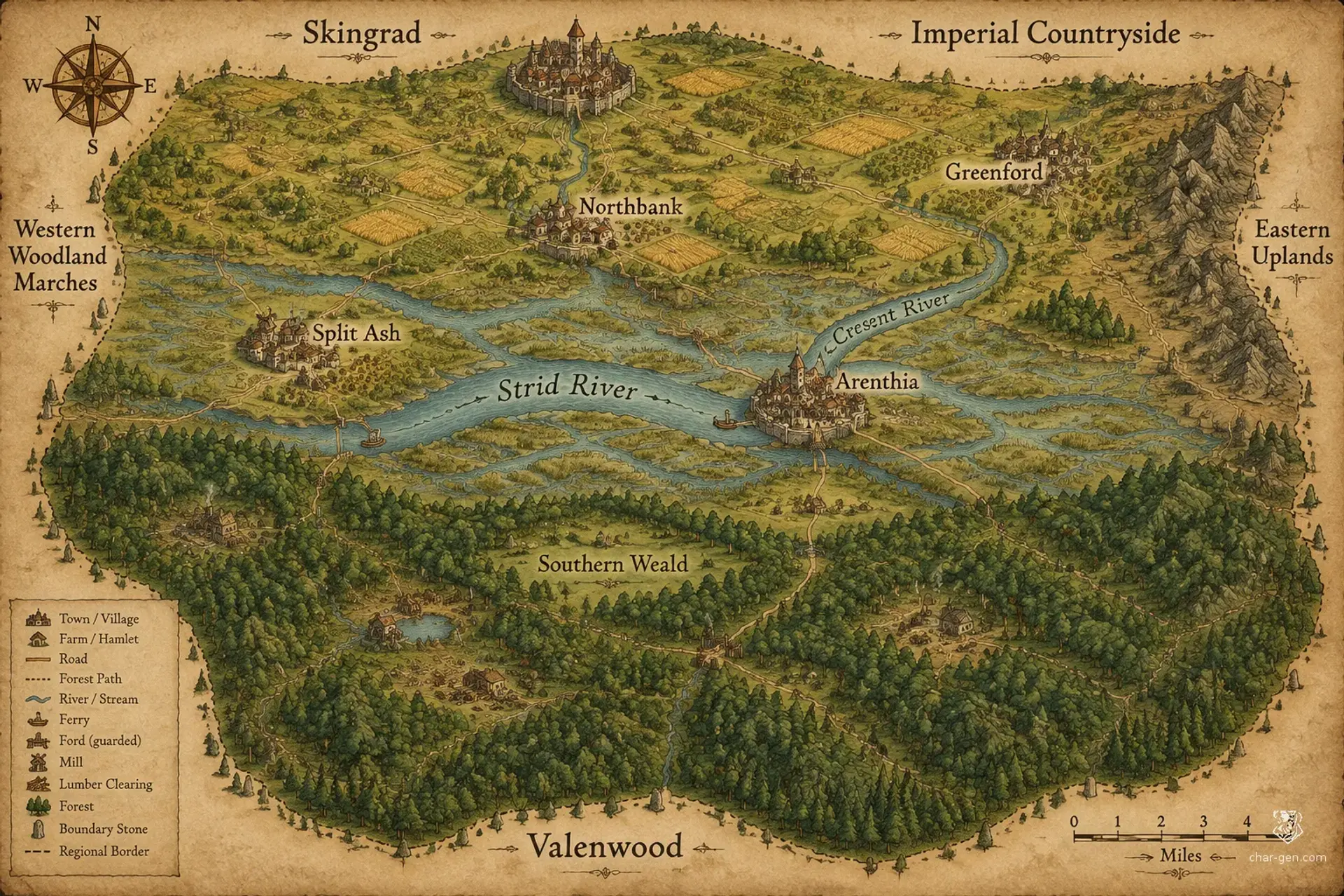
Where the Strid divides the plowland from the living wood.
TBThe Weald Borderlands
Overview
The Weald Borderlands span a broad stretch of country where Imperial farms give way to the forests of northern Valenwood. The Strid divides open northern fields from the Southern Weald, but ferries, woodland tracks, and market roads keep the two sides connected. Skingrad anchors the northern edge, while Arenthia lies beyond the Strid and Cresent confluence. Lumber, river traffic, and competing ideas of land stewardship create steady opportunity and friction.
Cultures
Bosmeri woodland traditions shape the southern Weald, emphasizing kinship, seasonal rites, and careful use of living forests.
Imperial customs dominate northern farms and roads, favoring written contracts, civic law, and organized trade.
River communities blend both traditions through shared markets, mixed households, and practical border customs.
Places
5 settlements
Large · CitySkingradNorthern market and administrative gatewayA major city on the northern edge, it channels Imperial law, supplies, and commerce into the borderlands.
Large · CityArenthiaSouthern trade centerSituated south of the Strid and Cresent confluence, it serves as a major southern market and meeting place.
Small · Lumber townSplit AshTimber processing and transportA lumber town west of Arenthia where timber crews, river haulers, and forest traders compete for contracts.
Small · VillageNorthbankRiver crossing and grain marketA replaceable example of a ferry village with crowded docks and farms on the open northern side.
Tiny · HamletGreenfordForest-edge provisions and guidanceA replaceable example of a woodland hamlet whose residents guide travelers and gather herbs under strict local customs.
How they spread
PatternSettlements cluster along roads, navigable stretches of the Strid and Cresent, and the forest edge. The Southern Weald holds scattered communities connected by narrow paths.
Common kinds
River crossings and ferry villages
Farm hamlets and market villages
Lumber camps and sawmill towns
Forest-edge shrines and ranger steadings
Trade routes
The north road runs between Skingrad and the Strid crossings.
River traffic follows the Strid toward the Cresent confluence and Arenthia.
Timber tracks link Split Ash with forest camps and western river landings.
Dangers and hooks
3 threats
Most dangerous · HighThe Rootbound StalkersMonstrous wildlifeUncommon sightings cluster around old groves and newly cut timber stands.
Flood-swollen StridModerateEnvironmental hazard
Seasonal, especially during spring rains and sudden storms.
Roadside CutpursesModerateBanditry
Regular along isolated routes and at crowded crossings.
Hazards of the land
Sudden river floods can sweep away camps and ferry lines.
Dense undergrowth hides sinkholes, old pits, and animal trails.
Poisonous plants and biting insects thrive in wet forest clearings.
Plot hooks
1
The Missing FerryInvestigationA ferry has vanished with its passengers, but fresh tracks on both banks suggest it never entered the water.Starts: A worried ferryman at a Strid crossingReward: A river passage token and a share of recovered cargo
2
Marks Beneath the MossNegotiationA new lumber camp has crossed its agreed boundary, and both the grove-keepers and merchants demand help before violence begins.Starts: A timber foreman near Split AshReward: Payment, local influence, or a promise of protected passage
3
The Stone That MovedExplorationAn old boundary stone has surfaced after a flood, bearing an inscription that could invalidate several land claims.Starts: A market clerk in ArenthiaReward: A legal claim, valuable map, or favor from a local council
4
The Empty ForestWilderness threatSomething has begun driving game from the forest, and hungry animals now threaten farms north of the river.Starts: A farmstead on the northern bankReward: Coin, provisions, and a guide familiar with the Southern Weald
The land
Climate and ground
ClimateVariable temperate weather brings mild, wet springs, warm summers, misty autumns, and occasional hard winter snaps.
TerrainA wooded border region divided by the Strid, with open countryside north of the river and the dense Southern Weald to the south.
Biomes
Temperate broadleaf forest, Mixed conifer woodland, Open farmland and pasture, River marsh and floodplain
Waters and borders
Waterways
The Strid River divides the open north from the Southern Weald.
The Cresent River joins the Strid south of Arenthia.
Small forest streams feed seasonal marshes and millponds.
Flood channels braid through the lowlands near the river confluence.
Borders
Skingrad and the northern Imperial countryside
The deeper forests of Valenwood to the south
The western woodland marches beyond Split Ash
Eastern uplands and scattered farming districts
On the road
The Strid is crossed by ferries and guarded fords, which can become impassable after heavy rain.
Forest paths shift under growth and storm damage, so local guides are valuable south of the river.
The road between Skingrad, the river crossings, and Arenthia carries the most reliable traffic.
Landmarks
The Strid's broad, fast-running crossings divide the region's cultures and trade.
The Southern Weald holds ancient groves interspersed with recent lumber clearings.
The Cresent-Strid confluence draws merchants, ferrymen, and seasonal fishers.
Old Imperial boundary stones vanish beneath roots and moss.
Landforms
Rolling northern pasture and farm country
Deeply wooded ridges of the Southern Weald
Low floodplains around the Strid and Cresent
Stone-strewn banks and wooded river bluffs
Resources
Hardwood and straight timber
Medicinal herbs and fragrant resins
Fertile floodplain soil
River fish and game
Power
Rule
GovernmentA patchwork of Imperial jurisdictions, Bosmeri community councils, and river compacts governs the region without a single local capital.
SeatAuthority is divided among Skingrad's northern administration, Arenthia's local offices, and councils in the smaller settlements.
StabilityUneasy but workable, with trade and shared river interests balancing disputes over forest rights.
Laws
River crossings may charge posted tolls but must honor recognized safe-conducts.
Unlicensed cutting of marked sacred groves is forbidden.
Disputes over land and timber may be heard by local councils or Imperial courts.
Carrying drawn weapons into a market requires the consent of its wardens.
Factions
The Split Ash FactorsMerchant consortium
Influence: Strong around Split Ash and influential among northern merchants.Secure predictable timber rights and keep the river roads open for commerce.
The Greenward CirclesBosmeri grove-keepers
Influence: Strong in forest communities and respected along the southern riverbanks.Protect sacred groves and prevent unchecked expansion into the Southern Weald.
The Strid CompactRiver-town alliance
Influence: Moderate at ferries, roads, and market settlements.Maintain crossings, enforce toll agreements, and prevent the border from descending into open conflict.
Faiths
The Green Pact
Influence: Strong among Bosmeri communities and influential in southern land disputes.Honoring the living forest, ancestral bonds, and the balance between taking and renewal.
The Eight Divines
Influence: Common in northern towns and among Imperial officials.Civic duty, household prosperity, and the protection of travelers.
The River Vows
Influence: Practiced informally by ferrymen, traders, and mixed river communities.River crossings, seasonal change, and safe journeys through unsettled country.
People and trade
Who lives here
How manyModerate near roads and rivers, sparse beneath the southern forest canopy.
Main peoples
Bosmer communities of the Southern Weald
Imperial settlers and townsfolk of the northern countryside
WealthUneven but generally modest, with prosperous merchants and landholders beside isolated woodland villages.
Work
Timber cutting and river transport
Mixed farming and orchard cultivation
Hunting, foraging, and resin gathering
Exports
Lumber and carved wood, Grain, fruit, and wine, Herbs, resins, and furs
Imports
Iron tools and worked metal, Salt and preserved foods, Fine cloth and glassware
Markets
Skingrad, Arenthia, Split Ash
History and secrets
The Weald Borderlands grew from the meeting of Imperial farming districts and Bosmeri forest communities. Roads and river trade tied the north to Skingrad and the south to Arenthia, while timber drew outsiders deeper into the woods. Repeated disputes over crossings and cutting rights produced local agreements rather than a unified government. Floods, shifting borders, and common commercial needs continue to reshape the region.
Key events
Early Imperial expansion
The Survey LinesImperial surveyors marked northern farms and roads, while southern communities maintained their own forest boundaries.
Several generations ago
The Ferry AccordRival timber crews clashed over access to river transport, prompting several towns to establish shared crossing rules.
Recent decades
The High Water YearsA succession of floods altered channels near the confluence and forced merchants to rebuild roads and landing places.
Secret 1 · GM only
The Strid once ran through a different channel, and a buried settlement still lies beneath the present forest.Found by: A root-covered cellar beneath an abandoned toll station contains a map that does not match any known river course.If found: The map may reveal a hidden old crossing and a forgotten claim to valuable woodland.
Secret 2 · GM only
A grove considered sacred by local Bosmer shelters an ancient magical boundary that is beginning to fail.Found by: Several unrelated trees bear the same fresh cut marks, though no lumber crew admits to making them.If found: The pattern suggests an unseen force is directing timber crews toward a sealed grove.
Media
0 images
No images yet.
Visual sheet
Turn The Weald Borderlands into a sheet
A high-res, share-ready sheet you can post or print.