Where the forest was cut back, its roots still remember.
SStumpward
Overview
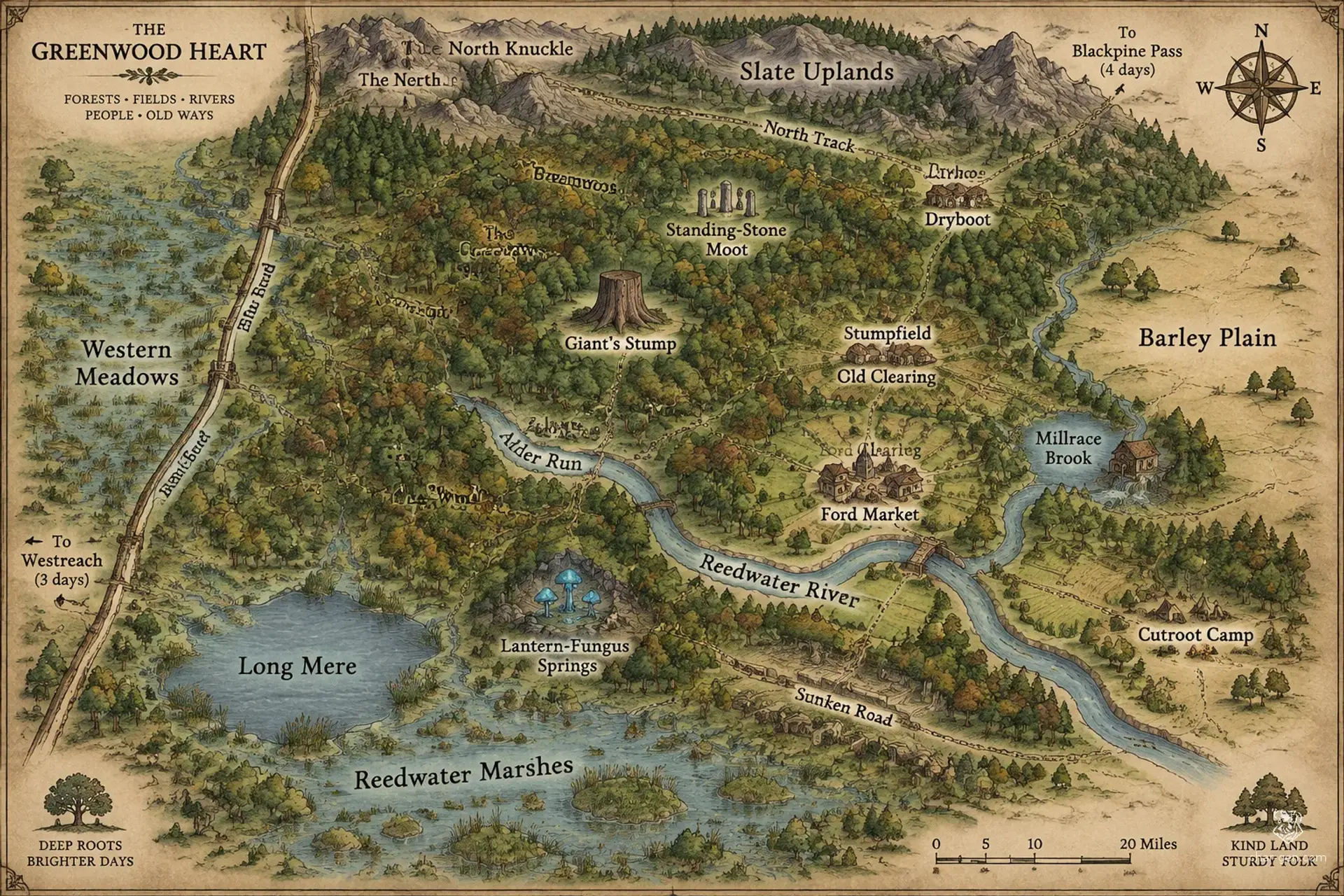
Stumpward is a broad forest heartland where old timber roads, rivers, and farm clearings connect dozens of villages and market towns. Its temperate seasons make travel and harvest predictable, but the woods remain close enough to swallow abandoned tracks and shelter dangerous magic. Local councils share authority through an old charter, balancing the needs of farmers, woodcutters, traders, and forest guardians. Adventurers find steady work in the gaps between settled land and the deep green.
Cultures
The stump-clearing communities prize shared labor and inherited woodland rights.
The river-market towns blend inland farming customs with the habits of passing traders.
The old forest clans preserve seasonal rites and paths older than the local roads.
Places
5 settlements
Large · Market townOld ClearingSeasonal market and moot gathering placeIts annual fair brings farmers, woodcutters, and traveling craftspeople together.
Medium · Market townFord MarketRiver trade hubBoat crews and cart traders compete for space along its crowded riverbank.
Medium · VillageStumpfieldAgricultural supply centerIts broad fields were won from a forest of old trees, and its farms are unusually fertile.
Small · Mill villageDrybootMilling and sawwork centerDespite its proud name, spring floods often isolate its mills and workshops.
Small · Logging campCutroot CampManaged timber outpostThe camp shifts with each licensed harvest and keeps a wary watch for forest spirits.
How they spread
PatternMost settlements sit along waterways, road junctions, and the edges of managed clearings. The forest interior holds isolated hamlets, seasonal camps, and protected groves.
Common kinds
River market towns serve as trading and craft centers.
Farm villages cluster around clearings and shared wells.
Logging camps move between licensed woodlots.
Mills and small hamlets line streams and old roads.
Trade routes
The King's Road links western farms to the eastern plain.
The Reedwater barge route carries bulk goods southward.
The North Track connects hill quarries with the central markets.
Dangers and hooks
3 threats
Most dangerous · HighThe Hollow StagFey predatorIts hoofprints circle isolated farms before livestock and travelers disappear.
The BrambleboundModerateEnchanted plant creatures
They appear near old clearings after heavy rain and pursue trespassers into the woods.
Charcoal Pit RaidersVariableBandits
Small bands strike remote camps and river barges, then vanish into abandoned tracks.
Hazards of the land
Sudden storms raise creeks and flood low crossings.
Old charcoal pits collapse beneath leaf litter.
Enchanted brambles can entangle travelers and resist ordinary blades.
Plot hooks
1
The Walking BoundaryInvestigationA boundary tree has moved overnight, placing a prosperous village inside a protected grove and threatening its harvest.Starts: The village reeve asks the party to inspect the disputed boundary before the seasonal moot.Reward: A modest purse, legal woodland access, and a favor from local stewards.
2
Grain Beneath the ReedwaterRescue and mysteryA barge carrying vital winter grain vanished near a stretch of river where no wreckage can be found.Starts: The Ford Market hires the party after the boat crew's families demand answers.Reward: Recovered cargo, payment, and a riverboat contact.
3
The Lantern SpringExplorationBlue lantern fungi have spread into a village well, and sleepers nearby share the same strange dream.Starts: A local healer seeks help tracing the growth to its hidden spring.Reward: A rare healing salve and knowledge of a safe forest path.
4
Under the Old ClearingDungeon delvingA crew of loggers has uncovered a sealed stone chamber beneath an old stump field.Starts: The Coppice Compact sends a discreet messenger to keep the discovery from rival claimants.Reward: A share of recovered valuables and a chartered favor.
The land
Climate and ground
ClimateTemperate, with mild wet springs, warm summers, colorful autumns, and occasional snowy winters.
TerrainA broad, rolling forest heartland crossed by rivers, old roads, and cultivated clearings.
Biomes
Mixed deciduous forest covers most of the region.
Fertile clearings support fields, orchards, and pasture.
Wet meadows spread beside the slow rivers.
A few pine ridges mark the cooler northern edge.
Waters and borders
Waterways
The Reedwater River carries barges through the southern lowlands.
The Alder Run links inland farms to riverside markets.
The Long Mere drains the western meadows.
The Millrace Brook powers scattered mills and sawpits.
Borders
The northern edge rises into the Slate Uplands.
The eastern forest thins into the open Barley Plain.
The southern boundary follows the broad Reedwater marshes.
The western limit is marked by the old King's Road and its roadside farms.
On the road
Rain can turn unpaved forest tracks into deep mud within hours.
Local guides know which old paths remain passable after floods.
Travelers should seek permission before crossing marked woodlots.
Landmarks
The Giant's Stump is a hollowed remnant of a vast ancient tree.
A ring of standing stones marks a meeting ground used for seasonal moots.
The Sunken Road disappears beneath the Reedwater in wet years.
Blue lantern fungi glow around several deep forest springs.
Landforms
Low wooded ridges divide the river valleys.
Wide floodplains support farms and wet meadows.
The North Knuckle is a broken line of rocky hills.
Hidden sinkholes mark old limestone ground.
Resources
Straight hardwood timber is carefully harvested from managed stands.
Ironstone and limestone are quarried in the northern hills.
Medicinal herbs grow in shaded clearings and along streambanks.
Rich river silt keeps the central fields productive.
Power
Rule
GovernmentA loose charter of town councils, village reeves, and woodland stewards governs through seasonal assemblies.
SeatA rotating moot meets at whichever market town can host the gathering, so no single settlement serves as a permanent capital.
StabilityMostly stable, though arguments over timber rights and river tolls periodically threaten local cooperation.
Laws
Marked boundary trees may not be felled without the landholders' consent.
River crossings must remain open to public passage except during declared floods.
Unlicensed fire-setting in woodland is punished by restitution and labor.
Disputes over common land must be heard at a seasonal moot.
Factions
Coppice CompactRural landholders' league
Influence: Strong in villages that depend on managed forests.The Coppice Compact regulates logging and seeks to protect shared woodland rights.
Ford FactorsMerchant association
Influence: Strong in market towns and among boat crews.The Ford Factors want tolls lowered and river traffic kept safe through every season.
Rootward CircleDruidic fellowship
Influence: Quiet but respected in woodland settlements.The Rootward Circle protects old groves and investigates disturbances in the deep forest.
Faiths
Hearth Mother
Influence: Widely observed among settled communities.The Hearth Mother is honored through household rites, planting blessings, and care for neighbors.
Green Witness
Influence: Strong among forest stewards and rural healers.The Green Witness teaches that every grove has memory and that harvest requires restraint.
Lantern Path
Influence: Popular with traders and travelers.The Lantern Path honors safe passage, honest bargains, and the guidance of ancestors.
People and trade
Who lives here
How manyModerate, with dense settlement along rivers and cleared roads and wide gaps beneath the forest canopy.
Main peoples
Humans form the largest population across farms and towns.
Half-elves are common in forest-edge communities.
Halflings maintain many river farms and market gardens.
Other peoples
Wood elves keep scattered ancestral enclaves.
Dwarves work the region's stone and iron deposits.
Languages
Common is used in markets and councils.
Sylvan survives in forest villages and ritual songs.
Dwarvish is common among quarry crews and metalworkers.
Trade
WealthGenerally comfortable in market towns, while remote hamlets rely on barter and shared stores.
Work
Timber cutting and woodland management support many villages.
Mixed farming produces grain, beans, fruit, and livestock.
River transport and craft workshops connect scattered markets.
Exports
Hardwood planks and charcoal travel downriver.
Wool, grain, and smoked meat supply neighboring regions.
Herbal remedies and carved household goods sell at local fairs.
Imports
Salt and coastal fish arrive from western traders.
Fine tools and worked metal come from neighboring uplands.
Markets
The Ford Market gathers traffic where the main river narrows.
The Old Clearing hosts seasonal fairs and wagon exchanges.
History and secrets
The region grew from a chain of clearings cut into old forest by farmers, charcoal burners, and road crews. Its communities learned to share woodland and water after repeated fires and floods made isolated rule impractical. The Common Charter remains a practical agreement rather than a strong central government, and its protections are tested whenever timber prices rise or a settlement expands into ancestral groves.
Key events
First Clearing
The Great FellingEarly settlers burned and cut a broad belt of forest to create shared fields and grazing commons.
Three Generations Ago
The Reedwater FloodA flood destroyed several riverside mills and forced communities to agree on common levee repairs.
Recent Past
The Common CharterThe first regional moot established rules for woodlots, road maintenance, and river access.
Secret 1 · GM only
The Common Charter was drafted to conceal an ancient grove from outside claimants, not merely to divide ordinary woodlots.Found by: Compare old moot records with the strange alignment of standing stones.If found: The charter's founding boundary excludes a vast grove that has been quietly protected for generations.
Secret 2 · GM only
A buried root-heart beneath the stump is slowly waking and has begun answering nearby dreams.Found by: Listen for voices beneath the Giant's Stump after rain.If found: The forest's local magic may be guided, bargained with, or provoked by whoever reaches the buried heart first.
Secret 3 · GM only
Someone is maintaining a concealed causeway under the flooded road and using it to move goods unseen.Found by: Track missing tools and fresh bootprints along the Sunken Road at low water.If found: A hidden crossing could alter trade routes and upset the balance between river towns.
Media
0 images
No images yet.
Visual sheet
Turn Stumpward into a sheet
A high-res, share-ready sheet you can post or print.