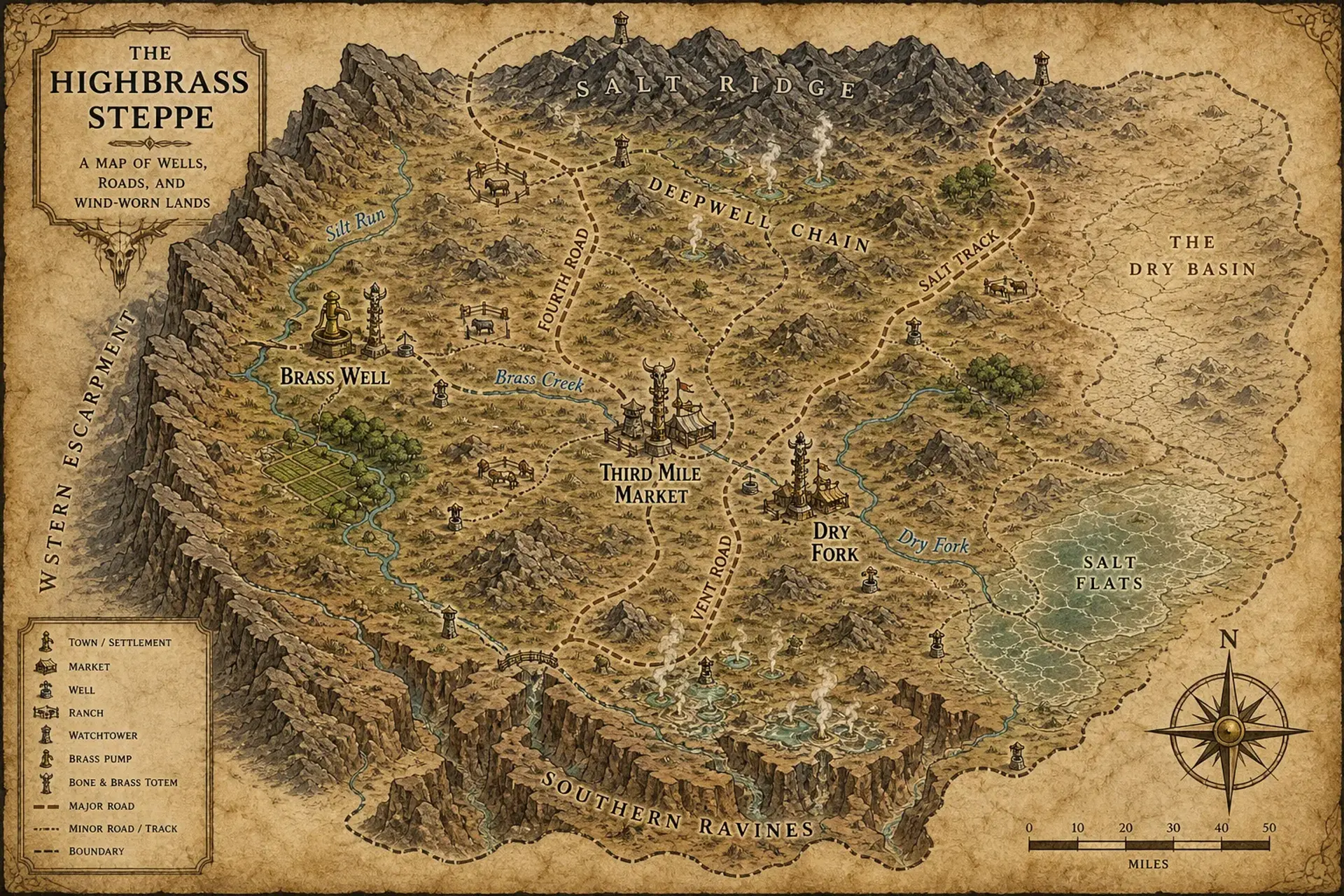
Where brass pumps draw water from the dark heart of the steppe.
ZSZrkamunthz Steppe
Overview
The Zrkamunthz Steppe is a broad, semi-arid highland region within the Bahag Duchy of the Principality of Khathiz. Wind combs dark grasses between rocky ridges, salt flats, and steaming vents, while settlements gather around deep wells and seasonal water. Gnoll artisans dominate its brasswork and clockwork trades, building towns of stone, timber, iron, and bone. Wagon roads connect scattered markets, ranches, and vent-heated forges across a landscape where water, craft, and clan obligation shape daily life.
Cultures
Gnoll artisan clans organize workshops around kinship, apprenticeship, and shared water rights.
Caravan communities blend steppe customs with trading practices from neighboring provinces.
Steampunk craft traditions prize repairable brasswork, hand-built engines, and public demonstrations of skill.
Places
4 settlements
Large · Well townBrass WellRegional market and water-rights meeting place.Fortified stone foundations support timber galleries, brass pumps, and crowded repair yards.
Medium · Salt townSalt RidgeSalt exchange and caravan staging point.Workers harvest mineral crusts beneath watch platforms built on the ridge.
Medium · Caravan marketThird Mile MarketTrade stop serving overland caravans.A roadside settlement of covered stalls, livestock pens, and engine repair sheds.
Small · Ranching villageDry ForkRanching center and guardian of a seasonal crossing.Raised homes and warning towers overlook a broad wash that floods after storms.
How they spread
PatternSettlements cluster around deep wells, springs, and dependable vent fields, with long open stretches between them. Smaller ranches and seasonal camps follow grazing and harvest cycles.
Common kinds
Fortified well towns with clustered workshops.
Ranching villages near seasonal grazing grounds.
Salt-harvesting camps on the flats.
Roadside caravan markets and repair yards.
Trade routes
The Fourth Road links western valley markets to eastern caravan lands.
The Salt Track carries mineral loads between the flats and the interior.
The Vent Road serves forge districts and geothermal works.
Dangers and hooks
4 threats
Most dangerous · HighSalt Flats SinkholesEnvironmental hazardHidden beneath fragile crusts, especially after seasonal storms.
The Unmoored EngineHighMagical construct
A dangerous clockwork machine is rumored to roam the vent fields after a workshop accident.
Vent WraithsModerateSupernatural hazard
Faintly magical figures appear near geothermal fissures during cold, still nights.
Roadside ReaversModerateHumanoid bandits
Small bands target isolated wagons on the long stretches between wells.
Hazards of the land
Seasonal flash floods race through dry riverbeds without warning.
Geothermal vents release scalding steam and faintly magical fumes.
Salt crusts conceal soft ground that can trap wagons and livestock.
Plot hooks
1
The Glittering WellMystery and explorationA public pump begins forcing out hot, glittering water, and nearby wells are losing pressure.Starts: The Deep Well Compact hires the party at a pump house outside Brass Well.Reward: A reliable steam-pump fitting and a share of the recovered mineral claims.
2
Tracks on the SaltRescue and investigationA caravan disappears after following fresh tracks across a salt flat that should be impassable.Starts: A worried factor seeks help at Third Mile Market.Reward: Caravan wages, trade favors, and salvage rights to recovered cargo.
3
The Silent TotemSocial intrigueA pack-totem has gone dark, and rival clans accuse each other of stealing its heartwork.Starts: The totem's keepers ask the party to inspect its sealed brass core.Reward: A hand-built clockwork tool and safe passage through several clan territories.
4
Runaway BoilerAction and pursuitAn experimental engine escapes its workshop and heads toward a crowded livestock market.Starts: The Vent Forge Circle offers payment at Salt Ridge for stopping the machine intact.Reward: A compact steam device, artisan services, and a favor from the artificers.
The land
Climate and ground
ClimateArid, with hot windy summers, cold dry winters, and brief seasonal storms.
TerrainA high semi-arid steppe of wind-combed grass, rocky ridges, dry channels, salt flats, and geothermal vents.
Biomes
Dark-brown semi-arid grassland.
Hardy thorn scrub and low rocky ridges.
Dark green salt flats.
Spring-fed groves and irrigated patches.
Waters and borders
Waterways
The Silt Run flows briefly after seasonal storms.
The Brass Creek is a spring-fed channel used by nearby farms.
The Dry Fork is a broad wash that carries flash floods.
The Deepwell Chain links several underground aquifers through pumps.
Borders
The western escarpment separates the steppe from wetter Khathizi valleys.
The northern ridge country marks the approach to colder uplands.
The eastern dry basin opens toward caravan lands beyond the principality.
The southern ravines lead toward the settled heartlands of the Bahag Duchy.
On the road
Travelers should carry water between wells because seasonal streams vanish quickly.
Dust squalls can obscure wagon tracks and make exposed ridges dangerous.
Caravans often schedule passage near dusk to avoid summer heat.
Landmarks
Tall bone-and-brass pack-totems vent faintly glowing steam at dusk.
Windmills turn above deep wells fitted with brass pumps.
Vent-heated forges work through the night in several craft districts.
Seasonal storm pools leave bright mineral rings on the flats.
Landforms
Low, broken ridges of dark stone.
Broad dry riverbeds and storm-carved ravines.
Dark green salt flats edged by crusted banks.
Scattered geothermal mounds and steaming fissures.
Resources
Brass-bearing and iron-rich ore.
Salt and mineral deposits.
Hardy grazing grasses and livestock.
Geothermal heat and spring water.
Power
Rule
GovernmentThe Bahag Duchy is a hereditary duchy within the Principality of Khathiz, relying on local councils, clan elders, and appointed road officers.
SeatThe Bahag ducal court governs from a fortified administrative settlement within the steppe; local councils handle routine matters.
StabilityGenerally steady under the Bahag Duchy within the Principality of Khathiz, though water disputes and workshop rivalries cause periodic unrest.
Laws
Wells and public pumps must remain accessible during drought emergencies.
Caravan tolls must be posted before a route enters a settlement.
Unlicensed steam engines may not be operated within crowded streets.
Damage to a marked pack-totem requires restitution to its custodians.
Factions
The Deep Well CompactWater-rights council
Influence: High among settled gnoll clans and local officials.Secure reliable water rights while keeping the duchy's workshops prosperous.
Fourth Road CaravaneersMerchant league
Influence: Strong along the principal wagon roads.Control caravan tolls and protect routes without surrendering local autonomy.
Vent Forge CircleArtificers' society
Influence: Growing among artisans and young inventors.Test dangerous engines and claim geothermal sites for experimental forges.
Faiths
The Wellward Vow
Influence: Strong in rural communities and among well keepers.Honors springs, wells, and the obligations of sharing water.
The Brass Measure
Influence: Prominent among smiths, engineers, and workshop guilds.Treats craft, repair, and measured invention as sacred duties.
The Totem Vigil
Influence: Widespread among gnoll families and caravan guards.Keeps ancestral memory through clan rites and the tending of pack-totems.
People and trade
Who lives here
How manySparse across the open steppe, with dense clusters around wells, springs, workshops, and salt flats.
Main peoples
Gnolls form the clear majority and dominate skilled metalworking and local governance.
Human caravan families maintain many long-distance trade connections.
Dwarven artisans and prospectors settle near mines and geothermal workshops.
Other peoples
Halfling herders tend hardy livestock along seasonal routes.
Orcish well crews and mercenary guards travel between settlements.
Languages
Khathizi, Steppe Gnoll, Trade Cant, Dwarvish
Trade
WealthModest overall, with notable wealth concentrated in artisan workshops and caravan houses.
Work
Ranching and hideworking.
Salt harvesting and small-scale irrigated farming.
Brasswork, clockwork, and steam machinery.
Exports
Brass fittings and intricate clockwork devices.
Salt, cured meat, and hardy wool.
Steam pumps and repair parts.
Imports
Grain and fruit from wetter Khathizi valleys.
Fine timber and medicinal herbs from neighboring uplands.
Markets
Brass Well, Salt Ridge, Third Mile Market
History and secrets
The Zrkamunthz Steppe was settled around springs, deep wells, and seasonal watercourses, where gnoll communities built durable towns and perfected metalworking. The spread of brass steam pumps transformed scattered workshops into a regional craft economy. Later, the Bahag Duchy brought the roads and water rights under a shared administration within the Principality of Khathiz. Old clan claims and newer engineering interests still compete over wells, vents, and caravan tolls.
Key events
Early settlement era
The First WellsGnoll clans established permanent settlements around reliable springs and deep wells.
Age of craft
The Pumpwright CompactBrass pumps and vent-heated forges allowed workshops to expand beyond the largest springs.
Ducal consolidation
The Road TallyThe Bahag Duchy secured caravan roads and formalized its place within Khathiz.
Secret 1 · GM only
A vast underground reservoir beneath the ridges is slowly replenishing itself through an unknown magical source.Found by: The oldest pump records show water levels rising when no rain has fallen.If found: A buried reservoir of magical water could end local shortages, but opening it may awaken something sealed below.
Secret 2 · GM only
Some of the bone-and-brass pack-totems were built over ancient mechanisms rather than simple boundary markers.Found by: At dusk, one pack-totem vents steam in a repeating rhythm that matches an old survey mark.If found: The totems may be parts of a forgotten warning system, and several vents could be concealing sealed chambers.
Secret 3 · GM only
An obsolete wagon road still crosses the steppe beneath the salt crust, connecting settlements that no longer acknowledge one another.Found by: A damaged caravan ledger lists toll payments to a road station absent from every current map.If found: Finding the station could reveal an unclaimed route and provoke a struggle over its tolls.
Media
0 images
No images yet.
Visual sheet
Turn Zrkamunthz Steppe into a sheet
A high-res, share-ready sheet you can post or print.