
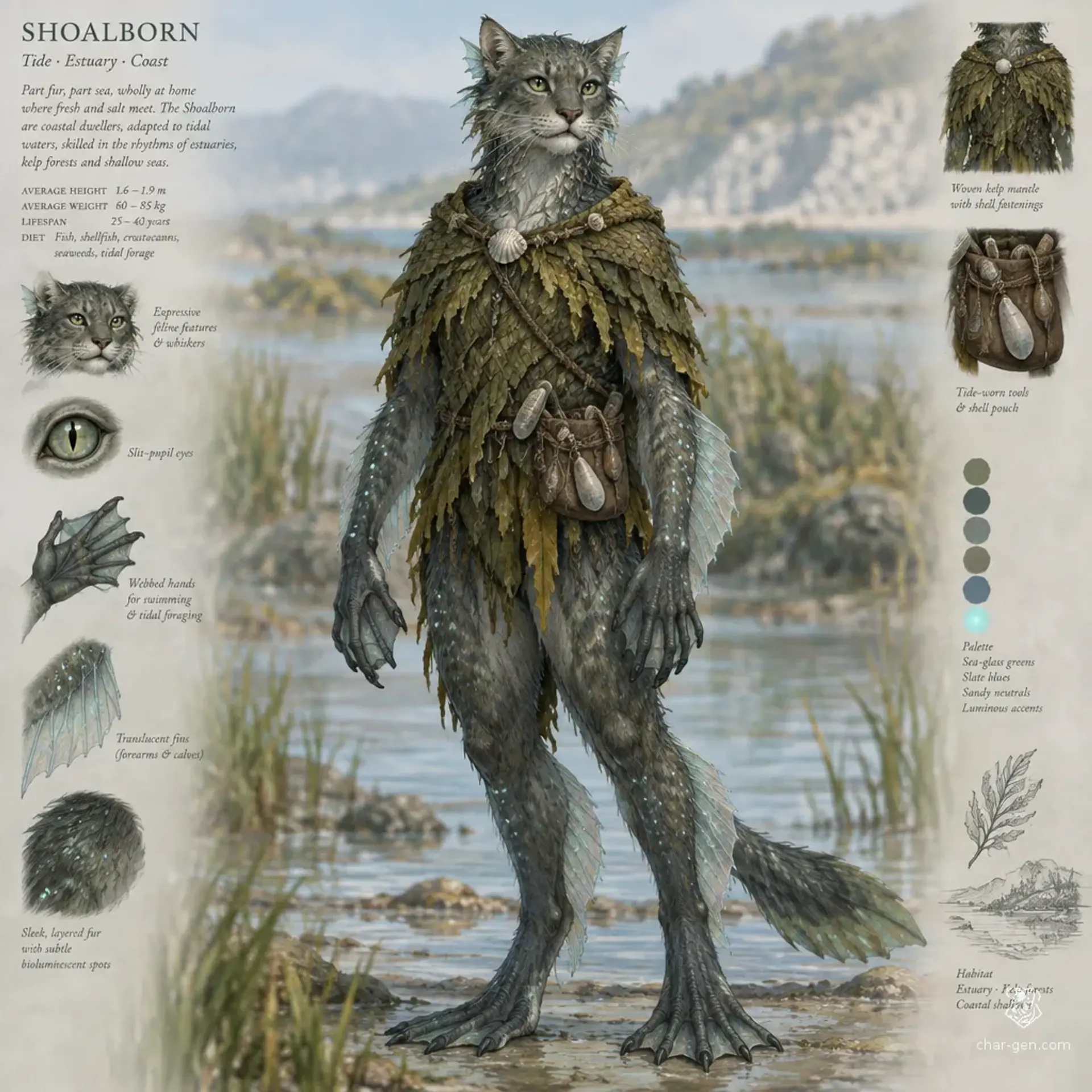
Felimaris pelagis
Shoalborn are sea-going catfolk whose old hunting songs once drew the unwary beyond the surf.
At a glance
Darkvision 60 ft.
Languages Common, Aquan
Height 4 ft. 8 in. to 6 ft. 2 in.
Weight 100 to 190 lb.
Lifespan 90 to 120 years, adult at 18
At the table
You have a swimming speed of 30 feet.
You can breathe air and water.
You have proficiency in the Perception skill.
As a Magic action, you can cause faint lights to shimmer along your skin for 1 minute. The lights shed dim light in a 10-foot radius. Once you use this trait, you can't use it again until you finish a Long Rest.
Common, Aquan
Perception
These folk often develop strong lungs, keen senses, and patience shaped by tides, but individuals vary widely. Choose any ability score increases allowed by your table; no scores are fixed by ancestry.
Their dark coats, broad paws, and strong low-light vision suit reefs and shadowed caverns.
Reefshade pods favor rocky coastlines and submerged grottoes. Their markings tend toward mottled charcoal, ink blue, and pale stone, and they are often skilled at navigating narrow passages.
Shoalborn are sea-going catfolk whose old hunting songs once drew the unwary beyond the surf. Some of their ancestors lured prey to the deep to feed; others made willing, intimate bonds through which a partner could become Shoalborn. Those traditions left a dangerous legacy, and modern pods argue fiercely over what was survival, what was coercion, and what must never happen again. A Shoalborn adventurer might be a watchful guide, a reformed lure-singer, or simply someone seeking a life beyond the tide.
Shoalborn are aquatic feline humanoids, with rounded or angular catlike faces, whiskers, slit or round pupils, and dense coats that lie sleek against the body when wet.
Their colors range from sand and slate to kelp green, with mottled patterns that break up their outlines underwater. Webbing joins their fingers and toes, while flexible fins may fringe their forearms, calves, or ears. Some bear faint bioluminescent spots or stripes. Their voices carry unusually well through water, though this is a natural resonance rather than a supernatural compulsion.
Coasts, kelp forests, estuaries, sea caves, and harbor cities; some live far inland near deep lakes.
Learns to swim and breathe in both air and water; closely supervised by kin.
Takes on adult responsibilities and chooses a pod, vocation, or solitary path.
Often becomes a memory-keeper, mediator, or guide through dangerous currents.
Shoalborn commonly organize into pods: flexible households joined by care, craft, and shared territory rather than strict bloodlines.
Their songs carry practical information as well as art, encoding routes, weather, and family histories in changing rhythms. Older hunting customs included drawing outsiders into deep water to feed or to form transformative bonds. Many communities now condemn coercive luring and insist that any transformation be knowingly and freely chosen. A transformed partner becomes Shoalborn through a rare inherited rite, not through an ordinary embrace; its details are local, contested, and never an adventuring species trait.
Shoalborn traditions honor ancestors, deep-water spirits, and the living sea, though practices vary by pod.
Some leave offerings at tide pools; others keep no formal faith. Their societies prize mutual care and freely chosen bonds, but individuals span every alignment. The old predatory customs are now disputed, not universal or required.
Coastal communities remember both rescues and disappearances, so Shoalborn often meet suspicion before they can explain themselves.
Many pods maintain careful agreements with nearby settlements, offering storm warnings and safe passage in exchange for trade. Shoalborn individuals reject inherited guilt, but some also believe accountability requires confronting their people's history. Their most important kinship bonds may be chosen rather than biological.
Their settlements favor sheltered coves, reef chambers, and tidal halls linked by broad channels.
Dry spaces are built on raised stone shelves, while submerged rooms use shell-inlaid walls and air pockets held beneath domed ceilings. Inland communities adapt these forms with cisterns, ramps, and pools.
No images yet.
A high-res, share-ready sheet you can post or print.