
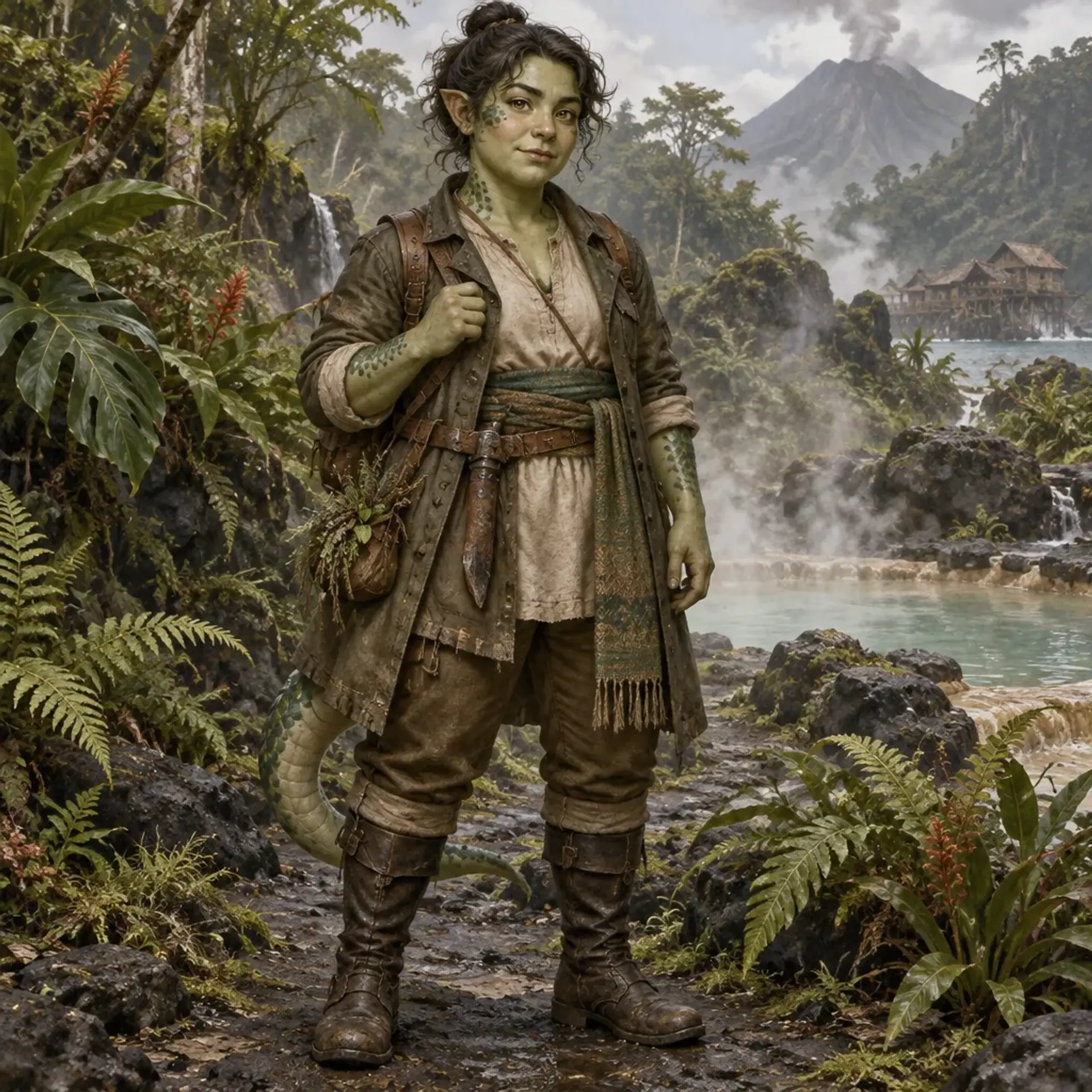
Homo draconicus marisvagus
At a glance
Darkvision 60 ft.
Languages Common, Halfling, Draconic
Resistances Poison
Height Low-blood: 3 to 4 ft. High-blood: 5 to 6 ft., with considerable variation.
Weight Low-blood: 35 to 55 lb. High-blood: 100 to 180 lb., depending on build and wings.
Lifespan 120 to 150 years
At the table
You can see in dim light within 60 feet of yourself as if it were bright light, and in darkness as if it were dim light. You discern colors in darkness only as shades of gray.
You have resistance to poison damage.
You can exhale a noxious green vapor in a 15-foot cone. Each creature in the area must make a Dexterity saving throw, with a DC equal to 8 plus your Constitution modifier and proficiency bonus. On a failed save, a creature takes poison damage; on a successful save, it takes half as much. The damage increases to at character level 5, at level 11, and at level 17. You can use this trait a number of times equal to your proficiency bonus, and you regain all expended uses when you finish a long rest.
Your size is Small or Medium, chosen when you select this species. Your walking speed is 30 feet.
Common, Halfling, Draconic
Poison
The Marshwake tend toward Constitution and either Wisdom or Charisma, reflecting hard survival and the competing inheritance of close-knit village life and draconic ambition. Players assign ability score increases as they wish.
Compact build and inherited halfling features, with only subtle signs of draconic blood.
Low-blood Marshwake most closely resemble their halfling ancestors. Their old family heritages remain visible in stature, manner, and craft traditions. You are Small and gain proficiency in Stealth. Once on each of your turns when you roll a 1 on a d20 test, you can reroll the die, and you must use the new roll.
Castaways who survived a dragon-haunted wilderness by accepting the blood of a wounded green dragon, the Marshwake are a young people caught between halfling fellowship and a growing draconic inheritance. Their island home is beautiful, dangerous, and changing beneath their feet. Now a taller, more aloof generation is coming of age, and old neighbors wonder whether the Marshwake are adapting to their new home or being remade for someone else's purposes.
Marshwake ancestry is visibly divided between two broad expressions.
Low-blood individuals retain many of their refugee ancestors' halfling features, including compact builds, rounded faces, and family-specific traits once associated with Stout, Lightfoot, or Hairfoot lineages. They may show faint greenish undertones, fine scales, unusually sharp eyes, or a trace of draconic coloration. High-blood individuals are generally taller and leaner, with pale green-tinted skin, green or amber eyes, and patches of green, dark, or blackish scales. Some develop tails, claws, wings, altered teeth, or other striking features; these changes can be painful and are not always useful. The people have lived on the islands for only three generations, and their appearance continues to change.
A remote volcanic archipelago of wet forests, rich fishing grounds, hot springs, ash-prone fields, and draconic-tainted wilderness.
Small, quick-footed children raised among kin and taught to read the weather, forage, and avoid the island's many predators.
Adolescents undergo painful and sometimes frightening changes. Low-blood youths usually retain their family's halfling stature, while High-blood youths may grow rapidly, develop scales, tails, claws, wings, or unusual digestive needs.
Adults form households, take on trades, and navigate a society increasingly divided over how much of its old halfling customs to preserve.
Low-blood elders may live to around 150 years, while High-blood longevity is uncertain. The oldest living Marshwake have witnessed only the first generations of their people.
The Marshwake number about 447 and are growing steadily.
Their first generations rebuilt halfling family networks, shared fields, fishing crews, and craft traditions after escaping shipwreck, starvation, and the island's predators. They value hospitality within the community, but their fear of dragons and other island peoples has made them guarded. A marked generational upheaval is underway: High-blood youth form the majority and increasingly favor rigid social expectations based on sex, formal hunting customs, and status earned through prowess. Elders see these habits as a distortion of halfling life; the youth often consider them necessary adaptations. The cause of the transformations is disputed. Some blame the wounded green dragon whose blood changed their people, others suspect a trained midwife, and a few fear a returned draconic patriarch is quietly shaping the settlement.
The first refugees held to family rites, practical household customs, and memories of their former home.
Since the green dragon's blood ritual, some have begun honoring dragons as protectors or ancestors, and a subtle current of Tiamat's influence has entered the settlement. Most worshipers do not understand the larger forces behind these practices. The people have no single alignment: Low-blood communities often prize cooperation, while some High-blood circles favor hierarchy, cunning, and strength.
The Marshwake keep mostly to their island and approach other peoples cautiously, shaped by the betrayal that left their ancestors shipwrecked.
Their elders favor trade and mutual aid when trust can be established; many younger High-bloods regard outside communities as potential rivals or resources. The islands' golden serpentine beings inspire particular fear, while some villagers suspect they may be less hostile than the dragons and stories suggest. The Marshwake are also wary of strangers who ask too much about their bloodline, their dragon benefactor, or the growing influence of dragon worship.
The Marshwake's main settlement stands on a sheltered island where early survivors built low, sturdy homes beneath trees and ridges for cover.
Their buildings combine old halfling practicality with local stone, timber, and Germanic-inspired steep roofs, shutters, woven wattle, and shared bakehouses. Gardens cluster behind windbreaks; stores and boats are guarded carefully. Recent High-blood fashion favors fitted coats, belted tunics, leather boots, and family colors, while Low-blood elders still favor familiar vests, aprons, practical cloaks, and communal work clothes.
No images yet.
A high-res, share-ready sheet you can post or print.