
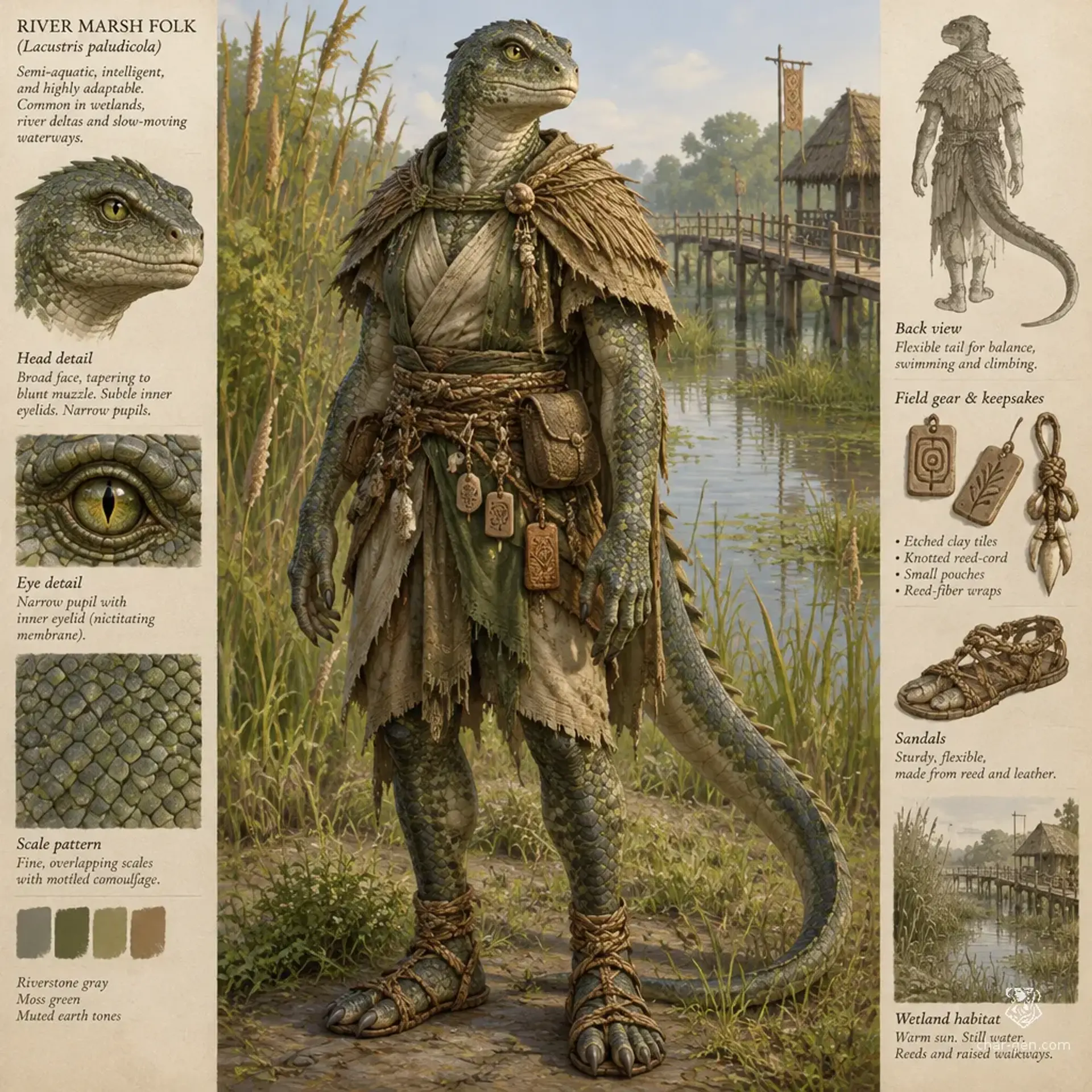
Lacertaviva communis
Patient river-dwellers with keen senses and a gift for finding safe paths through shifting terrain, the Rillith carry the memory of floods, migrations, and promises.
At a glance
Darkvision Darkvision 60 ft.
Languages Common, Rillith
Height 5 ft. to 6 ft. 2 in.
Weight 110 to 190 lb.
Lifespan 70 to 90 years, adult at 16
At the table
Your walking speed is 30 feet. You also have a swimming speed of 30 feet.
You can hold your breath for up to 15 minutes. This does not grant you the ability to breathe underwater.
You have advantage on Wisdom (Perception) checks that rely on smell. Your sensitive nostrils can distinguish familiar scents in waterlogged air and dense vegetation.
As a Magic action, you can use your tail to make an unarmed strike against a creature within 5 feet. On a hit, it deals bludgeoning damage equal to plus your Strength modifier. Once you use this trait, you cannot use it again until you finish a Short or Long Rest.
When you finish a Long Rest in a warm environment, choose one of the following benefits until you finish your next Long Rest: advantage on your next saving throw against exhaustion, or the ability to add to your next Wisdom (Survival) check. You can benefit from this trait only once per Long Rest.
Common, Rillith
Perception
Rillith tend toward Constitution and Wisdom, reflecting their resilient bodies and patient attention to their surroundings. Players assign any ability score increases according to their table's rules, such as +2 and +1 wherever they wish.
A broad, paddle-shaped tail and webbing between the fingers and toes.
Adapted to deep marshes and slow waters, Fen Rillith are strong swimmers and tend to make homes among floating gardens and reed platforms.
Patient river-dwellers with keen senses and a gift for finding safe paths through shifting terrain, the Rillith carry the memory of floods, migrations, and promises. A Rillith adventurer may be a scout, healer, envoy, or wanderer seeking a warmth and purpose their quiet homeland cannot provide.
Rillith are upright, reptilian humanoids with flexible tails, long-fingered hands, and fine overlapping scales.
Their broad faces taper toward blunt muzzles, while their eyes have narrow pupils and protective inner lids. Scale colors range from riverstone gray and moss green to copper, russet, and pale sand, often broken by mottling that helps conceal them among reeds. They shed in thin, papery patches several times a year. Their body temperature responds to their surroundings, so they favor warm resting places and can become sluggish after prolonged exposure to cold.
Warm marshes, slow rivers, reed-choked lakes, and sheltered coastal estuaries; established communities also thrive in temperate riverlands.
Newly hatched and reliant on a clutch circle for warmth, food, and instruction.
Learns practical skills by watching adults and taking part in small communal duties.
Considered ready to travel or establish a household after completing a chosen service to the community.
Often turns from daily labor toward teaching, mediation, and preserving the stories of earlier generations.
Rillith raise young in shared clutch circles, where several adults contribute care and instruction.
Individuals typically choose a craft or service after observing many roles: tending pools, making boats, tracking seasonal changes, keeping records, or mediating disputes. Their memory culture combines spoken histories with etched tiles and knotted reed cords. A promise is treated as a practical bond, and breaking one requires more than an apology to repair.
Rillith traditions honor the continuity of life through river, rain, soil, and sun.
Some revere named water spirits or ancestral keepers, while others understand the sacred as a balance maintained through care. Their customs do not prescribe an alignment, though communal responsibilities often encourage reliability and restraint.
Rillith are often valued as guides, witnesses, and mediators, though their measured speech can be mistaken for coldness.
They tend to build trust through repeated practical help rather than grand declarations. Some outsiders regard their communal child-rearing and attachment to waterways as strange; Rillith in turn may find hurried decisions and wasteful use of shared resources difficult to understand.
Rillith homelands follow water rather than borders.
Settlements occupy raised banks, sturdy rafts, and broad platforms supported above seasonal flood levels. Homes use clay, reed, driftwood, and stone, with shaded basking shelves and cool pools built into communal spaces. In drier regions, cisterns and sun-warmed courtyards serve as gathering places.
No images yet.
A high-res, share-ready sheet you can post or print.