
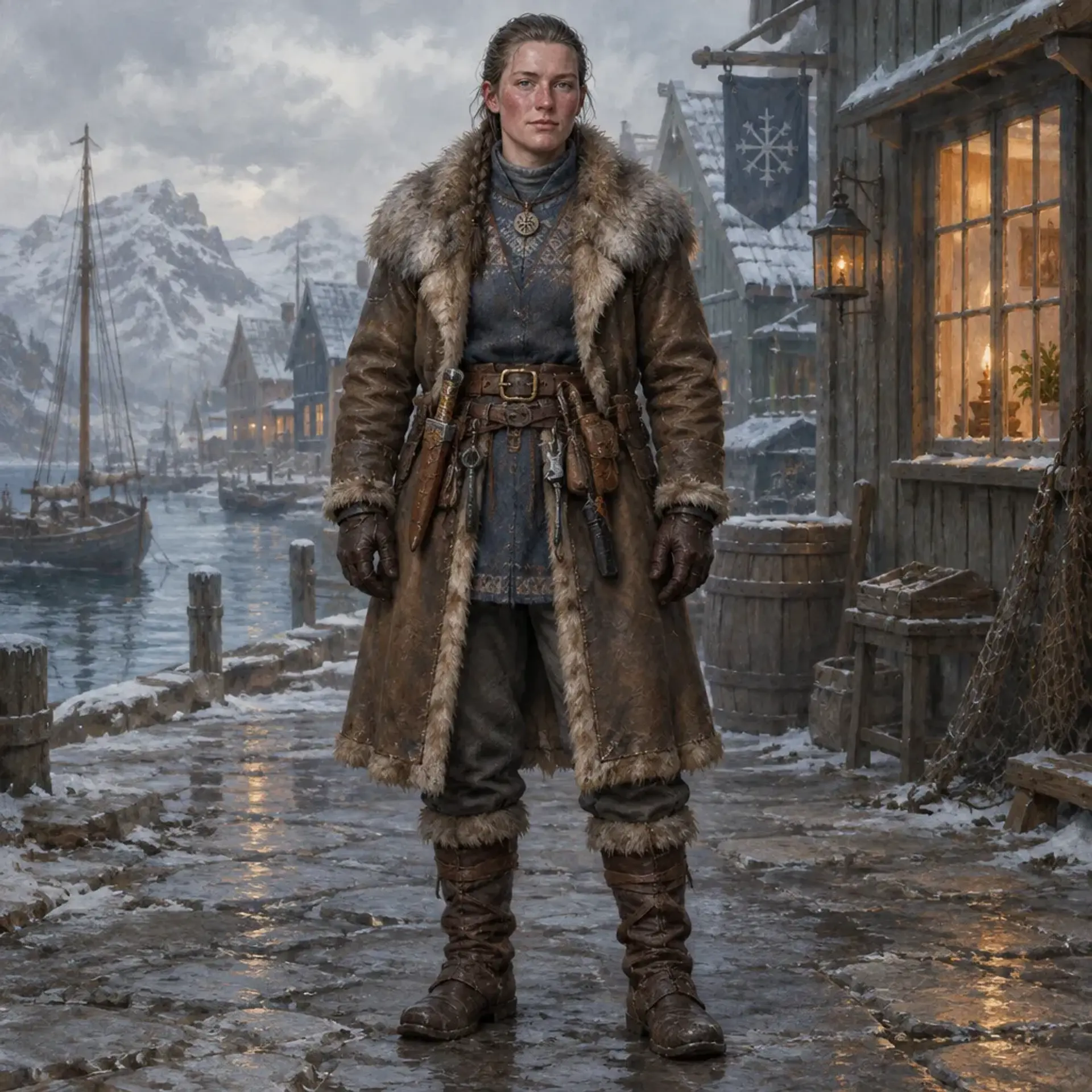
Homo borealis
Northlanders are hardy humans shaped by cold coasts, crowded ports, and the inherited memory of bondage to giants.
At a glance
Languages Common, One regional language appropriate to the character's homeland
Height 5 ft. 8 in. to 6 ft. 4 in.
Weight 150 to 240 lb.
Lifespan 70 to 90 years
At the table
As a human ancestry, Northlanders use the human ancestry rules for Pathfinder 2E. They have 8 ancestry Hit Points, a Speed of 25 feet, and two free ability boosts. They begin with Common and one additional language determined by their Intelligence modifier, if positive. They may select from the languages available to their region and ancestry options.
Choose a human heritage that reflects your upbringing or family history. Heritage options are presented below as Northlander cultural lineages and are suitable for characters from these communities.
Northlanders have no universal supernatural protection against cold, nor do they gain special combat training solely from ancestry. Their endurance is expressed through habits, skills, and the choices represented by their class, background, and feats.
Northlanders often cultivate endurance, practical judgment, and close attention to weather and people. These are cultural tendencies, not fixed ability modifiers; choose boosts and flaws according to your character concept and Pathfinder 2E rules.
You grew up among wind-scoured settlements and learned to recognize safe shelter, changing weather, and the practical signs of exposure.
Frostroad Northlanders come from the colder reaches and traveling communities of the Northlands. They tend to prize preparation and direct cooperation, and often know the old routes between isolated settlements.
Northlanders are hardy humans shaped by cold coasts, crowded ports, and the inherited memory of bondage to giants. They prize dependable neighbors, practical courage, and the warmth of a shared hearth. Many are superstitious and wary of wizards and sorcerers, not because all Northlanders share one belief, but because old family warnings have survived where written histories failed. A Northlander adventurer may be a sailor, artisan, envoy, guard, or scholar, carrying the customs of home into unfamiliar places.
Northlanders are tall, broad-shouldered humans with fair skin that may freckle or redden quickly in wind and cold.
Blue and steel-gray eyes are common, though brown, green, and hazel eyes also occur. Hair ranges from pale blond to dark brown and black, often worn braided or bound back for work. Their practical clothing favors layered wool, leather, and fur, but city dwellers readily adopt local fashions. Callused hands and weathered skin are common signs of an outdoor upbringing, not a requirement of ancestry.
Urban; especially the Northlands, the League of the Free Cities, and Elfheimr
Children learn household duties, local stories, and the signs of dangerous weather. Many communities mark a first solo winter errand as a small rite of passage.
Young adults are expected to choose a trade, take responsibility for their own provisions, and prove they can be relied upon when conditions turn harsh.
Elders are valued as witnesses, mediators, and keepers of family histories. Those who have survived many hard seasons may be sought out before any major undertaking.
Northlanders are humans rather than a separate supernatural kind, united more by northern conditions and shared histories than by a single culture.
They are accustomed to preserving food, clothing, and equipment against difficult weather, and value people who can be counted on when plans fail. Their ancestors were enslaved by giants in ancient times; stories of escape, resistance, and survival are preserved in family names, songs, and local memorials. In the present, many Northlanders live in cities and participate in commerce, craft guilds, and civic life. Superstitions vary by household, but distrust of wizards and sorcerers is common, particularly where magic is used without explanation or consent.
Their faith is varied, combining worship of regional gods with household rites, seasonal observances, and offerings made for safe travel.
Some leave a token at a crossroads or speak a warning before crossing frozen water. Such customs may be religious, superstitious, or simply inherited habit. Northlanders are no more bound to one alignment than other humans; communal duty and personal freedom are both widely admired, and disputes over which matters more are common.
Northlanders are found throughout the Northlands, the League of the Free Cities, and Elfheimr, where they live under elven rule.
They form ties through trade, neighborhood, kinship, and service rather than a single unified nation. Their wary attitude toward arcane spellcasters can strain friendships, especially when fear is mistaken for hostility. Many respect elves as neighbors and political authorities while still arguing fiercely for local customs. Accounts of ancient enslavement by giants remain a powerful part of family memory, though individuals differ over whether that history calls for vigilance, reconciliation, or vengeance.
Their settlements range from crowded northern ports to fortified market towns and neighborhoods within Elfheimr.
Buildings favor steep roofs, thick walls, sheltered courtyards, and shared hearths. In cities, Northlanders adapt readily, building communal halls and windbreaks into narrow streets or maintaining a warm public room near the docks. Older structures sometimes incorporate stones taken from giant ruins, a practice admired by some and considered dangerously boastful by others.
No images yet.
A high-res, share-ready sheet you can post or print.