
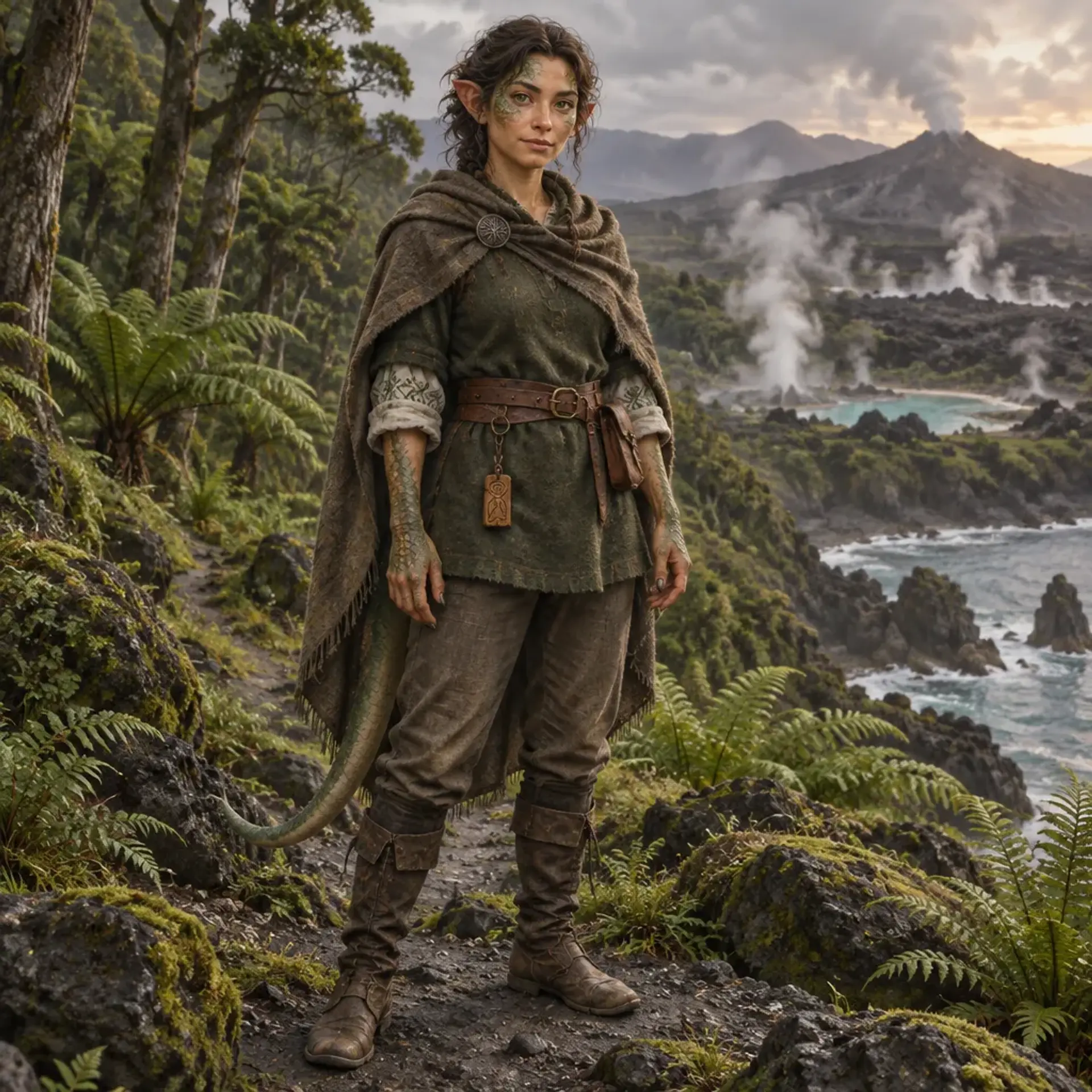
Homo draconis viridans
Shipwrecked halfling families found refuge on an island that seemed almost lovingly prepared for them, until ash, dragons, and strange golden figures made safety uncertain.
At a glance
Darkvision 60 ft.
Languages Common, Draconic
Height Low-blood adults: 3 to 4 ft. High-blood adults: 5 to 6 ft.
Weight Low-blood adults: 35 to 55 lb. High-blood adults: 110 to 190 lb.
Lifespan 120 to 160 years
At the table
You are a Humanoid. When you choose this species, your size is Small or Medium, reflecting your family’s ancestry and your character’s development.
Your walking speed is 30 feet.
Accustomed to dark forest paths and unlit volcanic caverns, you can see in dim light within 60 feet of yourself as if it were bright light, and in darkness as if it were dim light. You discern colors in darkness only as shades of gray.
Your draconic inheritance lets you exhale a toxic green mist. When you take the Attack action, you can replace one attack with a 15-foot cone of poisonous breath. Each creature in the cone makes a Constitution saving throw, with a DC equal to 8 plus your Constitution modifier and Proficiency Bonus. On a failed save, a creature takes poison damage; on a successful save, it takes half as much. The damage increases to at character level 5, at level 11, and at level 17. You can use this breath a number of times equal to your Proficiency Bonus, and you regain all expended uses when you finish a Long Rest.
Your blood has adapted to the toxins of the island. You have Advantage on saving throws you make to avoid or end the Poisoned condition.
You speak, read, and write Common and Draconic. Draconic phrases and naming customs have entered everyday speech, though elders sometimes preserve older family words unknown to their descendants.
Common, Draconic
Their island-forged lives tend to cultivate Constitution and Wisdom, while the calculating High-blood often favor Intelligence or Charisma. Assign ability score increases according to your character’s background or table rules, not their ancestry.
Compact stature and comparatively faint draconic features; most preserve a strongly communal outlook.
The older branch of the people, descended from the first families who accepted the green dragon’s gift. Low-blood adults generally retain halfling stature and appearance, though green eyes, small scales, and unusual toughness are not uncommon. They are often the keepers of family crafts and memories of the crossing.
Shipwrecked halfling families found refuge on an island that seemed almost lovingly prepared for them, until ash, dragons, and strange golden figures made safety uncertain. A wounded green dragon offered them her blood as a means to endure. Three generations later, the resulting people are divided between elders who remember their small, communal beginnings and a majority of tall, draconic youths whose instincts, customs, and ambitions are reshaping the settlement. Every family carries a question: was the dragon’s gift a rescue, a curse, or the first move in someone else’s long game?
The Verdant-Blooded descend from shipwrecked halfling families who survived a dragon-haunted archipelago and accepted the blood of a crippled green dragon in an ancient rite.
Low-blood adults remain short and broad or slight, with familiar halfling features and only faint signs such as green-flecked eyes, pointed teeth, or a faintly scaled patch of skin. High-blood youths undergo a painful adolescence in which many grow much taller and leaner, their eyes turn vivid green, and scales, claws, tails, or vestigial wings may emerge. Their features vary widely; not every High-blood shows every mark, and some retain a distinctly halfling face.
A remote, volcanic archipelago of deep forests, hot springs, mineral-rich uplands, dangerous shores, and dragon-haunted wilderness.
Small-bodied and quick to recover from childhood illnesses, though the first generation after the shipwreck carried deep fear and grief.
Adolescence can bring painful, sudden changes in High-blood youths: increased stature, draconic features, volatile tempers, and sometimes unusual bodily needs.
Most are considered adults in their late teens. Low-blood adults often remain close to the stature and habits of their halfling ancestors.
They commonly live 120 to 160 years. Older generations tend to be more communal and halfling in manner, while the youngest adults are increasingly shaped by draconic blood and island customs.
Only three generations have passed since the survivors reached the island.
Early life was organized around shared food, family labor, small fields, fishing, and careful shelter from dragons. Their descendants now argue over what survival requires. Low-blood elders often cherish cooperation and inherited halfling customs; many High-blood youths are more aloof, competitive, and drawn to hunting, alchemy, and displays of competence. A rigid set of customs based on sex has recently gained ground among the young, though it is contested and not universal. Family names and old crafts persist, but nobody agrees whether tradition is a refuge or a chain.
There is no settled faith shared by all.
Some families honor the dead lost at sea, the land that sheltered them, or the green dragon who gave them her blood. Others reject dragon reverence as dangerous gratitude. Most elders favor mutual aid and restraint; some young High-bloods prize hierarchy, cunning, and the right to take what they can hold. Individuals span every alignment, though the growing influence of draconic ambition makes the community’s choices increasingly fraught.
The elders preserve the memory of the shipwreck and distrust dragons, especially the golden-scaled islanders whose appearance recalls old terror.
Many High-blood youths view this caution as weakness, though others fear becoming tools of the returned green dragon’s kin. Their community remains bound by family and shared hardship, but arguments over hunting, leadership, sex-based customs, and the meaning of the old halfling traditions are widening the generational divide. Outsiders may be welcomed as useful allies, watched as possible threats, or treated as bargaining pieces by those seeking draconic favor.
The people began with sheltered hamlets and carefully tended plots on a fertile island, building low timber homes with steep roofs, stout doors, covered walkways, and concealed storage.
Germanic-inspired dress and craft traditions have grown over three generations: wool tunics, linen shifts, embroidered cuffs, leather belts, carved household marks, and practical cloaks against wet coastal weather. Their settlements still bear halfling traces, such as shared kitchens and communal gardens, but High-blood influence is changing the scale and layout of homes, workshops, and meeting halls.
No images yet.
A high-res, share-ready sheet you can post or print.