
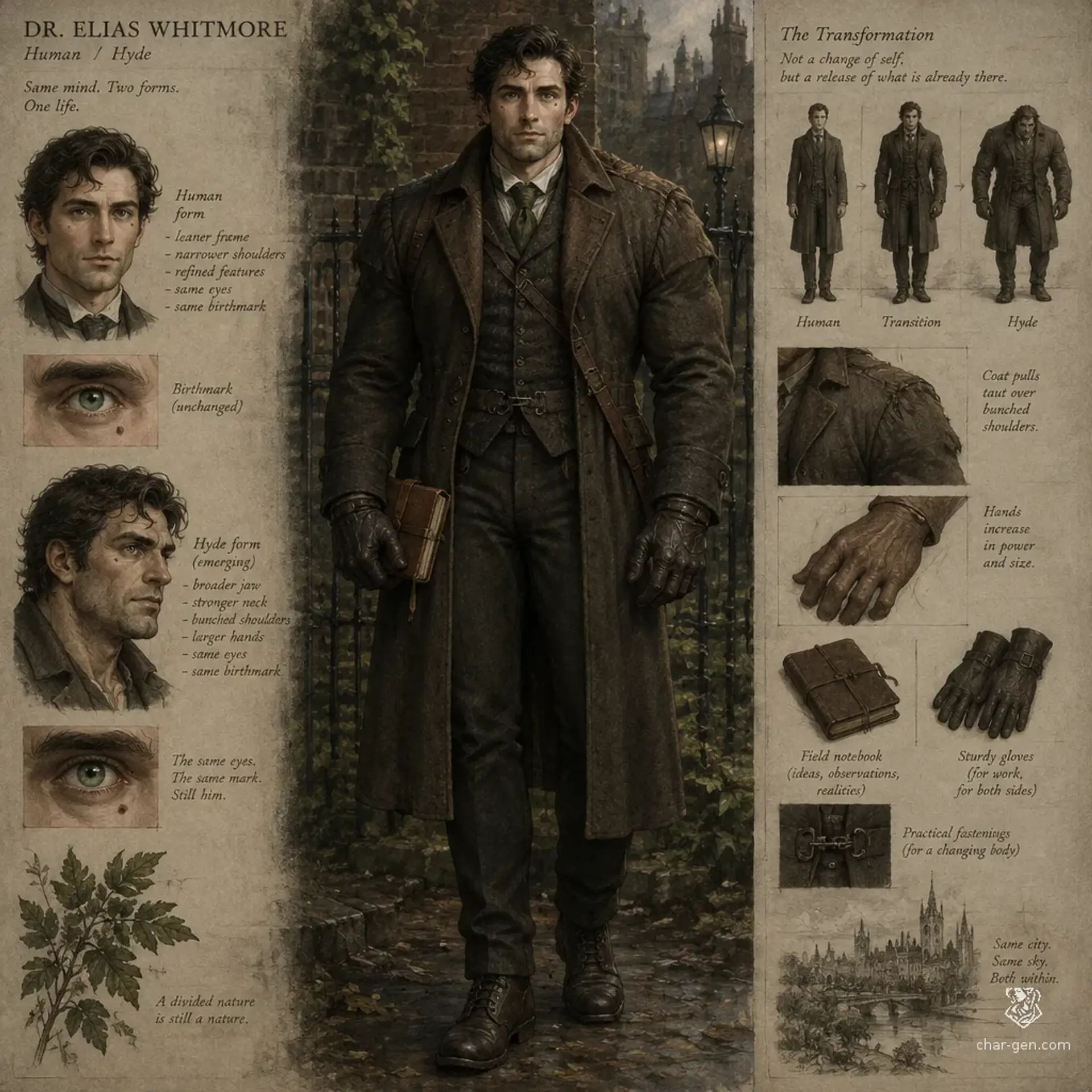
Homo duplex
At a glance
Languages Common, One other language of your choice
Height 5 ft. 2 in. to 6 ft. 4 in. in ordinary form; the transformed form often stands 6 ft. 6 in. to 8 ft.
Weight 110 to 220 lb. in ordinary form; transformed weight varies widely, often increasing by 50 to 120 lb.
Lifespan 70 to 100 years
At the table
As a Bonus Action, you transform for up to 1 minute. You can end the transformation early as a Bonus Action. When it begins, you gain Temporary Hit Points equal to your character level plus your Proficiency Bonus. The transformation ends early if you have the Incapacitated condition. Once you use this trait, you cannot use it again until you finish a Long Rest, unless you expend a spell slot of 2nd level or higher to use it again. While transformed, you have Advantage on Strength checks and Strength saving throws, and your Unarmed Strike can deal plus your Strength modifier in Bludgeoning damage instead of its normal damage. The form changes your appearance but does not alter your equipment.
You gain proficiency in one of the following skills of your choice: Insight, Investigation, Medicine, or Athletics. This reflects the varied training and talents passed through bearer families.
Bearers tend toward Constitution and either Intelligence or Strength, reflecting the divided inheritance of keen intellect and overwhelming force. Assign ability score increases as you wish, such as +2/+1 or +1/+1/+1.
A powerful frame and a transformation marked by heavy shoulders, dense muscle, and a thunderous stride.
Ironhide bearers are known for endurance and a practical, physical approach to problems. Their Hyde forms tend to be imposing without losing the familiar face and mannerisms of the person beneath.
Descended from the first families to study the divided self, these people carry two bodies' worth of possibility in one life: a thoughtful, capable person and a formidable Hyde shaped by instinct, pressure, and choice. Their transformation can turn a scholar into a terrifying combatant, but it does not decide who they are. Every bearer must answer the same question in their own way: when strength rises faster than reason, what will you choose to protect?
In their ordinary state, bearers may look entirely human, though many share a family tell: unusually bright eyes, a distinctive birthmark, a low resting pulse, or hands that seem too strong for their frame.
Their Hyde form is not a separate creature but a dramatic bodily shift. Muscles bunch beneath the skin, posture becomes forward and predatory, the jaw may broaden, and the voice deepens or roughens. The exact appearance is individual, and the same person remains recognizable through the eyes, gestures, or a persistent scar. Transformation is uncomfortable and tiring, but not inherently painful or morally corrupting.
Most often found in crowded cities, university districts, old industrial quarters, and isolated estates with room for private study.
Bearers also settle wherever their unusual nature can be understood rather than merely feared.
Children show no reliable sign of the second nature, though some have unusually vivid dreams or bouts of startling strength.
The Hyde commonly emerges during adolescence, often after fear, shame, or intense pressure. Learning to recognize its onset is a major part of growing up.
Most bearers find a workable balance between their selves, though that balance may require vigilance, ritual, or trusted company.
With age, some bearers gain composure and insight, while others find the transformation harder to contain. Their later years vary greatly.
The name Jekyll is used for the ancestral line and its legacy, not as a single nation or blood-pure lineage.
Bearer communities are small and scattered. Their customs often focus on trust: who may witness a transformation, what signals mean someone needs help, and how to repair harm without treating every bearer as guilty in advance. Some practice controlled exercises with partners, while others prefer solitude. Intellectual achievement and physical prowess are both respected, but neither is considered proof of moral character.
Bearers follow many faiths and philosophies.
Some seek traditions of discipline, confession, or healing; others find meaning in accepting contradiction without shame. Their dual nature does not determine alignment. A Hyde may be protective, cruel, frightened, or joyful, just as its bearer may be.
Bearers are often met with fascination, suspicion, or demands that they prove they are safe.
Many build close circles of trust and make practical agreements about transformation, while others refuse to let prejudice dictate their lives. Among bearers, opinions differ sharply: some see the Hyde as an honest part of the self, others as a dangerous condition to manage, and many reject both explanations as too simple.
There is no single homeland.
Bearer neighborhoods favor discreet entrances, sturdy doors, private courtyards, and rooms with furnishings that can survive a sudden change in strength. Some families keep a quiet chamber for solitary recovery; others reject such precautions as a way of treating a person like a danger.
No images yet.
A high-res, share-ready sheet you can post or print.