
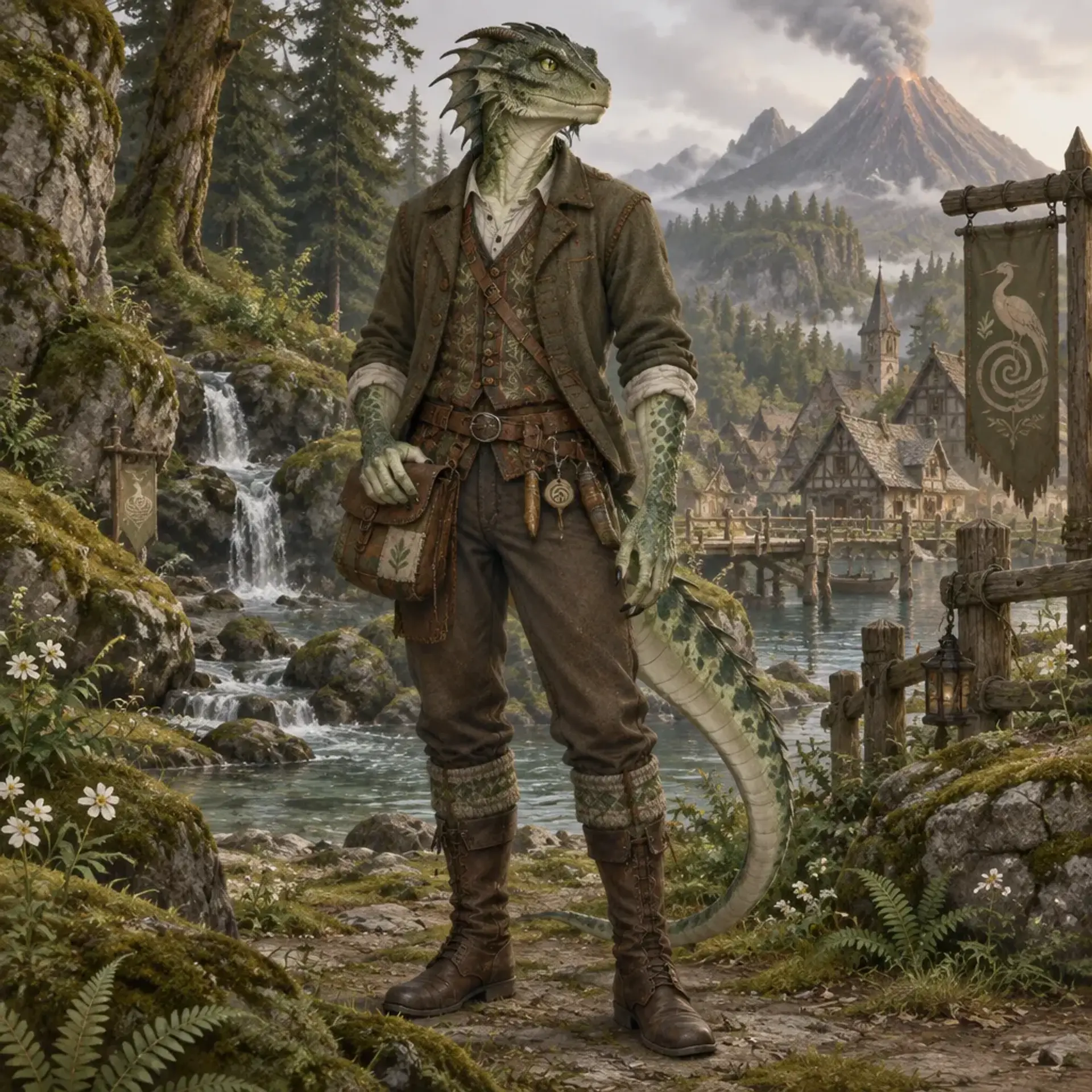
Homo draconis insularis
Shipwrecked halflings found refuge on a beautiful island after surviving a dragon's massacre, only to discover that sanctuary had its own price.
At a glance
Darkvision 60 ft.
Languages Common, Halfling, Draconic
Resistances Poison
Height Low-blood adults usually stand 2 ft. 8 in. to 3 ft. 6 in.; high-blood adults range from 5 ft. 4 in. to 6 ft. 2 in.
Weight Low-blood adults commonly weigh 35 to 55 lb.; high-blood adults commonly weigh 115 to 190 lb., varying greatly with build and draconic growths.
Lifespan Low-blood people commonly live about 150 years, much like their halfling ancestors
At the table
Your walking speed is 30 feet.
You have darkvision with a range of 60 feet. In dim light, you see as if it were bright light, and in darkness as if it were dim light, discerning colors only as shades of gray.
You have resistance to poison damage.
When you take the Attack action on your turn, you can replace one attack with a breath of toxic vapor in a 15-foot cone. Each creature in the cone makes a Dexterity saving throw, with a DC equal to 8 + your Constitution modifier + your Proficiency Bonus. On a failed save, a creature takes poison damage, or half as much on a successful save. The damage increases to at character level 5, at level 11, and at level 17. You can use this breath a number of times equal to your Proficiency Bonus, regaining all expended uses when you finish a Long Rest.
Common, Halfling, Draconic
Poison
Low-blood families often prize resilience, practical judgment, or nimble hands; high-blood families commonly cultivate force of personality, cunning, and physical endurance. These are cultural tendencies only. Assign ability score increases as your table's rules allow.
Usually Small, with recognizable family variation in build, feet, hair, and other halfling features.
Low-blood descendants bear the least visible signs of the old ritual. Their families preserve stout, lightfoot, and hairfoot traditions, though their children can still suffer difficult growth and unusual tempers. Many elders see them as the last keepers of the village's original communal ways.
Shipwrecked halflings found refuge on a beautiful island after surviving a dragon's massacre, only to discover that sanctuary had its own price. A wounded green dragon gave their ancestors her blood in a desperate ritual, and now the descendants are dividing into familiar low-blood families and taller, scaled high-blood youths whose appetites, tempers, and ambitions are changing the village. In a community of fewer than five hundred, every birth, harvest, and whispered dragon prayer can tilt the future.
The Greenwake Kin descend from halfling refugees who survived a shipwreck and years of hardship on a dragon-touched archipelago.
Low-blood families retain varied halfling features: stout builds, rounded faces, nimble hands, and the familiar hair, feet, and complexions of their family lines. High-blood descendants are generally taller and leaner, with pale greenish skin, slit or vividly colored eyes, scales, clawed hands, tails, and, in some cases, wings. Their adolescence can be painful and unpredictable. One young man has lost the ability to chew and swallows stones to digest his food. High-blood traits are not uniform, and families disagree over whether they are gifts, illnesses, or signs of a ritual still unfolding.
A remote archipelago of deep forests, hot springs, mineral-rich uplands, fertile coves, and a distant active volcano.
The settlers' island is increasingly blighted by ash, strange magic, and draconic influence.
Children are raised among extended family, learning household crafts, local paths, and which dangers must never be approached.
The painful, sometimes alarming changes of high-blood adolescence can bring scales, claws, tails, unusual appetites, or wings. Low-blood youths usually retain familiar halfling features, though their growth can still be difficult.
Most adults build lives through farming, craft, fishing, hunting, or service to the village. High-blood adults are increasingly numerous and influential.
Elders are treasured keepers of the migration's history and halfling customs, though many fear that the younger generation is remaking both.
Only three generations have passed since the survivors reached the island.
The first settlers endured drowning, hunger, dangerous forests, and a volcanic eruption before founding a village around clear springs, fertile ground, and good fishing. Their halfling traditions of shared labor, close family ties, and practical hospitality persist, but are under pressure. High-blood youths are now a majority, and many are more aloof, calculating, and willing to hunt for sport than their elders. Strict gender norms are taking hold alongside new displays of wealth and draconic identity. Elders blame the green dragon whose blood changed them; others suspect one of her daughters, or a hidden ritual that was never completed. Meanwhile, a secret circle and a returning green dragon patriarch are exploiting the community's fear and division.
Many families preserve household customs of gratitude, shared food, and remembrance for the dead.
Some have begun venerating dragons, especially a fivefold dragon goddess whose influence is entering the village through secret rites and ambitious leaders. Others reject dragon worship as a betrayal of the refugees' suffering. Low-blood communities tend toward cooperation and mutual aid; high-blood society is more varied, with a growing faction favoring hierarchy, strict gender roles, hunting prestige, and calculated self-interest. No single alignment defines the people.
The Greenwake Kin largely avoid the island's other peoples, partly from inherited fear and partly because they cannot tell whether the golden serpentine beings are protectors, rivals, or something stranger.
Low-blood elders remember the dragon-blood ritual as a painful bargain that saved their families. Many high-blood youths see it as the foundation of a stronger people. The village is wary of dragons after the massacre that drove its ancestors from home, yet dragon worship and the influence of a fivefold dragon goddess are quietly growing. Their green dragon benefactor once loved a halfling and tried to save the settlers, but her absent, revenge-seeking father now treats them as useful pawns.
The people number roughly 447 and live in a compact village of timber homes, stone footings, steep roofs, and covered workyards built to shed rain and ash.
Their German-inspired dress favors wool, linen, aprons, fitted jackets, sturdy boots, and practical embroidered family motifs. Halfling habits of shared meals, gardens, and close-knit lanes remain, but high-blood fashion increasingly favors sharper silhouettes, rigid gendered expectations, and conspicuous displays of status.
No images yet.
A high-res, share-ready sheet you can post or print.