
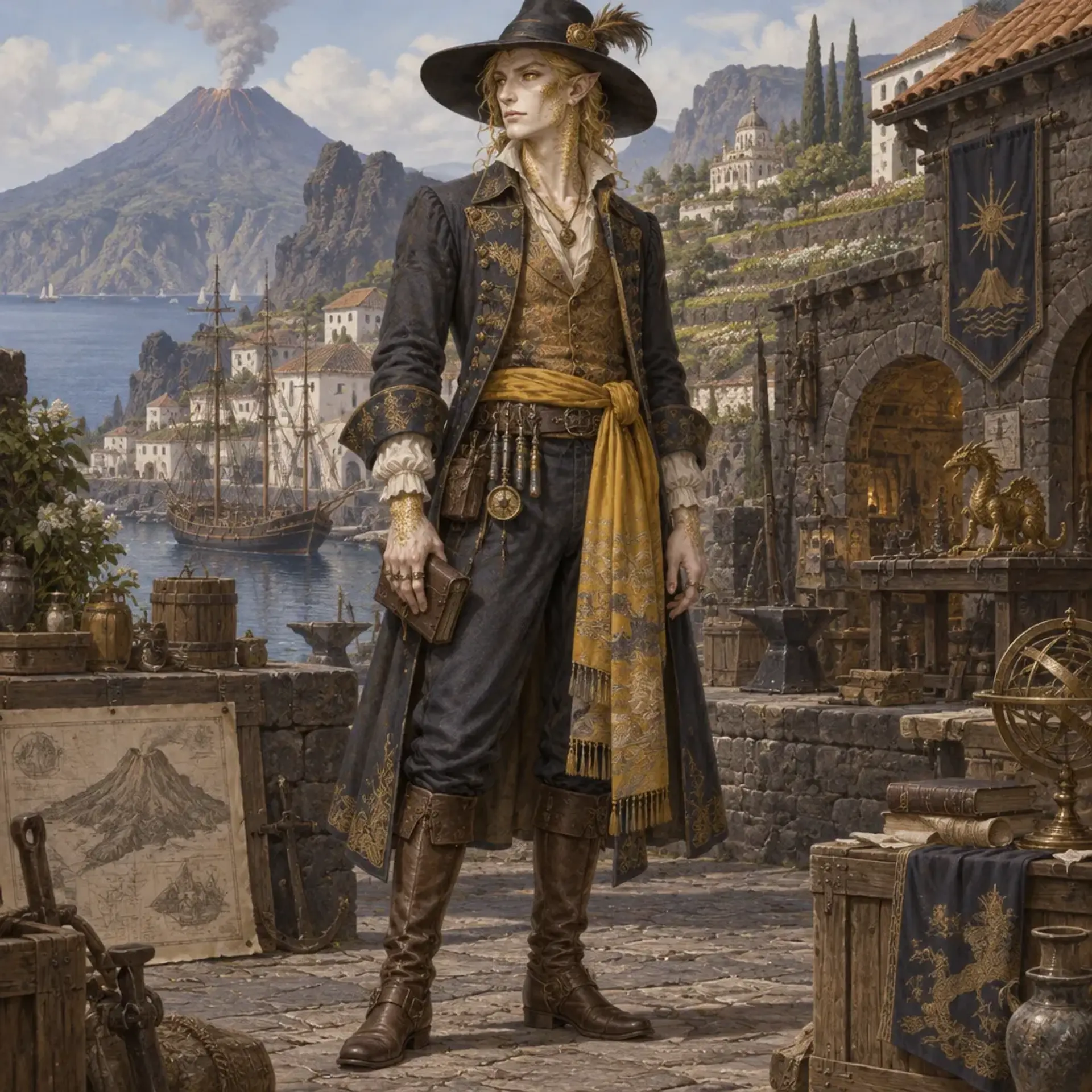
Gnomus aureosanguis draconis
Forged from gnomish lives and a golden dragon’s blood, the Aureate Gnomes are a tall, meticulous people of island workshops, tidal farms, and fiercely debated histories.
At a glance
Languages Draconic, Gnomish, Common
Height 5 ft. 8 in. to 6 ft. 6 in.; High-blooded individuals commonly exceed 6 ft.
Weight 150 to 230 lb., with strong variation by build and subspecies
Lifespan 200 to 300 years
At the table
Aureate characters are Medium. Their unusual height is part of their ancestry’s transformation, not a guarantee of greater physical reach or strength than other Medium creatures.
Your walking speed is 30 feet.
Choose one of the following damage types when you create your character: acid, cold, fire, lightning, or poison. You have resistance to that damage type. This inherited resilience is a modest echo of the old rite, not immunity to dragonfire.
You can speak, read, and write Draconic and Common. You also know Gnomish. Your Draconic is often marked by island vocabulary and local turns of phrase, though it remains understandable to speakers from elsewhere.
You know the mending cantrip. When you reach 3rd level, you can cast identify once with this trait, without expending a spell slot. You regain the ability to cast it this way when you finish a long rest. Intelligence is your spellcasting ability for these spells. The ritual’s association with experimental craft is especially common among Aureate families.
You have advantage on saving throws against being frightened. This resistance reflects cultural instruction as much as inherited blood: from childhood, Aureates are taught to study danger, name it, and keep their hands steady.
Draconic, Gnomish, Common
These people often cultivate Constitution through hard labor and Wisdom through careful observation, while their experimental scholars may favor Intelligence. Choose ability score increases as appropriate to your table; this ancestry grants no fixed increases.
More conspicuous golden scales and draconic facial details are common. Horns, claws, tails, or other pronounced traits are more likely than among Low-bloods, though still rare and often treated as socially delicate.
High-blooded Aureates carry a stronger share of the rite’s draconic inheritance and form the majority of the island’s population. They are often lean and muscular, with bright golden eyes, lighter gold hair, and scale patterns that blend into their skin. Their bearing can seem proud or predatory, and some struggle with possessiveness, territorial instincts, or an inherited sense of entitlement. These are tendencies and social stereotypes, not inevitable traits. High-blooded families occupy much of the public influence, a fact that Low-blooded neighbors may find overbearing.
Forged from gnomish lives and a golden dragon’s blood, the Aureate Gnomes are a tall, meticulous people of island workshops, tidal farms, and fiercely debated histories. They honor the dragon who rescued their ancestors as both maker and spirit, yet now face a new ruler, new fashions, and old questions about blood, inheritance, and what their transformation truly means.
The Aureate Gnomes descend from gnomes who underwent a deliberate ritual transformation using the blood of a golden dragon.
They are not simply a natural branch of their ancestral people: the old rite altered their growth, blood, and inheritance over generations. Children often resemble ordinary gnomes until puberty, when many undergo a sudden and painful growth spurt. Their bones lengthen, their voices change, and their bodies settle into forms far taller than their origins would suggest. Growing pains and volatile moods are so familiar that households mark the period with rest, extra meals, and close supervision. Most adults stand between five feet eight inches and six feet six inches. Their complexions range from pale ivory to a muted golden cast, with some retaining more familiar gnomish skin tones. High-blooded Aureates tend toward lean, muscular builds reminiscent of a golden dragon: long-limbed, poised, and quietly predatory in their stillness. Fine gold scales may merge almost seamlessly with their skin. Their hair is often a brighter, lighter gold, and their eyes can be amber, yellow, purple, or gemlike shades that catch the light with a distinctly draconic quality. Teeth may be unusually sharp and metallic-looking; claws occasionally develop in adulthood. Low-blooded Aureates more often retain recognizably gnomish features and proportions, but are still notably tall and sturdy beside gnomes elsewhere. High-blooded individuals are more likely to develop pronounced scales, claws, horns, tails, or even vestigial wings. Such births are uncommon and often regarded as beastly or unfortunate, despite the family’s pride in its dragon ancestry. High-blooded families sometimes approach marriage with conspicuous care, hoping to avoid traits they fear will bring shame or social suspicion. Physical differences do not determine character, aptitude, or worth, though they can shape a person’s place in a society that is both proud of its inheritance and uneasy about its visible consequences.
The forged volcanic island and neighboring islands of the Archipelagoes Draconis, especially harbors, workshops, terraced farms, and scholarly towns
Born with the compact proportions and features of their gnome ancestors, infants and young children usually show little sign of the rite beyond a faint warmth to the skin.
Puberty brings rapid growth, deep aches, unpredictable changes in appetite and temper, and the first emergence of golden scales or other draconic signs. Families treat the ordeal as ordinary, though outsiders often find it alarming.
Most are considered adults in their late teens, after their growth settles and they have completed a practical apprenticeship, public examination, or comparable service to their household.
They commonly live for two to three centuries. Elders may become renowned for technical mastery and measured counsel, though some grow increasingly possessive of familiar homes, tools, and traditions.
Aureate society is built around households, craft associations, learned societies, and the memory of the oath sworn to the golden dragon who saved their forebears from the harsh rule of the archipelago.
The old lord created their island as a place of refuge. His death has unsettled a people whose political and spiritual identity had long centered on one living protector. The successor rules reluctantly, and his court has brought Chinese scholarship, etiquette, art, and fashion into contact with an established culture shaped by Dutch civic life and gnomish ingenuity. These influences are most visible among scholars, officials, and social climbers, while village life remains more conservative. They prize artisanship in metal, clocks, jewelry, printing, instruments, and ingenious machines. A good hat is both practical and a source of civic pride; jewelry-making is an especially respected art. Alchemy and magic are pursued with a confidence that can border on recklessness, and experiments are frequently argued over in public. Silk has become a fashionable fascination, and plans to cultivate local silkworms are the subject of ambitious proposals. Their farming traditions are less developed than their crafts. Their ancestors relied heavily on foraging, and the island’s poor sandy ground once made cultivation difficult. Recent volcanic upheaval has raised new, fertile land from the sea, prompting communities to experiment with crops, irrigation, and livestock of gnomish origin. Their culture is tradition-minded but not intellectually timid. They keep extensive records, enjoy formal debate, and document disagreements that other societies might leave unspoken. The inherited preference for male heirs is a persistent source of controversy. Families often defend it as a safeguard against abrupt inheritance disputes, while critics point out that its consequences are neither neutral nor inevitable. High-blooded Aureates dominate in number and visibility, so Low-blooded citizens may face subtle pressure to prove their lineage does not limit their talent. The distinctions describe degrees of inherited dragon blood, not separate castes, and individual families differ in how much importance they attach to them.
The old golden dragon lord is revered as ancestor, rescuer, and a source of spiritual counsel.
Prayer may take the form of offerings at a household forge, consultation with animal spirits, or quiet shamanic rites in volcanic groves and sea caves. Dragons are considered bearers of wisdom and fortune, though reverence does not mean blind obedience. Sorcery associated with metallic dragon blood is often celebrated as a blessing; its physical or magical manifestations may nevertheless cause anxiety. Their cultures favor careful obligations, public service, and respect for law, but individual alignments vary widely.
They are generally welcoming toward metallic dragons and people with metallic draconic heritage, whom they regard as kin or possible allies.
Their attitude toward chromatic dragons is fearful, and that fear can become suspicion or cruelty toward chromatic-blooded people who have done nothing to merit it. They view dragonborn as an unsettling imitation of draconic ancestry, a prejudice that can complicate diplomacy. Kobolds are commonly assigned labor and are not treated as social equals, a practice some Aureate scholars criticize and many households defend as customary. Half-dragons appear in old poems and heroic pictures, but many Aureates consider them legendary until confronted with convincing evidence. Within their own society, High-blooded families form the majority and often set its public standards; Low-blooded families are not formally despised, but may find their contributions overshadowed. The people are notably patriarchal: sons are commonly preferred as inheritors to prevent disruptive changes in family estates, while women are not considered inherently inferior. Scholars record and debate the tension between this custom, gnomish precedent, and outside influence.
Their homeland is an island raised and shaped by the old golden dragon lord, their revered ancestor spirit.
Its oldest districts combine compact gnomish workshops with Dutch-inspired brick houses, steep roofs, canals, quays, and broad public squares. Temples, academies, and the new lord’s court increasingly feature Chinese-influenced layouts, painted screens, courtyards, rooflines, and formal gardens. The island’s once sandy, poor soil has begun to change after volcanic activity pushed new land above the waves. Farming remains experimental: families adapt foraging knowledge and small-scale cultivation to ash-rich ground, unfamiliar livestock, and uncertain seasons.
No images yet.
A high-res, share-ready sheet you can post or print.