
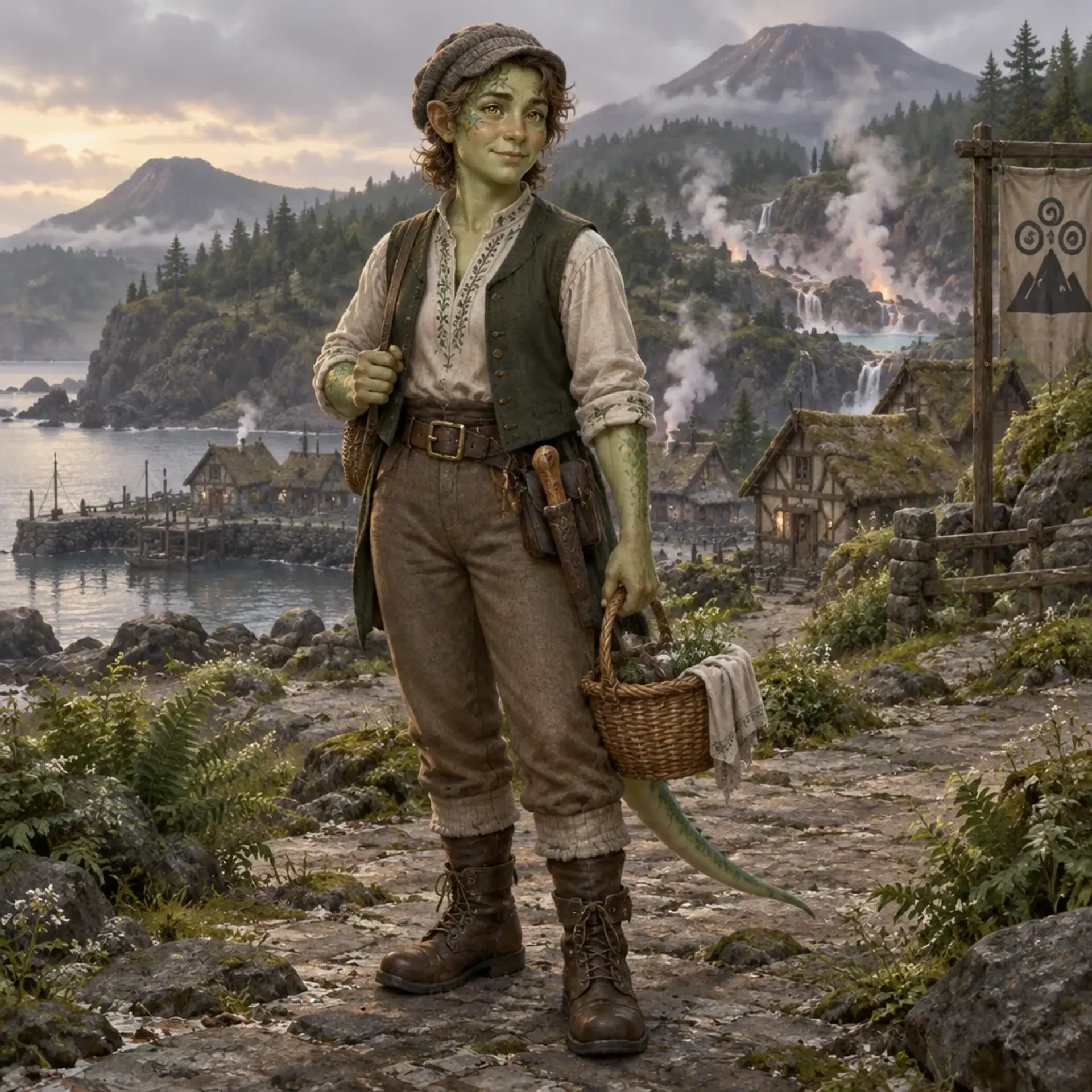
Homo draconis insularis
On a storm-wrecked archipelago, halfling refugees built a cautious little town after surviving dragons, famine, and volcanic ash.
At a glance
Darkvision Darkvision 60 ft., gained through the dragon-touched blood common to both lineages.
Languages Common, Draconic
Height Low-blooded adults: 3 to 4 ft.; High-blooded adults: 5 to 6 ft.
Weight Low-blooded adults: 35 to 55 lb.; High-blooded adults: 110 to 190 lb.
Lifespan Low-blooded members commonly live about 100 years
At the table
Your walking speed is 30 feet. Your size is Small or Medium, chosen when you select this species.
You have darkvision with a range of 60 feet. In darkness, you see in shades of gray rather than color.
Choose either Low-blood or High-blood. Low-blooded characters can move through the space of a creature one size larger than themselves, reflecting inherited halfling agility and familiarity with crowded places. High-blooded characters have resistance to poison damage, reflecting the green dragon's poisonous heritage. This choice represents a common lineage, not an absolute rule about your appearance or family.
Common, Draconic
Early generations often tend toward Constitution and Wisdom, while many High-blooded youths favor Constitution and Charisma. These are cultural and bodily tendencies only; assign ability score increases as the rules allow, without fixed species bonuses.
Usually Small, with halfling features that vary by ancestral family; often nimble and community-minded.
The older lineage, descended most directly from the shipwrecked halfling families. Low-blooded people retain diverse Lightfoot, Hairfoot, or Stout traits, though many show subtle signs of dragon influence. Their communities often preserve the strongest ties to the original refugee traditions.
On a storm-wrecked archipelago, halfling refugees built a cautious little town after surviving dragons, famine, and volcanic ash. Three generations later, their descendants carry the blood of a crippled green dragon: some remain recognizably halfling, while others grow tall, scaled, and stranger with every generation. As family loyalties fracture and dragon worship quietly spreads, the Isle-blooded must decide whether their altered inheritance is a gift, a curse, or a deliberate design.
Isle-blooded people descend from halfling refugees who survived a wreck on a distant archipelago and later took in the blood of a wounded green dragon through an incomplete ritual.
The older Low-blooded retain much of their families' halfling appearance, with considerable variation among Lightfoot, Hairfoot, and Stout kin. They are usually short and compact, with familiar rounded features, quick hands, and a faint green cast to the eyes or complexion in some families. High-blooded people are generally taller and leaner, with pale greenish skin, bright or draconic eyes, and increasingly common scales, claws, tails, or wings. Their adolescence can be painful and unpredictable. A few develop unusual digestive changes, including an inability to chew. Neither lineage is wholly uniform, and children may show traits unlike those of their parents.
A remote, volcanic archipelago of dense forests, hot springs, deep freshwater sources, ash-prone fields, and dangerous dragon-haunted wilderness.
Small, nimble, and often strongly marked by the halfling family traits of their ancestors. They are considered children through their early teens.
Most reach adult stature around twenty. High-blooded adolescents may undergo painful, uneven changes as scales, tails, altered teeth, or wings emerge.
Low-blooded adults commonly live around a century. High-blooded adults have no reliably established lifespan; the oldest living members remain vigorous, but their lineage is still young.
The Isle-blooded have lived in their new home for only three generations.
Their first families were bound by shipwreck, hunger, and the shared work of making fields on a kind island. That communal halfling heritage persists in family kitchens, neighborly childcare, and stores shared during lean seasons, but it is under pressure. A new generation, now the majority, often appears more aloof and calculating. Hunting parties have become a source of prestige and authority, and some youths prize dominance over consensus. Germanic-style dress, crafts, and surnames have taken hold alongside older halfling customs. Adults disagree over whether these changes are a natural response to danger or evidence of a deliberate draconic influence. The village counts about 447 residents, and its first High-blooded families are beginning to raise children of their own.
Many Low-blooded residents favor household devotions, seasonal observances, and practical gratitude for good soil and safe water.
High-blooded dragon worship is growing, with Tiamat's influence entering through private rites and suggestive promises of strength. The injured green dragon once offered her blood in an effort to protect the refugees, but the ritual was incomplete and she did not understand all its workings. Her returned father is secretly steering the town toward chromatic dragon influence. Isle-blooded individuals span every alignment; communal care remains strong among many elders, while some youths embrace secrecy, ambition, or cruelty.
The Isle-blooded keep apart from most island populations, partly from fear and partly because the traumatic arrival of the golden, serpentine islanders left lasting suspicion.
Their elders tend to favor mutual aid and halfling kinship customs; many High-blooded youths are more reserved, competitive, and willing to hunt or act alone. This difference strains households and has begun to reshape expectations around sex, marriage, and leadership. Some residents blame the green dragon's blood, others suspect a family member or outside influence, and a few worship dragons openly. The community is small enough that nearly every dispute becomes personal.
Their one settlement stands on a sheltered island whose rich soil, sweet springs, and fishing grounds once seemed like a providential refuge.
Timber houses have stout foundations, covered entries, smoke vents, and concealed stores, built to withstand storms and to hide from dragons. Germanic-inspired clothing and craft traditions are increasingly common: wool garments, linen, leather aprons, carved furniture, and carefully mended tools. Homes still preserve halfling-sized doors and low hearths, though newer buildings accommodate High-blooded residents. The settlement numbers roughly 447 people and is growing, but its land and food supply remain vulnerable to ash and poisoned waters.
No images yet.
A high-res, share-ready sheet you can post or print.