
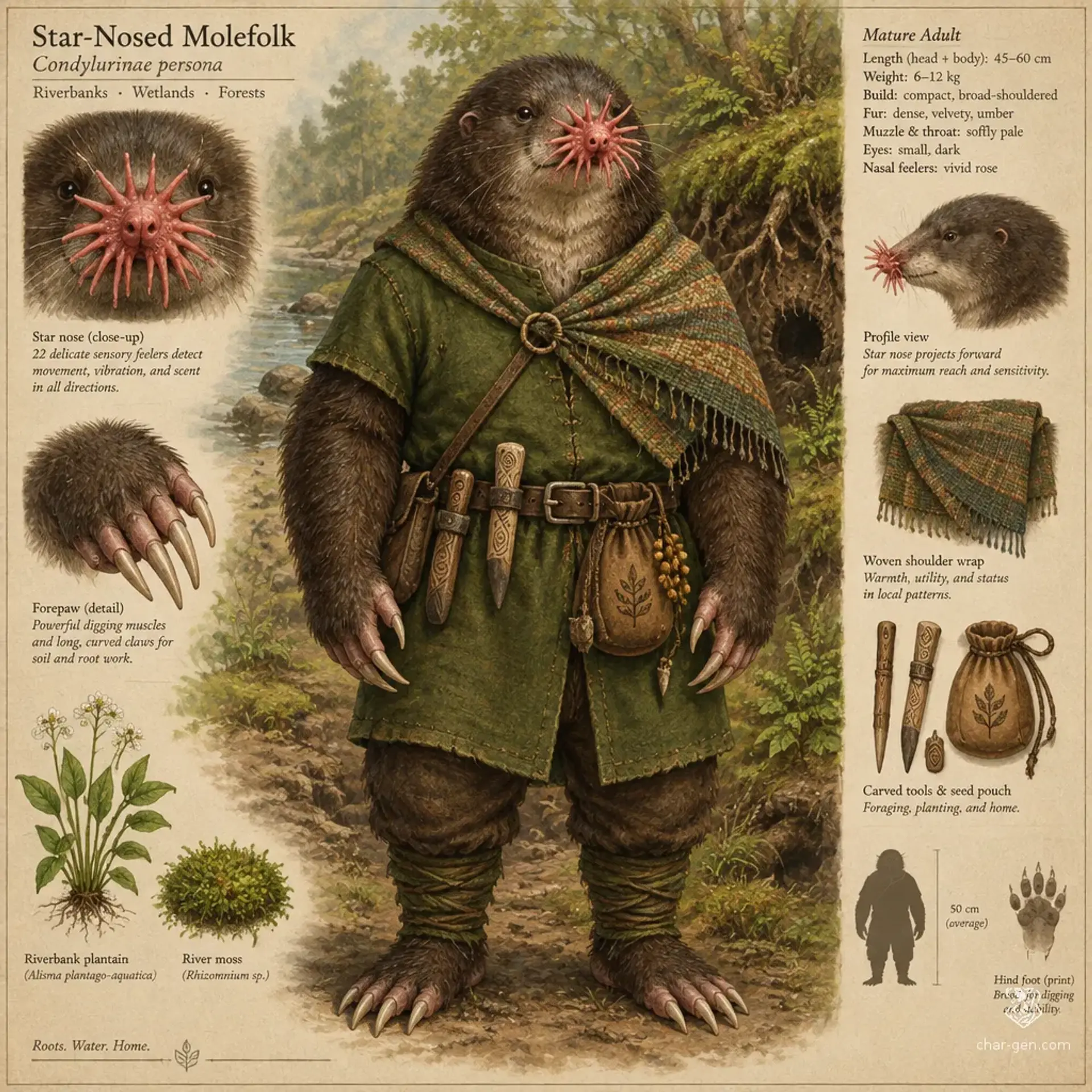
Talparadix stellaris
Beneath the fields and forests, star-nosed molefolk follow the world by touch, scent, and tremor.
At a glance
Darkvision 60 ft.
Languages Common, Terran
Height 2 ft. 8 in. to 3 ft. 8 in.
Weight 30 to 55 lb.
Lifespan 70 to 90 years, adult at 15
At the table
Your flexible nasal feelers can distinguish fine textures and carry scent information with remarkable precision. You have advantage on Wisdom (Perception) checks that rely on smell or touch.
As a bonus action, you can touch the ground and listen for movement. Until the start of your next turn, you know the location of creatures within 10 feet that are touching the same continuous surface as you, provided that surface is not separated from you by a gap. You do not learn their identities, and this sense does not reveal creatures that are motionless. You can use this trait a number of times equal to your proficiency bonus, regaining all expended uses when you finish a long rest.
You have a burrowing speed of 10 feet through loose earth, sand, or similar unworked soil. You cannot burrow through solid stone, and you leave a passage behind you that others can use.
Common, Terran
Perception, Survival
Star-nosed molefolk tend toward Constitution and Wisdom, reflecting their endurance and finely tuned senses; assign ability score increases as you wish, such as +2/+1 under your table’s rules.
A fringe of especially sensitive feelers, often marked with pale or copper tones.
Springseekers favor wetland edges and river valleys. Their communities are known for locating underground water and maintaining channels that carry it safely.
Beneath the fields and forests, star-nosed molefolk follow the world by touch, scent, and tremor. Their remarkable noses can read a trail in darkness and find a hidden spring through packed earth, while their sturdy bodies are made for long journeys through tight places. A molefolk adventurer may be a scout, healer, artisan, or simply the one person in the party who notices that the floor has started to move.
Star-nosed molefolk are compact humanoids with dense, velvety fur, broad shoulders, and powerful forearms ending in long, curved claws.
Their small eyes are suited to dim light, while their most striking feature is a ring of flexible, rose-colored sensory feelers around the nose. These delicate appendages read minute textures and carry scent to sensitive receptors. Their coats range from charcoal and umber to warm gray, often paling at the muzzle and throat.
Woodlands, meadows, riverbanks, orchards, and cultivated lands with deep, workable soil; some communities also thrive in caverns and beneath dense cities.
A dependent youngling who learns familiar scents, safe tunnels, and the first signs of danger.
An adolescent who earns a place in the community by taking a solo route through a newly opened tunnel.
An adult, commonly recognized after completing a chosen craft or a journey beyond the home burrow.
An elder whose memory of routes, people, and seasonal changes is valued as a living archive.
Molefolk communities prize dependable work, shared stores, and the knowledge needed to keep a settlement safe.
Children learn routes by following scent and touch, while adults pass on practical skills through apprenticeship. A person’s reputation rests on what they maintain and whom they help, not on inherited rank. Many molefolk enjoy surface travel, but they make frequent stops to investigate soil, roots, and unfamiliar traces.
Many molefolk honor powers associated with earth, harvest, springs, and the quiet labor that sustains a community.
Their household rites may include leaving a seed or polished pebble at a new tunnel junction. No alignment is prescribed, though communal care and practical fairness are common ideals.
Molefolk are often cautious with strangers but generous once trust is established, valuing reliability over grand promises.
They trade in seeds, carved tools, medicinal roots, and practical knowledge of terrain. Surface-dwellers may mistake their reserved manner for secrecy; molefolk, in turn, can find loud, open-air customs disorienting. They are especially comfortable with communities that respect shared spaces and keep clear agreements.
Molefolk settlements are networks of dry chambers linked by gently sloping passages, with separate stores, nurseries, workshops, and quiet sleeping galleries.
Entrances are discreetly screened with roots or stones, while surface structures tend to be modest and easy to dismantle. Their builders favor rounded supports, drainage channels, and tactile wall marks that remain legible in darkness.
No images yet.
A high-res, share-ready sheet you can post or print.