
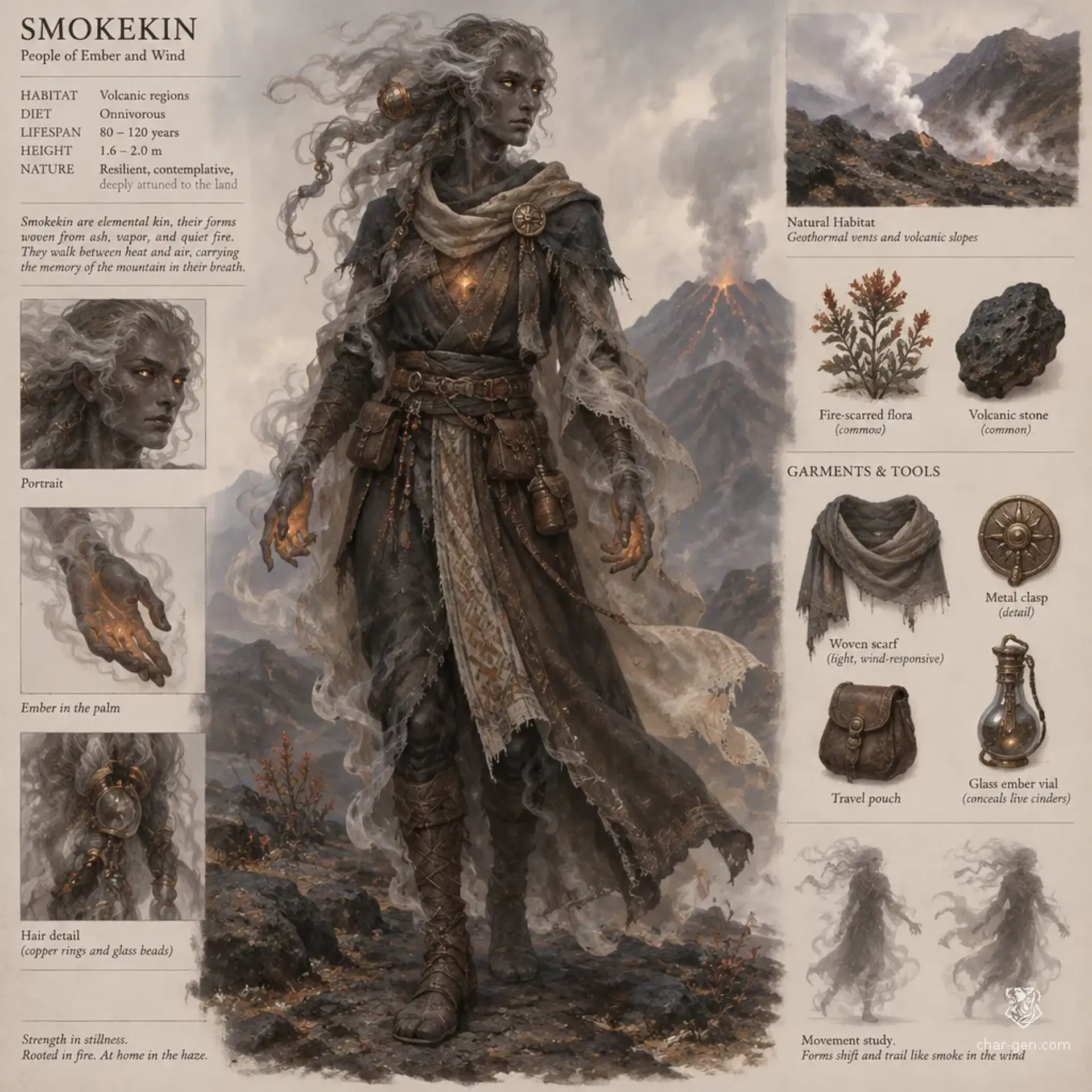
Fumivagus cinereus*, the wandering ash-breath
A smokekin is a person of ash and living vapor, at home beside a kiln or a volcanic vent, yet never quite contained by the place they leave behind.
At a glance
Darkvision 60 ft.
Languages Common, Ignan
Resistances Fire
Height 5 to 6 ft. when fully extended
Weight Light for their apparent size; their dense core of ash and cinder typically weighs 50 to 90 lb.
Lifespan 120 to 160 years, adult at 18
At the table
Your size is Medium, and your walking speed is 30 feet.
You have darkvision with a range of 60 feet. In darkness, you see in shades of gray rather than color.
You have resistance to fire damage.
You have advantage on saving throws against effects caused by inhaled gases, vapors, or smoke. This protection does not apply to effects that do not rely on breathing, such as magical compulsion or a cloud of corrosive liquid.
Common, Ignan
Fire
Smokekin often tend toward Constitution and Wisdom, shaped by life among heat, ash, and uncertain air. Assign ability score increases as your character creation rules allow; no ability score is fixed by ancestry.
Their smoke tends toward pale gray or silver, and their eyes glow white-gold.
Hearthwisps descend from smokekin families that gathered around domestic fires and village kilns. They often prize hospitality, craft, and the preservation of local stories.
A smokekin is a person of ash and living vapor, at home beside a kiln or a volcanic vent, yet never quite contained by the place they leave behind. They carry their hearth in their chest, read the air as others read a map, and can turn their ember-lit gaze into a steady beacon in the dark. Wherever a smokekin travels, stories, warmth, and a little drifting smoke follow.
Smokekin are humanoids formed from living vapor gathered around a compact heart of warm ash and cinder.
Their outlines are clear enough to show face, hands, and clothing, yet their edges continually feather and curl. Their skin may look like charcoal, pale ash, or translucent gray; pinpricks of ember glow in their eyes, throat, or palms. Hair resembles streaming smoke, and many shape it into braids or crests with rings of copper and glass. Their apparent clothing is often woven from soot-dark cloth and light fabrics that move freely around their bodies. Strong wind can scatter their edges, but does not readily harm them.
Volcanic slopes, geothermal caverns, old fire-scarred forests, foundries, and cities built around vents or communal kilns.
Smokekin also thrive in places where smoke is part of daily life, provided they can find sheltered air to rest in.
Small wisps gather around a newborn’s shoulders; the child learns to hold a steady shape by watching family members.
A young smokekin’s form is restless and expressive. They learn breath discipline, local customs, and how to read wind and flame.
Most reach physical and social adulthood in their late teens, when they can maintain a distinct silhouette through strong emotion.
Over decades, an elder’s smoke grows denser and their movements more deliberate, often marked by drifting sparks or pale ash.
Smokekin culture treats breath, warmth, and shelter as gifts that should be shared.
Families may be close-knit or chosen, bound by years of tending the same hearth. Their elders preserve histories through spoken recitations, changing the shape and color of their smoke to distinguish characters and events. Personal names are often short and vivid; surnames commonly refer to a hearth, craft, place, or memorable deed. Some smokekin adopt the names of places where they have been welcomed, carrying those homes with them.
Smokekin commonly honor hearth spirits, ancestors, and powers associated with transformation, craft, or the natural forces beneath the earth.
Their rites favor shared meals, remembered names, and offerings of fragrant herbs cast onto a communal fire. No alignment is typical, though their emphasis on hospitality and keeping promises can draw many toward generous or principled lives.
Many peoples find smokekin striking or unsettling at first, especially when their edges drift in a breeze.
Smokekin tend to meet curiosity with patience, but dislike being treated as omens or walking hazards. They often form close ties with communities that share food and fuel, including artisans, miners, and travelers. In mixed settlements, they are valued as keen observers and calm guides through smoke or darkness.
Traditional smokekin settlements cluster around warm vents, kilns, and fissures.
Their buildings use stone, fired clay, and metal, with high ceilings and adjustable vents that guide smoke without trapping it. Homes often have a central hearth or brazier, not as a necessity for survival but as a place to gather, tell stories, and mark family occasions.
No images yet.
A high-res, share-ready sheet you can post or print.