
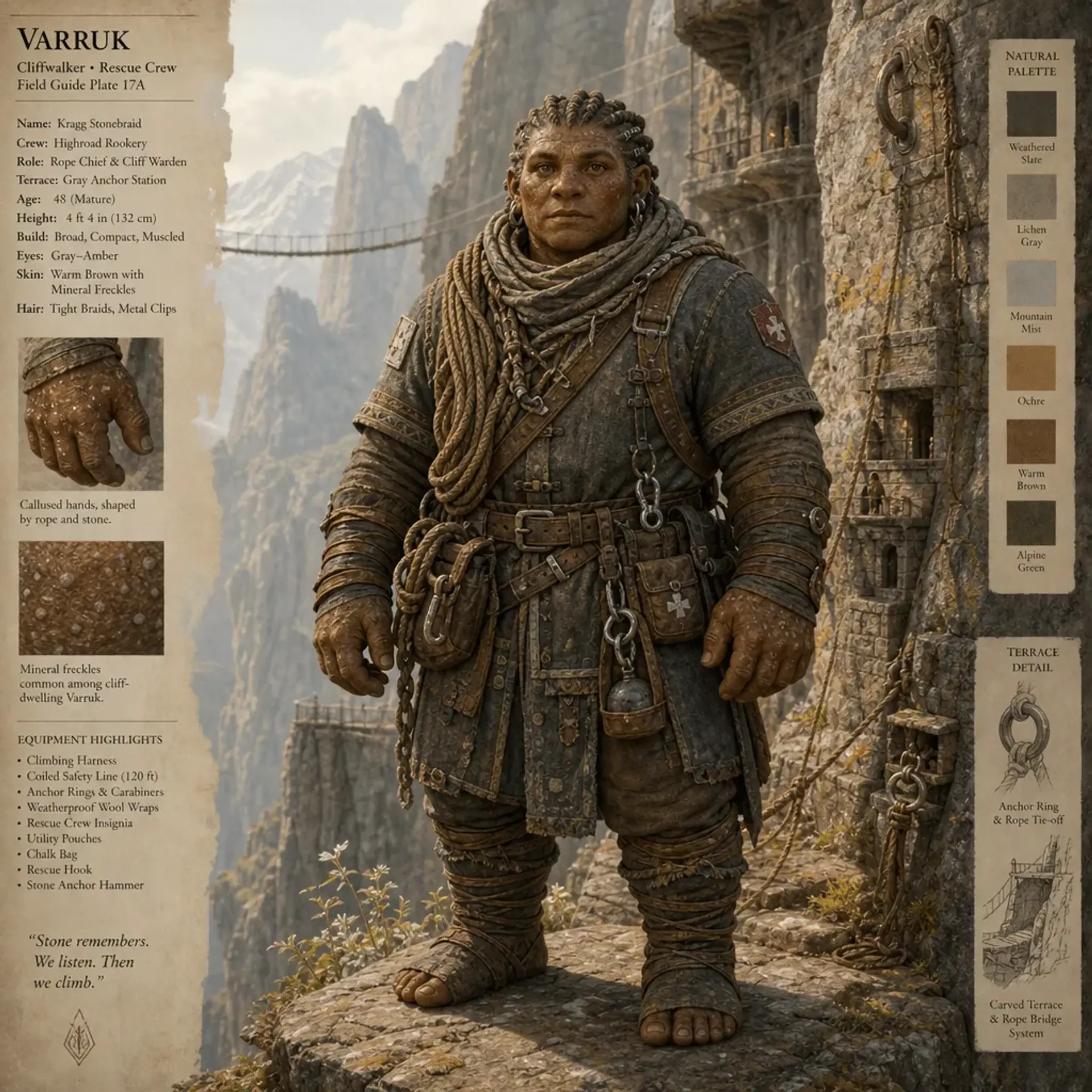
Rupicola rupivaga
The Varruk are a people of sheer heights and careful promises, dwelling only in homes carved into mountain faces.
At a glance
Darkvision Darkvision 60 ft.
Languages Common, Dwarvish
Height 4 ft. 8 in. to 5 ft. 6 in.
Weight 130 to 190 lb.
Lifespan 250 to 350 years
At the table
Your size is Medium. Your walking speed is 30 feet, and you have a climbing speed of 20 feet. You can climb difficult surfaces, including ceilings, without needing to make an ability check, provided you have at least one hand free to hold on.
You have Darkvision with a range of 60 feet. In darkness, you see shades of gray rather than color.
You gain proficiency in one of the following skills of your choice: Athletics, Nature, or Survival.
When you make an ability check to avoid falling or to keep your grip while climbing, you can add to the roll. You can use this benefit a number of times equal to your proficiency bonus, and you regain all expended uses when you finish a Long Rest.
Common, Dwarvish
These cliff-dwelling folk tend toward Constitution and Wisdom, reflecting endurance and sure judgment, but players assign their ability score increases as they wish, such as +2/+1 or +1/+1/+1.
Broad palms, thick fingertips, and a distinctive pattern of pale mineral flecks.
Ironledge Varruk favor exposed, wind-scoured heights and are renowned for maintaining long traverses between settlements. Their communities train rescue crews from an early age.
The Varruk are a people of sheer heights and careful promises, dwelling only in homes carved into mountain faces. They measure a community by the routes it keeps open, the ropes it maintains, and the strangers it brings safely to shelter. A Varruk adventurer may leave the cliff to map distant heights, recover a lost route, or learn whether courage can mean more than making it safely home.
Varruk are compact, broad-bodied humanoids with dense muscle, thick joints, and hands built for gripping rough stone.
Their skin ranges from warm brown to slate gray, often with pale mineral-like freckles across the shoulders and forearms. Hair is usually worn short or tightly bound to keep it clear of ropes, and many decorate braids with small metal clips that mark family or rescue crews. Their eyes are often gray, amber, or deep green, adapted to shifting light on exposed rock. Calluses, old rope burns, and tiny pale scars are common, and practical clothing favors layered wool, leather, and weatherproof wraps with secure pockets.
Mountainous cliff faces, especially sunlit escarpments, narrow ravines, and sheer ranges with reliable ledges and springs.
They live solely in cliffside settlements, not in caves or buried halls.
A child is taught balance, rope etiquette, and how to read weather in the movement of clouds along the face.
Adulthood is recognized after a person completes a supervised descent and returns by a route of their own choosing.
Long experience is marked by the routes entrusted to an elder, rather than by any single rite or title.
Varruk culture centers on shared risk.
Children learn to inspect handholds and read weather before they are trusted with independent errands, while adults take turns maintaining routes, beacons, and rescue stores. Skill is admired, but boasting is not: a good climber is one who brings the whole party home. Disputes over routes or ledge rights are settled through testimony, careful inspection, and negotiated repairs. Music carries between terraces in call-and-response patterns, and warning calls are taught with the same seriousness as songs.
Varruk traditions honor powers of stone, weather, endurance, and safe passage.
Some keep small shrines to local mountain spirits; others follow broader faiths, adapting their rites to cliffside life. Their communities value mutual responsibility and generally favor cooperative, dependable conduct, though individual beliefs range widely.
Varruk often welcome travelers who respect shared routes and listen to local warnings.
They may seem wary of outsiders who treat ledges as scenery or disregard safety rules, but patience and practical help earn trust quickly. Their settlements trade with valley communities for grain, timber, and metal, while offering guides, stonework, and reliable mountain passage.
Their homes are cut into the sides of cliffs, opening onto terraces, balconies, and narrow ledges.
Rooms are carved back into the stone, but settlements are built around open air: ladders, bridges, carved steps, anchor-rings, and rope lifts connect families and workshops. Each district maintains rescue lines and storm shelters. A settlement's routes are communal infrastructure, carefully inspected and recorded, and old paths are preserved with memorial marks where climbers have died.
No images yet.
A high-res, share-ready sheet you can post or print.